DeFi Risks Guide: Complete Analysis
Decentralised Finance (DeFi) has revolutionised the financial landscape, offering unprecedented opportunities for yield generation, liquidity provision, and financial innovation that were previously impossible in traditional finance. However, this groundbreaking technology comes with a complex array of risks that every participant must understand to protect their investments and navigate the ecosystem safely.
You should know that the DeFi ecosystem has grown exponentially, with total value locked reaching hundreds of billions of dollars across thousands of protocols. Your opportunities for yield generation are unprecedented, but you must also understand the sophisticated attack vectors and smart contract vulnerabilities that continue to evolve as the space matures.
This comprehensive guide examines every category of DeFi risk in 2025, from smart contract vulnerabilities and impermanent loss to governance attacks and regulatory uncertainty. We'll explore real-world examples of how these risks have materialised, analyse the latest attack vectors, and provide practical strategies for risk mitigation that allow you to participate in DeFi's opportunities while minimising exposure to its dangers.
Introduction
Decentralised Finance (DeFi) has revolutionised financial services, offering unprecedented yields and opportunities unavailable in traditional finance. However, this innovation comes with unique risks that every DeFi participant must understand before committing capital.
Unlike traditional finance, DeFi operates without intermediaries, relying on smart contracts and blockchain technology. This eliminates counterparty risk in some areas but introduces new risk categories that can result in significant losses if not properly managed.
You should understand that the DeFi ecosystem has experienced explosive growth, with total value locked (TVL) reaching hundreds of billions across thousands of protocols. Your yield generation and liquidity provision opportunities are unprecedented, but you must also recognise the sophisticated attack vectors and systemic risks that come with this rapid expansion.
You must approach DeFi with comprehensive risk assessment that accounts for technical vulnerabilities, economic incentive misalignments, and regulatory uncertainties. Your strategy should employ multi-layered approaches including protocol diversification, position sizing based on risk assessment, and continuous monitoring of protocol health metrics.
You should stay aware that the risk landscape evolves rapidly as new protocols launch and attackers develop increasingly sophisticated techniques. Your assessment methodologies must be updated regularly, especially given recent developments in cross-chain protocols and liquid staking derivatives that introduced novel risk categories.
This comprehensive guide examines the full spectrum of DeFi risks in 2025, providing detailed analysis of each risk category, real-world examples of how these risks materialised, and practical strategies for mitigating exposure whilst maintaining participation. Whether you're a newcomer or experienced user, understanding these risks protects your capital whilst allowing you to capture unique opportunities.
The permissionless nature of DeFi creates both opportunities and risks through interconnected systems where protocols build upon each other. This composability, called "money legos," allows innovative financial products but creates cascading failure risks where problems in one protocol can rapidly spread throughout the ecosystem, amplifying losses and creating systemic vulnerabilities.
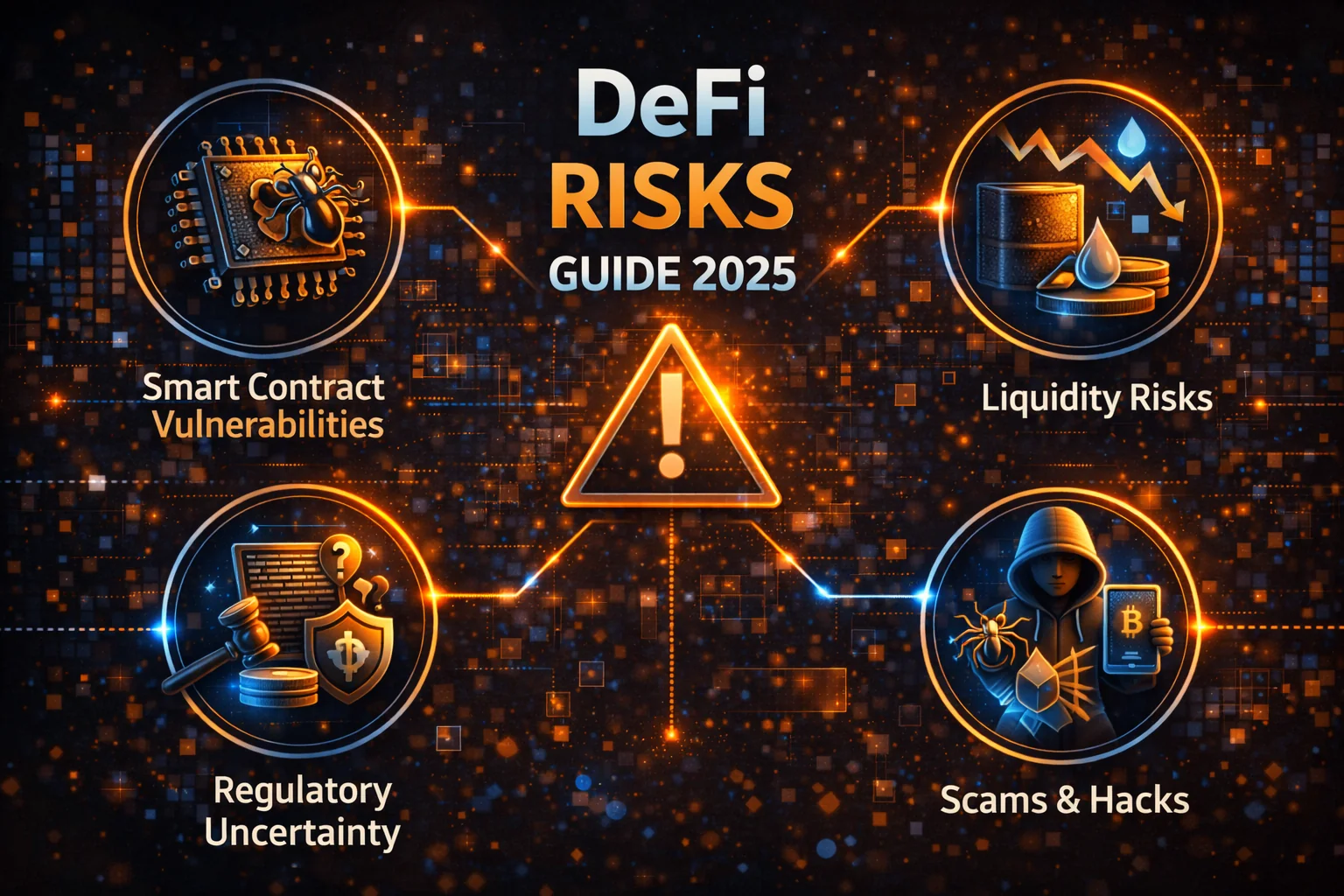
Smart contract risks represent the most fundamental category, as these immutable programs control billions in user funds without the safety nets available in traditional finance. Unlike traditional systems where errors can be reversed through human intervention, smart contract vulnerabilities result in permanent loss of funds, making thorough due diligence essential.
The rapid pace of innovation often prioritises speed over security, creating an environment where new protocols launch with minimal auditing or battle-testing. This creates opportunities for early adopters to earn high yields but exposes them to significant risks from untested code, experimental tokenomics, and unproven governance mechanisms that may fail under stress.
Regulatory uncertainty adds another layer of complexity to DeFi risk management, as changing regulations can impact protocol operations, token values, and user access across different jurisdictions. The global and decentralised nature of DeFi makes it challenging for regulators to oversee effectively, but increasing regulatory attention could significantly impact the ecosystem's development, accessibility, and long-term viability in various markets.
Market volatility in DeFi extends beyond simple price fluctuations to include liquidity risks, impermanent loss, and correlation risks that can affect multiple positions simultaneously across different protocols and strategies. The 24/7 nature of cryptocurrency markets means that significant price movements can occur at any time, potentially triggering liquidations, creating arbitrage opportunities, or causing protocol failures that impact user positions and overall portfolio performance.
Governance risks in DeFi protocols stem from the decentralised decision-making processes that control protocol parameters, upgrades, treasury management, and strategic direction. Whilst governance tokens provide users with voting rights and protocol ownership, they also create risks from governance attacks, voter apathy, centralised control by large token holders, and conflicts of interest that can lead to decisions that negatively impact smaller token holders and protocol users.
Technical infrastructure risks include blockchain congestion, oracle failures, cross-chain bridge vulnerabilities, and dependency on external services that can disrupt protocol operations and create opportunities for exploitation. These infrastructure dependencies create single points of failure that can affect multiple protocols simultaneously, amplifying systemic risks across the DeFi ecosystem and potentially causing widespread disruptions during critical market events.
User experience risks in DeFi stem from the complex interfaces, technical requirements, and lack of customer support that characterize many protocols compared to traditional financial services. Unlike traditional financial services with customer service departments, fraud protection, and regulatory oversight, DeFi users must navigate complex systems independently, making user errors, phishing attacks, and interface confusion significant sources of fund loss that require constant vigilance and education to mitigate effectively.
Smart contract risks represent the most fundamental category of DeFi risks, as these immutable programs control billions of dollars in user funds without the safety nets available in traditional finance. Unlike traditional financial systems where errors can often be reversed or mitigated through human intervention, smart contract vulnerabilities can result in permanent and irreversible loss of funds.
The rapid pace of innovation in DeFi often prioritises speed to market over comprehensive security testing, creating an environment where new protocols launch with minimal auditing or battle-testing. This creates opportunities for early adopters to earn high yields but also exposes them to significant risks from untested code and experimental tokenomics models.
Regulatory uncertainty adds another layer of complexity to DeFi risk management, as changing regulations can impact protocol operations, token values, and user access. The global and decentralised nature of DeFi makes it challenging for regulators to oversee, but increasing regulatory attention could significantly impact the ecosystem's development and accessibility.
Market volatility in DeFi extends beyond simple price fluctuations to include liquidity risks, impermanent loss, and correlation risks that can affect multiple positions simultaneously. The 24/7 nature of cryptocurrency markets means that significant price movements can occur at any time, potentially triggering liquidations or creating arbitrage opportunities that impact user positions.
Governance risks in DeFi protocols stem from the decentralised decision-making processes that control protocol parameters, upgrades, and treasury management. Whilst governance tokens provide users with voting rights, they also create risks from governance attacks, voter apathy, and conflicts of interest that can lead to decisions that negatively impact token holders and protocol users.
Technical infrastructure risks include blockchain congestion, oracle failures, and cross-chain bridge vulnerabilities that can disrupt protocol operations and create opportunities for exploitation. These infrastructure dependencies create single points of failure that can affect multiple protocols simultaneously, amplifying systemic risks across the DeFi ecosystem.
User experience risks in DeFi stem from the complex interfaces, technical requirements, and lack of customer support that characterize many protocols. Unlike traditional financial services with customer service departments and fraud protection, DeFi users must navigate complex systems independently, making user errors a significant source of fund loss.
Smart Contract Risks
Code Vulnerabilities and Bugs
Smart contracts are immutable programs that can contain critical flaws:
- Coding Errors: Bugs in contract logic can be exploited by attackers
- Reentrancy Attacks: Malicious contracts can drain funds through recursive calls
- Integer Overflow/Underflow: Mathematical errors can cause unexpected behavior
- Access Control Issues: Improper permissions can allow unauthorised actions
- Logic Bombs: Hidden functions that can be triggered to drain funds
Major DeFi Exploits in Recent Years
- Wormhole Bridge (2022): $320 million stolen through signature verification bug
- Ronin Bridge (2022): $625 million drained via compromised validator keys
- Poly Network (2021): $610 million exploit (later returned by hacker)
- Cream Finance (2021): Multiple exploits totaling over $130 million
- Compound (2021): $80 million distributed incorrectly due to bug
Smart Contract Risk Mitigation
- Use protocols with multiple independent security audits
- Prefer battle-tested protocols with long track records
- Check for active bug bounty programs
- Monitor protocol governance and upgrade processes
- Start with small amounts to test protocol behaviour
IL (Temporary Loss) and Liquidity Risks
Understanding IL (Temporary Loss)
You should understand how IL occurs when you provide liquidity to automated market makers (AMMs):
- Price Divergence: When token prices change relative to each other
- Arbitrage Impact: Arbitrageurs rebalance pools, affecting LP positions
- Volatility Correlation: Higher volatility increases IL risk
- Time Factor: Loss becomes permanent when you withdraw
Calculating IL
You should know that IL varies based on price changes in your liquidity pool:
- 1.25x price change: 0.6% loss
- 1.5x price change: 2.0% loss
- 2x price change: 5.7% loss
- 5x price change: 25.5% loss
- 10x price change: 42.0% loss
Liquidity Provider Strategies
- Choose correlated pairs (ETH/stETH, USDC/USDT)
- Use concentrated liquidity ranges in Uniswap V3
- Monitor and adjust positions regularly
- Factor in trading fees and incentive rewards
- Consider IL protection protocols
Governance and Protocol Risks
Governance Token Attacks
You should be aware that DeFi protocols governed by token holders face unique risks to your holdings:
- Governance Attacks: Malicious proposals to drain protocol funds
- centralised Control: Large token holders controlling decisions
- Vote Buying: Purchasing governance tokens to influence decisions
- Flash Loan Governance: Temporary token acquisition for voting
- Proposal Manipulation: Misleading or harmful governance proposals
Admin Key Risks
- centralised Control: Admin keys can pause or drain protocols
- Key Compromise: Stolen admin keys used maliciously
- Insider Threats: Team members acting against user interests
- Upgrade Risks: Malicious protocol upgrades
Governance Risk Assessment
- Check governance token distribution and concentration
- Review voting mechanisms and proposal processes
- Assess admin key controls and multi-signature requirements
- Monitor governance proposals and voting patterns
- Evaluate protocol decentralisation roadmap
Oracle and Price Feed Risks
Oracle Manipulation Attacks
DeFi protocols rely on price oracles that can be manipulated:
- Flash Loan Attacks: Temporary price manipulation for profit
- Sandwich Attacks: Front-running large transactions
- Oracle Failure: Price feeds going offline or providing stale data
- centralised Oracles: Single points of failure in price feeds
- Low Liquidity Exploitation: Manipulating prices in thin markets
Common Oracle Attack Vectors
- DEX Price Manipulation: Skewing AMM prices temporarily
- Arbitrage Exploitation: Profiting from price discrepancies
- Liquidation Cascades: Triggering mass liquidations
- Governance Token Attacks: Manipulating governance token prices
Oracle Security Best Practices
- Use protocols with multiple oracle sources
- Prefer time-weighted average prices (TWAP)
- Check for oracle circuit breakers and safeguards
- Assess oracle update frequency and reliability
- Monitor for unusual price movements or oracle failures
Cross-Chain and Bridge Risks
Bridge Vulnerabilities
You must understand that cross-chain bridges are high-value targets for attackers who can exploit your funds:
- Validator Compromise: Controlling bridge validators
- Smart Contract Bugs: Exploiting bridge contract vulnerabilities
- Signature Verification: Bypassing multi-signature requirements
- Relay Attacks: Replaying transactions across chains
- centralisation Risks: Trusted bridge operators
Major Bridge Exploits
- Ronin Bridge: $625 million stolen via validator compromise
- Wormhole: $320 million exploit through signature bug
- Nomad Bridge: $190 million drained in copycat attacks
- Harmony Bridge: $100 million stolen via compromised keys
Bridge Risk Mitigation
- Use established bridges with strong security records
- Limit exposure to any single bridge
- Prefer native bridges over third-party solutions
- Monitor bridge health and validator status
- Consider insurance for large bridge transactions
Liquidity and Market Risks
Liquidity Crises
You should be aware that your DeFi positions can face severe liquidity shortages during market stress:
- Bank Runs: Mass withdrawals depleting protocol liquidity
- Liquidation Cascades: Forced selling creating price spirals
- Market Stress: Extreme volatility affecting protocol stability
- Stablecoin Depegging: Algorithmic stablecoins losing their peg
- Yield Farming Exits: Mercenary capital leaving protocols
Slippage and MEV Risks
- High Slippage: Large trades moving prices significantly
- Front-Running: Bots extracting value from user transactions
- Sandwich Attacks: Manipulating prices around user trades
- MEV Extraction: Miners/validators extracting maximum value
Liquidity Risk Management
- Monitor protocol utilisation rates and available liquidity
- Use limit orders and slippage protection
- Avoid protocols with excessive leverage or utilisation
- Consider market depth when entering/exiting positions
- Use MEV protection services when available
Regulatory and Compliance Risks
Regulatory Uncertainty
You must understand that DeFi operates in a rapidly evolving regulatory landscape that can affect your investments:
- Securities Classification: DeFi tokens may be deemed securities
- AML/KYC Requirements: Identity verification mandates
- Tax Implications: Complex tax treatment of DeFi activities
- Geographic Restrictions: Protocols blocking certain jurisdictions
- Enforcement Actions: Regulatory crackdowns on protocols
Compliance Challenges
- Pseudonymous Nature: Difficulty implementing KYC/AML
- Cross-Border Operations: Multiple jurisdictional requirements
- decentralised Governance: No clear regulatory entity
- Rapid Innovation: Regulations lagging behind technology
Regulatory Risk Mitigation
- Stay informed about regulatory developments
- Use protocols with legal compliance efforts
- Maintain detailed records of all DeFi activities
- Consult tax professionals for complex strategies
- Consider geographic diversification of protocols
User Error and Operational Risks
Common User Mistakes
You should know that many DeFi losses result from preventable user errors:
- Wrong Network: Sending tokens to incorrect blockchain
- Contract Interactions: Approving malicious contracts
- Phishing Attacks: Connecting to fake protocol interfaces
- Private Key Loss: Losing access to wallet seed phrases
- Transaction Errors: Incorrect amounts or addresses
Wallet and Security Risks
- Hot Wallet Compromise: Malware stealing private keys
- Browser Extensions: Malicious wallet extensions
- Social Engineering: Scammers tricking users
- Approval Exploits: Unlimited token approvals
User Security Best Practices
- Use hardware wallets for large amounts
- Verify contract addresses and protocol URLs
- Start with small test transactions
- Regularly revoke unnecessary token approvals
- Keep software and browsers updated
- Use dedicated devices for DeFi activities
DeFi Risk Management Framework
Portfolio Diversification
You should spread your risk across multiple dimensions to protect your portfolio:
- Protocol Diversification: Use multiple DeFi protocols
- Chain Diversification: Deploy across different blockchains
- Strategy Diversification: Mix lending, LP, and staking
- Asset Diversification: Use different token types
- Time Diversification: Dollar-cost average entries/exits
Position Sizing and Limits
- Never invest more than you can afford to lose
- Limit exposure to any single protocol (5-15% max)
- Set maximum allocation to experimental protocols
- Use stop-losses and profit-taking strategies
- Regularly rebalance based on risk assessment
Monitoring and Alerts
- Set up price and liquidation alerts
- Monitor protocol health metrics
- Track governance proposals and changes
- Follow security researchers and audit firms
- Use portfolio tracking tools
DeFi Insurance and Protection
DeFi Insurance Protocols
You can protect your funds by purchasing coverage from several DeFi insurance protocols:
- Nexus Mutual: decentralised insurance for smart contract risks
- InsurAce: Multi-chain coverage for various DeFi risks
- Unslashed Finance: Capital-efficient insurance solutions
- Bridge Mutual: Discretionary coverage model
- Risk Harbor: Underwriter-backed protection
Coverage Types
- Smart Contract Coverage: Protection against code bugs
- Custodial Coverage: Protection against fund theft
- Slashing Coverage: Protection for staking risks
- Stablecoin Depeg: Protection against peg loss
Insurance Considerations
- Understand coverage terms and exclusions
- Assess claim assessment processes
- Consider cost-benefit of insurance premiums
- Review historical claim payouts
- Monitor insurance protocol health
Advanced Attack Vectors and Exploits
Flash Loan Attacks
You must understand that flash loans enable sophisticated attacks by providing temporary capital without collateral:
- Arbitrage Manipulation: Exploiting price differences across DEXs
- Governance Attacks: Temporarily acquiring voting power
- Oracle Manipulation: Skewing price feeds for profit
- Liquidation Cascades: Triggering mass liquidations
- Reentrancy Exploits: Recursive calls to drain funds
- Sandwich Attacks: Front-running and back-running transactions
MEV (Maximal Extractable Value) Risks
- Front-Running: Bots copying profitable transactions
- Back-Running: Extracting value after user transactions
- Sandwich Attacks: Manipulating prices around trades
- Liquidation MEV: Competing for liquidation rewards
- Arbitrage MEV: Cross-DEX arbitrage opportunities
- Time-Bandit Attacks: Reorganizing blocks for profit
Layer 2 and Scaling Risks
- Sequencer Risks: centralised transaction ordering
- Bridge Vulnerabilities: L1-L2 communication exploits
- State Channel Disputes: Malicious channel closures
- Rollup Data Availability: Off-chain data storage risks
- Fraud Proof Delays: Challenge period vulnerabilities
Composability and Integration Risks
Protocol Interdependencies
You should recognise that DeFi's composable nature creates systemic risks across your positions:
- Cascading Failures: One protocol failure affecting others
- Liquidity Contagion: Shared liquidity pools creating risks
- Yield Farming Dependencies: Complex strategies with multiple failure points
- Collateral Rehypothecation: Same assets used across protocols
- Governance Token Correlations: Shared governance risks
Smart Contract Interaction Risks
- Approval Exploits: Unlimited token approvals
- Proxy Contract Risks: Upgradeable contract vulnerabilities
- Delegate Call Exploits: Malicious delegate calls
- Storage Collision: Proxy storage layout conflicts
- Function Selector Clashes: Signature collision attacks
Yield Aggregator Risks
- Strategy Risks: Complex multi-protocol strategies
- Auto-Compounding Failures: Automated strategy malfunctions
- Vault Token Depegging: Vault shares losing value
- Emergency Withdrawals: Forced exits at poor prices
- Performance Fees: High fees eroding returns
Institutional DeFi Risks
Custody and Operational Risks
You must be aware that institutional DeFi participation introduces unique challenges for your organisation:
- Multi-Signature Security: Key management across teams
- Compliance Requirements: Regulatory reporting obligations
- Audit Trail Maintenance: Transaction tracking and documentation
- Counterparty Risk Assessment: Due diligence on protocols
- Operational Procedures: standardised interaction protocols
Treasury Management Risks
- Concentration Risk: Over-exposure to single protocols
- Liquidity Management: Ensuring sufficient liquid reserves
- Mark-to-Market Volatility: DeFi position valuation
- Governance Participation: Voting responsibilities and risks
- Insurance Coverage: Institutional-grade protection needs
Regulatory Compliance
- Securities law compliance for governance tokens
- AML/KYC requirements for institutional users
- Tax reporting for complex DeFi strategies
- Fiduciary duty considerations
- Cross-border regulatory coordination
Safer DeFi Strategies
Blue-Chip DeFi Protocols
You should focus your DeFi strategy on established protocols with strong track records:
- Aave: Leading lending protocol with extensive audits and institutional adoption
- Compound: Pioneer in DeFi lending with governance token model
- Uniswap: Most liquid DEX with concentrated liquidity features
- Curve: specialised stablecoin AMM with low slippage
- Lido: Liquid staking with distributed validator set
- MakerDAO: decentralised stablecoin with over-collateralization
Conservative DeFi Strategies
- Stablecoin Lending: USDC/USDT lending on Aave or Compound
- Correlated LP Pairs: ETH/stETH, USDC/USDT for minimal IL
- Native Staking: Direct validator staking over liquid staking
- Single-Asset Strategies: Avoid complex multi-token strategies
- Insurance Coverage: Nexus Mutual or InsurAce protection
- Gradual Scaling: Start small and increase exposure gradually
Risk-Adjusted Returns Framework
- Smart Contract Risk Premium: 2-5% annual risk adjustment
- IL modelling: Historical volatility analysis
- Gas Cost Amortization: Factor in transaction costs
- Opportunity Cost Analysis: Compare to risk-free rates
- Liquidity Risk Premium: Account for exit liquidity
- Regulatory Risk Buffer: Reserve for compliance costs
Emerging Risks and Future Considerations
Quantum Computing Threats
You should understand that future quantum computers may threaten your current cryptographic security:
- ECDSA Vulnerability: Quantum attacks on elliptic curve signatures
- Hash Function Risks: Potential SHA-256 vulnerabilities
- Private Key Exposure: Quantum algorithms breaking encryption
- Migration Challenges: Upgrading to quantum-resistant cryptography
- Timeline Uncertainty: Unknown quantum computer development pace
AI and Machine Learning Risks
- Adversarial AI: AI systems attacking DeFi protocols
- Market Manipulation: AI-driven price manipulation
- Automated Exploits: AI discovering and exploiting vulnerabilities
- MEV optimisation: AI maximising extractable value
- Governance Manipulation: AI-coordinated voting attacks
Regulatory Evolution
- Central Bank Digital Currencies (CBDCs) impact on DeFi
- Global regulatory coordination efforts
- Privacy coin restrictions affecting DeFi privacy
- decentralised identity requirements
- Carbon footprint regulations for blockchain networks
Real-World DeFi Risk Examples: Lessons learnt
Case 1: Smart Contract Exploit - Euler Finance Hack (2023)
Incident: You should study how $197 million was stolen through a flash loan attack
Vulnerability: Donation attack exploiting liquidation logic
Impact: Users lost funds, protocol temporarily halted
Lesson learnt:
- Even audited protocols can have vulnerabilities
- Complex DeFi interactions create unexpected attack vectors
- Diversification across protocols reduces single-point failure risk
- Never invest more than you can afford to lose in DeFi
Outcome: You should note that the hacker eventually returned funds after negotiations, but this incident highlighted smart contract risks even in established protocols.
Case 2: IL Risk - Uniswap V3 LP Experience
User: You can learn from this liquidity provider with $50,000 in ETH/USDC pool
Strategy: Concentrated liquidity in narrow price range
Market Event: ETH price dropped 40% in 2 weeks
Results:
- Initial position: 10 ETH + $20,000 USDC (ETH at $2,000)
- After price drop: 15 ETH + $9,000 USDC (ETH at $1,200)
- Position value: $27,000 (vs $32,000 if held)
- IL: $5,000 (15.6%)
- Trading fees earned: $800
- Net loss: $4,200 (8.4%)
Lesson: You should remember that concentrated liquidity amplifies both your fees and IL. Use wide price ranges and stable pairs to reduce your IL risk.
Case 3: Oracle Manipulation - Venus Protocol (2021)
Incident: You should understand how XVS token price manipulation caused $77 million in losses
Attack Method: Attacker borrowed large amounts, manipulated the oracle price, and borrowed more against inflated collateral
Loss: $77 million in bad debt
Root Cause: Reliance on single DEX price feed as oracle
Lessons:
- Single-source oracles are vulnerable to manipulation
- Low-liquidity tokens shouldn't be used as collateral
- Time-weighted average prices (TWAP) provide better security
- Multiple oracle sources reduce manipulation risk
Impact: You should know that the protocol implemented stricter collateral requirements and improved your oracle design options.
Case 4: Bridge Exploit - Ronin Network (2022)
Incident: You must study how $625 million was stolen from the Ronin bridge
Attack Vector: Compromised validator keys (5 of 9 validators)
Vulnerability: Centralised validator set, insufficient security
User Impact: Thousands of users lost funds, some never recovered
Lessons:
- Cross-chain bridges are high-value targets
- centralised validator sets create single points of failure
- minimise funds kept on bridges and sidechains
- Use established bridges with strong security track records
Outcome: You must recognise that this incident highlighted critical security risks in your cross-chain infrastructure choices.
Case 5: User Error - Wrong Network Transfer
User: You can learn from this DeFi beginner who was transferring USDC
Mistake: Sent $10,000 USDC to Ethereum address on BSC network
Result: Funds permanently lost, no recovery possible
Common User Errors:
- Sending tokens to wrong network (ETH vs BSC vs Polygon)
- Sending to contract address instead of wallet
- Approving unlimited token allowances to malicious contracts
- Not verifying transaction details before signing
- Falling for phishing sites mimicking real DeFi protocols
Prevention: You should always verify your network, address, and amount before confirming. Start with small test transactions and use hardware wallets for your large amounts.
Quantitative Risk Assessment Models for DeFi
Value-at-Risk (VaR) Models for DeFi Portfolios
You can use Value-at-Risk models to quantify your potential losses across different confidence intervals. Monte Carlo simulations should help you generate thousands of scenarios that incorporate smart contract failure probabilities and impermanent loss distributions for your DeFi portfolio.
Your advanced VaR calculations should incorporate protocol-specific risk factors including TVL volatility and historical exploit frequencies. You must also consider Expected Shortfall metrics to measure your tail risk beyond standard VaR thresholds for comprehensive worst-case scenario planning.
Stress Testing and Scenario Analysis
You should stress test your DeFi portfolio under extreme market conditions including flash crash scenarios and protocol exploit events. Your historical stress tests must analyse how your positions would have performed during the March 2020 liquidation cascade and the May 2022 Terra Luna collapse.
Your forward-looking scenario analysis should incorporate potential future risks including quantum computing threats and regulatory framework changes. You can use probability-weighted outcomes to assess your portfolio resilience and identify optimal hedging strategies.
Correlation Analysis and Systemic Risk Measurement
You should track dynamic correlations between your DeFi protocols to identify periods of increased systemic risk. Your diversification strategy must account for shared infrastructure dependencies and common governance token exposures across protocols.
You can use network analysis techniques to map interconnections between your DeFi protocols through shared liquidity pools and cross-protocol integrations. Your risk management should include circuit breakers and position limits that prevent excessive concentration in systemically risky protocols.
Institutional DeFi Risk Management Frameworks
Enterprise Risk Governance Structures
You must establish robust governance frameworks that clearly define your risk appetite and implement comprehensive oversight mechanisms. Your risk committees should comprise blockchain experts, quantitative analysts, and compliance professionals for independent oversight.
You should implement a three-lines-of-defence model that separates your risk-taking functions from risk management and internal audit. Your first-line business units must execute DeFi strategies within established risk limits while second-line functions provide independent oversight.
Operational Risk Management
You must address unique operational risks in your institutional DeFi operations including key management failures and smart contract interaction errors. Your operational risk framework should implement multi-signature wallet controls and automated monitoring systems.
Your business continuity planning should address potential disruptions including blockchain network congestion and oracle failures. You must establish contingency procedures that enable rapid position unwinding and emergency liquidity access during crisis situations.
Regulatory Capital and Liquidity Management
You must consider capital adequacy requirements and liquidity coverage ratios when structuring your DeFi exposures. Your risk-weighted asset calculations should carefully analyse smart contract vulnerabilities and counterparty exposures.
Your liquidity risk management framework must account for the unique characteristics of DeFi markets including automated market maker mechanics and potential for rapid capital flight. You should maintain adequate liquid reserves to meet potential margin calls without forced selling of your illiquid DeFi positions.
Technical Failure Analysis: Major DeFi Exploits Dissected
The Euler Finance Exploit: Donation Attack Mechanics
You should study how the March 2023 Euler Finance exploit demonstrated sophisticated attack vectors targeting liquidation mechanisms. Your understanding of this $197 million exploit will help you recognise how complex DeFi interactions can create unexpected attack surfaces even in audited protocols.
You must note that the attack utilised flash loans to acquire initial capital and manipulated eToken and dToken balances through self-liquidation. Your security awareness should include understanding how donation mechanisms can inflate collateral values in ways that auditors may miss.
Curve Finance Exploit: Vyper Compiler Vulnerability
You should understand how the July 2023 Curve Finance exploit affected multiple pools totalling over $60 million in losses. Your risk assessment must consider that this vulnerability stemmed from the Vyper compiler rather than the protocol logic itself, showing how compiler bugs can create systemic vulnerabilities.
You must recognise that this incident highlighted infrastructure risks beyond protocol-specific vulnerabilities. Your due diligence should include checking the compiler versions and dependencies that underpin the protocols you use, not just the protocol code itself.
Multichain Bridge Collapse: centralisation Risks realised
You must learn from the Multichain bridge collapse in 2023 which demonstrated extreme centralisation risks in cross-chain infrastructure. Your bridge selection should avoid protocols with centralised key management that can result in over $1.5 billion in locked funds becoming inaccessible.
You should understand that Multichain's architecture depended on centralised servers controlled by a small team. Your due diligence must verify that bridge protocols have truly decentralised architectures and transparent operational procedures before you commit your funds.
Lessons from Technical Failures
You should recognise that major DeFi exploits reveal common patterns including inadequate testing of edge cases and insufficient consideration of economic incentives for attackers. Your risk assessment must account for how exploits often combine multiple vulnerabilities in unexpected ways.
You can protect your positions by supporting protocols that implement comprehensive integration testing and formal verification. Your preferred protocols should adopt time delays for critical operations and multi-signature controls for administrative functions.
Advanced Risk Metrics and Performance Attribution
Risk-Adjusted Return Calculations
You should use modified Sharpe ratios that account for non-normal return distributions in your DeFi portfolio analysis. Your risk metrics must incorporate skewness and kurtosis to capture the tail risks common in DeFi markets, and you can use Sortino ratios to focus specifically on your downside deviation.
You should track your maximum drawdown to understand the largest peak-to-trough declines in your DeFi positions. Your Calmar ratio will help you compare annualised returns to maximum drawdowns, giving you a clearer picture of your risk-adjusted performance.
Performance Attribution Models
You can decompose your DeFi returns into constituent risk factors including protocol selection effects and timing decisions. Your factor models should identify systematic risk sources such as TVL growth and governance token performance that drive your protocol returns.
You should separate your skill-based returns from market beta exposure to evaluate how well your strategy performs independently of overall DeFi market movements. Your attribution analysis will help you identify which decisions contributed most to your portfolio performance.
Dynamic Risk Monitoring Systems
You should set up real-time risk monitoring systems that track your portfolio exposures across protocol concentration and smart contract risk. Your automated alerts must notify you when positions exceed your predetermined thresholds or when unusual market conditions develop.
You can leverage machine learning algorithms that analyse transaction patterns and governance proposals to identify emerging risks before they materialise into losses for your portfolio. Your monitoring systems should incorporate sentiment analysis and fundamental protocol metrics for comprehensive risk intelligence.
Regulatory Risk Management and Compliance Strategies
You must develop a comprehensive understanding of evolving legal frameworks that affect your DeFi participation. Your compliance monitoring should cover multiple jurisdictions, and you should implement adaptive procedures that ensure regulatory adherence while maintaining your operational flexibility.
You should build flexible compliance frameworks that can adapt to regulatory changes without disrupting your DeFi strategy. Your documentation systems must track all transactions and governance participation to ensure you can demonstrate compliance when required.
You must continuously monitor legal changes and evaluate how new compliance requirements affect your DeFi positions. Your scenario planning should prepare you for various regulatory outcomes so you can maintain your DeFi participation regardless of how regulations evolve.
Your successful DeFi risk management requires combining thorough due diligence with systematic mitigation strategies. You should treat risk management as an ongoing process and regularly reassess your exposure based on changing market conditions and regulatory developments.
Advanced DeFi Risk Management and Professional Strategies
Institutional Risk Assessment Frameworks
You should implement comprehensive risk frameworks that address protocol risks, market risks, and operational risks through systematic assessment. Your institutional risk management must include quantitative modelling and stress testing scenarios to maintain appropriate risk controls.
Advanced Hedging Strategies and Portfolio Protection
You can implement advanced hedging strategies that protect your portfolio against various risk factors while maintaining exposure to DeFi yield opportunities. Your hedging approach should include derivatives strategies and cross-protocol diversification to achieve optimal risk-adjusted returns.
Conclusion
DeFi offers unprecedented opportunities for financial innovation and yield generation, but it comes with significant risks that require careful consideration and management. The key to successful DeFi participation is understanding these risks, implementing proper mitigation strategies, and never investing more than you can afford to lose.
As the DeFi ecosystem continues to mature in 2025, we can expect to see improved security practices, better risk management tools, and more sophisticated insurance products. However, the fundamental risks of smart contract vulnerabilities, market volatility, and regulatory uncertainty will remain.
The evolution of DeFi risk management has brought institutional-grade tools and practices to retail users, including automated monitoring systems, insurance protocols, and sophisticated risk assessment frameworks. These developments have significantly improved the safety profile of DeFi participation, but they cannot eliminate all risks, and users must remain vigilant and educated about the protocols they use.
Your successful DeFi participation requires a balanced approach that combines thorough due diligence with appropriate position sizing. You should treat risk management as an ongoing process, regularly reassessing your exposure and adjusting your strategies based on changing conditions.
The interconnected nature of DeFi protocols means that risk management must consider not only individual protocol risks but also systemic risks that can affect the entire ecosystem. Understanding these relationships and maintaining diversification across different protocols, blockchains, and risk categories is essential for building resilient DeFi portfolios.
By staying informed, diversifying your exposure, using established protocols, and implementing proper security practices, you can participate in the DeFi revolution while minimising your risk of catastrophic losses. Remember that in DeFi, you are effectively your own bank – with all the opportunities and responsibilities that entail. The future of DeFi will likely bring new opportunities and new risks, making continuous education, careful portfolio monitoring, and strategic adaptation essential for long-term success.
Sources & References
Frequently Asked Questions
- What are the biggest risks in DeFi?
- The biggest DeFi risks include smart contract vulnerabilities, impermanent loss, governance attacks, oracle manipulation, bridge exploits, and regulatory uncertainty. Major incidents, such as Wormhole ($320M) and Ronin Bridge ($625M), demonstrate these risks.
- How can I minimise DeFi risks?
- Minimise DeFi risks by using audited protocols with long track records, diversifying across platforms, starting with small amounts, using insurance when available, and staying informed about security best practices.
- What is impermanent loss, and how do I avoid it?
- Impermanent loss occurs when providing liquidity to AMMs and token prices diverge. Avoid it by using correlated pairs (ETH/stETH), concentrated liquidity ranges, or single-asset staking instead of LP positions.
- Are DeFi protocols insured against hacks?
- Some DeFi protocols offer insurance through platforms like Nexus Mutual, InsurAce, and Risk Harbour. Coverage typically includes smart contract bugs, custodial risks, and slashing events; however, the terms vary significantly.
- What are oracle attacks in DeFi?
- Oracle attacks manipulate price feeds that DeFi protocols rely on. Attackers use flash loans to temporarily skew prices, trigger liquidations, or exploit arbitrage opportunities. Use protocols with multiple oracle sources and TWAP pricing.
- How do governance attacks work in DeFi?
- Governance attacks involve acquiring enough governance tokens to pass malicious proposals, often through flash loans or vote buying. Attackers can drain treasuries, change protocol parameters, or redirect funds.
- What are the risks of cross-chain bridges?
- Cross-chain bridges are high-value targets with risks including validator compromise, smart contract bugs, signature verification exploits, and centralisation. Major bridge hacks include Ronin ($625M) and Wormhole ($320M).
- Should I use experimental DeFi protocols?
- Experimental protocols offer higher yields but carry significantly higher risks. Only use them with small amounts you can afford to lose, after thorough research, and preferably with insurance coverage.
- How do I protect against MEV attacks?
- Protect against MEV by using private mempools, MEV-protected RPCs, limit orders instead of market orders, and services like Flashbots Protect or CowSwap that provide MEV protection.
- What is the safest way to start with DeFi?
- Start safely by using established protocols (Aave, Compound, Uniswap), beginning with stablecoin lending, using small amounts initially, getting insurance when possible, and gradually learning more complex strategies.
- How do I assess DeFi protocol security?
- Assess security by checking audit reports, TVL and age of protocol, governance structure, admin key controls, bug bounty programs, and track record of the development team. Avoid protocols that have recently been exploited or exhibit poor security practices.
- What are the tax implications of DeFi activities?
- DeFi activities may trigger taxable events, including trading, yield farming rewards, liquidity mining, and governance token distributions. Maintain detailed records and consult with tax professionals for complex tax strategies.
← Back to Crypto Investing Blog Index
Financial Disclaimer
This content is not financial advice. All information provided is for educational purposes only. Cryptocurrency investments carry significant investment risk, and past performance does not guarantee future results. Always do your own research and consult a qualified financial advisor before making investment decisions.