Binance vs OKX: Exchange Comparison
Binance and OKX are the two most capable centralised exchanges available today. Binance leads on liquidity and asset selection — 120 million users, $20B+ daily volume, 600+ trading pairs. OKX leads on Web3 integration and fee structure — built-in DeFi wallet, 20% lower spot fees, and a cleaner interface for derivatives traders. This comparison covers fees, security, earning products, and DeFi access to help you choose based on your actual use case.
Introduction
If you trade more than $1,000 per month in crypto, the choice between Binance and OKX affects your costs directly. Binance charges 0.10% spot fees at the lowest tier; OKX charges 0.08%. On $10,000 monthly volume, that 0.02% gap saves you roughly $24 per year on OKX — a modest amount on its own, but fees are only one factor. Liquidity, DeFi access, and withdrawal costs all shift the balance depending on how you trade.
Binance gives you the deepest order books in crypto, with consistently high liquidity: $65B+ daily volume, 600+ trading pairs, and a $1B insurance fund (SAFU). If you regularly execute $50,000+ trades or need access to micro-cap altcoins, Binance's liquidity advantage matters most. OKX counters with a built-in Web3 wallet covering 80+ chains, lower withdrawal fees on most assets, and direct access to DeFi protocols like Aave and Curve without leaving the exchange interface.
This comparison covers fees, security, earning products, and DeFi integration with specific numbers so you can decide based on your trading volume, preferred asset types, and whether on-chain access is part of your strategy. Both platforms require mandatory KYC. Binance holds licences across the UAE, France, and several other jurisdictions following its 2023 DOJ settlement. OKX operates from Dubai with a Virtual Asset Service Provider licence.
Quick Comparison Table
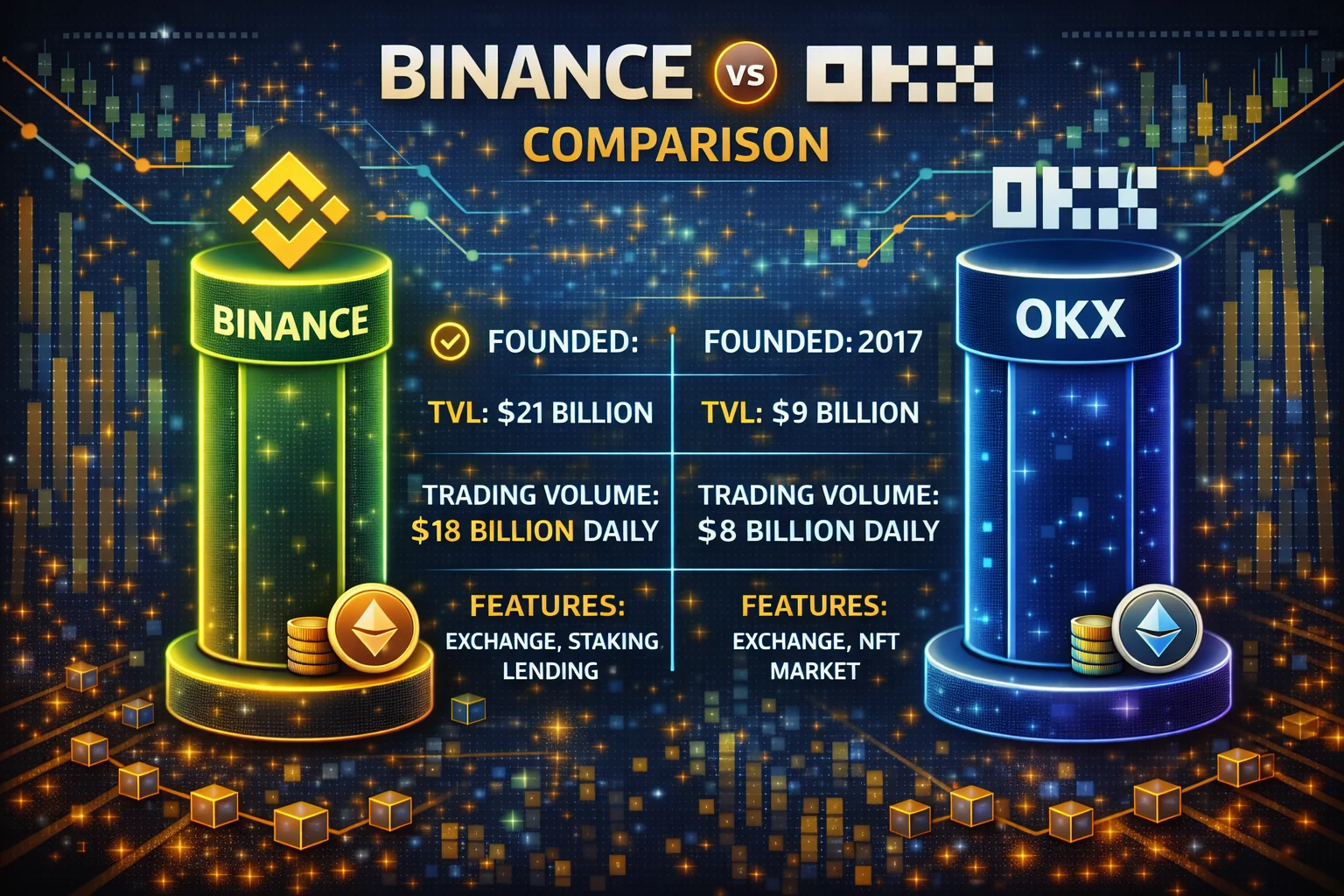
| Feature | Binance | OKX |
|---|---|---|
| Spot Fees (tier 0) | 0.10% | 0.08% |
| Futures Fees | 0.02% / 0.04% | 0.02% / 0.05% |
| Listed Assets | 600+ | 350+ |
| Earn Products | Simple Earn, Launchpad | DeFi Earn, Liquid Staking |
| Web3 Wallet | Trust Wallet (external) | Built-in OKX Wallet |
| KYC | Mandatory | Mandatory |
| SAFU Fund | Yes ($1B) | N/A |
| Mobile App Rating | 4.5/5 | 4.3/5 |
Liquidity & Trading Experience
If you trade high volume, Binance's $65B daily turnover gives you tighter spreads and faster fills. On a $10,000 BTC market order, you can expect 0.01–0.03% slippage on Binance versus 0.03–0.08% on OKX during normal market hours. During high-volatility events, the gap widens further.
OKX's $15–20B daily volume is smaller, but if you trade mid-cap altcoins or perpetual contracts, you may find comparable depth. OKX's BTC/USDT perp order book often matches Binance's within 0.01% of mid-price — meaning your execution cost on major pairs is effectively identical.
If you regularly execute positions above $50,000, you should test both platforms with a small order first. Binance's deeper liquidity reduces slippage on large fills, but OKX's lower base fees can offset that advantage depending on your tier.
Trading Interface Comparison
Binance Interface: If you are new to crypto, switch to Binance Lite mode immediately — the default Pro interface shows dozens of panels, indicators, and order types that can overwhelm you. The mobile app mirrors the desktop experience and handles high-frequency order flow without lag.
OKX Interface: OKX's default layout is cleaner and you can switch between spot, futures, and options from a single unified screen. If you use DeFi regularly, the integrated Web3 wallet tab means you do not need a separate app — you can swap between CEX trades and on-chain positions within seconds.
Order Types and Smart Features
Both platforms offer market, limit, and stop-loss orders. If you run algorithmic strategies, OKX gives you native iceberg orders and TWAP execution — you do not need a third-party tool to split large orders into smaller fills. If you prefer commercial bots like 3Commas or Pionex, Binance's API has broader support because most bot developers build for Binance first and add OKX later. If you are still mapping these primitives to your trading flow, our breakdown of order type availability across exchanges walks through where each one helps and where it gets in the way.
Comprehensive Fee Analysis
Spot Trading Fees Breakdown
| Trading Volume (30d) | Binance Maker/Taker | OKX Maker/Taker |
|---|---|---|
| $0 - $25,000 | 0.10% / 0.10% | 0.08% / 0.10% |
| $25,000 - $50,000 | 0.09% / 0.10% | 0.07% / 0.09% |
| $50,000 - $100,000 | 0.08% / 0.10% | 0.06% / 0.08% |
| $100,000 - $250,000 | 0.07% / 0.10% | 0.05% / 0.07% |
| $250,000+ | 0.02% / 0.04% | 0.02% / 0.05% |
Token Discount Programs
Binance BNB Discounts: If you hold BNB, you receive up to 25% fee reduction. The discount tiers scale with your BNB balance and 30-day trading volume. For example, holding 25+ BNB reduces your effective spot fees to 0.075% — a meaningful saving if you trade actively.
OKX OKB Benefits: If you hold OKB, you receive up to 20% fee discounts plus higher lending rates and priority customer support. At current prices, you need roughly $500 worth of OKB to unlock the first discount tier. You should calculate whether the discount savings exceed the opportunity cost of holding OKB versus other assets in your portfolio.
Futures and Derivatives Fees
Both platforms offer competitive futures trading with maker fees as low as 0.02%. OKX often offers lower funding rates on popular perpetual pairs. For example, BTC/USDT funding rates are often better on OKX. This can significantly impact the cost of holding leveraged positions overnight.
If you hold leveraged positions overnight, check the funding rate before opening. A 0.01% difference per 8-hour cycle costs you 1.1% annually on a perpetual contract — enough to erode gains on a medium-conviction trade.
Withdrawal Fees Comparison
| Cryptocurrency | Binance Withdrawal Fee | OKX Withdrawal Fee |
|---|---|---|
| Bitcoin (BTC) | 0.0005 BTC | 0.0004 BTC |
| Ethereum (ETH) | 0.005 ETH | 0.005 ETH |
| USDT (ERC-20) | 25 USDT | 20 USDT |
| USDT (TRC-20) | 1 USDT | 0.8 USDT |
| BNB/OKB | 0.005 BNB | 0.01 OKB |
If you withdraw crypto weekly, OKX saves you money on most assets. Withdrawing 1 BTC costs you 0.0004 BTC ($25 at $62,000) on OKX versus 0.0005 BTC ($31) on Binance — a $6 saving per withdrawal. For USDT on ERC-20, you save $5 per transaction. These differences compound if you move funds frequently between exchanges or to cold storage.
If you withdraw stablecoins frequently, always select TRC-20 instead of ERC-20. You will pay $0.80–$1.00 on TRC-20 versus $20–$25 on ERC-20 — a 96% saving per transaction on both exchanges.
Real-World Fee Examples
Let's look at some real examples to see how fees add up:
Example 1: Small Trader ($1,000/month)
- Binance: $10 in trading fees (0.1%)
- OKX: $8 in trading fees (0.08%)
- Monthly savings with OKX: $2
Example 2: Active Trader ($10,000/month)
- Binance: $100 in trading fees
- OKX: $80 in trading fees
- Monthly savings with OKX: $20
Over 12 months, an active trader on OKX saves roughly $240 compared to Binance at default tiers. If you hold BNB and use Binance's 25% discount, the gap narrows to under $60 per year — worth calculating for your specific volume. To put these two platforms next to the rest of the market, our broader 2026 fee landscape across the top exchanges walks through Coinbase, Kraken, Bybit and Bitstamp on the same metrics.
Earning Opportunities Deep Dive
Binance Earn Ecosystem
Simple Earn: Binance's main earning product offers flexible and locked staking options. Popular assets like ETH offer around 4-5% APY. This comes through liquid staking (BETH). Stablecoins like USDT provide 8-12% in flexible savings.
Launchpad Access: BNB holders get priority access to new token launches. These often provide 10x+ returns on successful projects. Recent launches like Arkham (ARKM) and Cyber (CYBER) have delivered great returns. They delivered these returns to participants.
Dual Investment: This product allows users to earn higher yields. You can get 15-30% APY. But you accept the risk of receiving payments in different cryptos. This depends on market performance.
To participate in Launchpad, you need to hold BNB during the subscription period. Your allocation scales with your BNB balance, so smaller holders typically receive modest allocations — calculate whether the opportunity cost of holding BNB justifies the expected Launchpad return for your portfolio size.
OKX Earn Innovation
DeFi Integration: OKX Earn connects smoothly to major DeFi protocols. These include Aave, Compound, and Curve. Users can access yield farming opportunities directly. They can do this through the exchange interface. This removes the need to manage multiple wallets.
Liquid Staking Solutions: Beyond basic ETH staking, OKX offers exposure to new protocols. These include EigenLayer restaking. This provides 6-8% base yields. You also get additional rewards from actively validated services (AVS).
Cross-Chain Yield Farming: The integrated Web3 wallet allows users to farm yields. You can do this across multiple blockchains. These include Ethereum, Polygon, Arbitrum, and Optimism. You don't need to leave the OKX ecosystem.
If you want to farm yields across Aave, Curve, or Uniswap without managing separate wallets and gas, OKX's integrated approach removes the technical overhead. You can enter and exit DeFi positions from the same interface you use for spot trading.
Risk-Adjusted Returns Comparison
When you compare yields, always factor in lock-up periods and conditions. Higher APY usually means higher risk or longer commitment:
- Stablecoin Savings: Binance 8–12% APY vs OKX 10–15% APY. If you park $10,000 in USDT, that 2–3% gap earns you $200–$300 more per year on OKX — but verify whether the rate is promotional or sustained before committing.
- ETH Staking: Binance 4–5% APY vs OKX 5–6% APY. Both use liquid staking derivatives, so you can unstake without waiting for the Ethereum withdrawal queue.
- DeFi Yield Farming: Not available inside Binance Earn. OKX offers 15–40% APY through integrated DeFi protocols, but you should understand impermanent loss risk before providing liquidity.
- Structured Products: Binance 15–30% APY vs OKX 12–25% APY. Your principal can be converted to a different asset if the strike price is hit — read the payoff conditions carefully before depositing.
- Launchpad / Jumpstart: Returns are event-driven and unpredictable. Your expected allocation depends on your BNB/OKB holdings relative to total demand.
Web3 Integration & DeFi Access
OKX Web3 Wallet Advantages
The integrated OKX Web3 wallet represents a significant competitive advantage. It supports over 80 blockchains. These include Bitcoin, Ethereum, Solana, and Polygon. It also supports emerging networks like Base and Arbitrum. Key capabilities include:
- Multi-Chain Asset Management: View and manage assets across all supported networks. You can do this in a single interface.
- Built-in DEX Aggregator: Access to 200+ decentralised exchanges. It has automatic route optimisation for best prices.
- NFT Support: Full NFT marketplace integration. It supports minting, trading, and portfolio tracking.
- Bitcoin Ordinals: Native support for Bitcoin NFTs and BRC-20 tokens.
- Cross-Chain Bridges: Seamless asset transfers between different blockchains. It has competitive fees.
Binance Web3 Approach
Binance takes a different approach with Trust Wallet. This is their recommended Web3 solution. Whilst this requires a separate app installation, it offers some advantages:
Your preference between a unified app (OKX) and a separate specialised wallet (Binance + Trust Wallet) depends on how often you move between CEX trading and on-chain activity. If you bridge funds daily, OKX saves you time. If you interact with DeFi once a week or less, the added security of a separate wallet may outweigh the convenience cost.
- Enhanced Security: Separate app reduces attack surface. This helps with Web3 interactions.
- Broader DApp Support: Trust Wallet supports over 100 blockchains. It supports thousands of DApps.
- Open Source: Trust Wallet's open-source nature allows for community audits. It also allows for contributions.
- Hardware Wallet Integration: Seamless connection with Ledger and other hardware wallets.
DeFi Yield Comparison
OKX's integrated approach makes DeFi participation significantly easier. It's also more accessible for mainstream clients. Users can:
- Stake ETH directly to Lido or Rocket Pool. You can do this from the exchange interface. It has one-click functionality.
- Provide liquidity to Uniswap V3 pools. It has automated position management. It also has impermanent loss protection.
- Participate in governance voting for major DeFi protocols. You don't need to leave the platform.
- Access yield farming opportunities on Layer 2 networks. These have lower gas fees. They also have optimised strategies.
- utilise cross-chain yield farming. It has automatic asset bridging. It also has position optimisation.
- Access exclusive DeFi partnerships. Get higher APY rates via OKX's institutional relationships.
Advanced DeFi Features Comparison
OKX offers smart DeFi tools. These rival dedicated DeFi platforms:
- Portfolio Analytics: Real-time tracking of DeFi positions. This works across multiple protocols and chains.
- Risk Management: Automated alerts for impermanent loss and liquidation risks. Also alerts for yield changes.
- Strategy optimisation: AI-powered recommendations for maximising yield. This also minimises risk.
- Gas optimisation: Intelligent transaction batching and timing. This reduces network fees.
- Institutional DeFi: Access to institutional-grade DeFi products. These have enhanced security and compliance.
Binance DeFi Integration Challenges
Whilst Binance offers extensive DeFi access via Trust Wallet, the separation creates several challenges:
- Fragmented Experience: Users must manage assets across multiple applications. They also need to manage multiple interfaces.
- Manual Bridging: Complex process for moving funds. This applies to moving between centralised and decentralised platforms.
- Higher Complexity: Requires deeper technical knowledge. This is needed to navigate DeFi protocols effectively.
- Gas Fee Management: Users must manually optimise transaction timing. They also need to optimise batching.
- Limited Integration: Reduced synergy between centralised trading and DeFi strategies.
However, Binance clients benefit from greater control. They can also get potentially higher yields. This works for experienced clients who can navigate DeFi protocols independently. The separation also offers enhanced security. It does this by isolating DeFi risks from centralised exchange holdings.
If you are comfortable managing MetaMask or a hardware wallet alongside your exchange account, Binance's separated approach gives you more control and better isolation of on-chain risk from your exchange balance. If you want a single login for everything — CEX trades, DeFi yields, NFTs, and cross-chain swaps — OKX's integrated wallet is the more practical choice.
Security Infrastructure & Compliance
Binance Security Measures
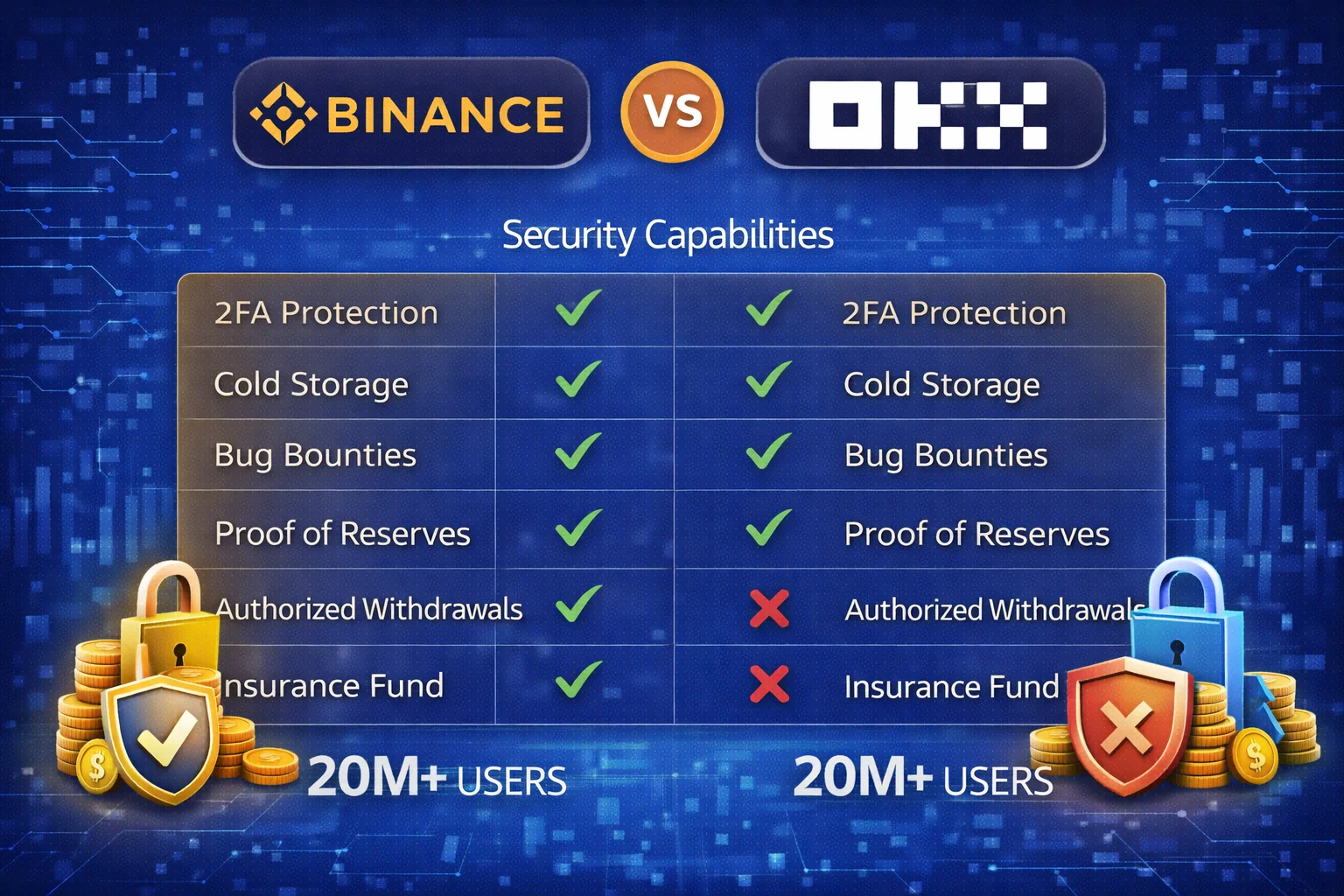
SAFU Fund: Binance maintains a $1 billion Secure Asset Fund for Users. This is funded by 10% of trading fees. This fund has successfully compensated clients during security incidents. This includes the 2019 hack. During this hack, 7,000 BTC was stolen but was fully reimbursed.
The SAFU fund proved its value in 2019 when Binance reimbursed 7,000 BTC stolen in a security breach — you received full compensation without filing individual claims. No other exchange has matched this level of user protection in a live incident.
Multi-Tier Security:
- Cold storage for 95% of user funds
- Multi-signature wallet architecture
- Real-time risk monitoring and AI-powered fraud detection
- Mandatory 2FA for all accounts
- Whitelist withdrawal addresses with 24-hour delay
- Device management and login notifications
OKX Security Framework
Proof-of-Reserves: OKX offers monthly Merkle tree proofs. These allow clients to verify that their funds are backed 1:1 independently. This transparency initiative was launched in the wake of the FTX collapse. It fosters trust via verifiable cryptographic evidence.
You can verify your balance against OKX's Merkle tree proof independently — if you are concerned about exchange solvency after the FTX collapse in 2022, this is a concrete security advantage you should use monthly.
Advanced Protection:
- Semi-offline signature technology for enhanced cold storage
- Multi-party computation (MPC) for institutional clients
- Real-time blockchain monitoring for suspicious activities
- Insurance coverage via third-party providers
- Regular security audits by leading cybersecurity firms
KYC and Regulatory Compliance
Binance KYC Process: You need a government-issued ID, proof of address, and facial verification. The process takes 15–30 minutes for most users, but if your documents are flagged for manual review, expect up to 48 hours. Once verified, your withdrawal limit increases to 8 million USDT per day — far more than most retail traders need. If you want to deposit fiat via bank transfer, you must complete the enhanced KYC tier, which requires a utility bill or bank statement dated within 3 months.
OKX Verification: Similar requirements, but OKX places extra emphasis on source of funds documentation once your 30-day trading volume exceeds $100,000. If you trade below that threshold, the standard ID + selfie verification is sufficient and typically completes in under 15 minutes. OKX holds licences in Malta, Dubai, and several other jurisdictions — if you operate from a regulated environment, the multi-licence coverage reduces your compliance risk.
Regulatory Standing
If you are choosing based on regulatory track record, consider the full picture. Binance paid $4.3B in fines in 2023 and now operates under a US compliance monitorship — this actually means the exchange is under closer regulatory scrutiny than any competitor, which some institutional users view as a positive. OKX has avoided comparable enforcement actions and has proactively obtained licences in multiple jurisdictions.
If regulatory risk concerns you, note that Binance paid a $4.3B fine in 2023 and now operates under a compliance monitorship — the settlement actually reduced your counterparty risk because the exchange is under direct US oversight. OKX has avoided comparable enforcement actions and holds licences in Dubai, Malta, and other jurisdictions.
Detailed Pros & Cons Analysis
Before deciding, you should weigh the concrete trade-offs below. Each advantage listed comes with a specific use case — if the use case matches your trading pattern, that advantage applies directly to you.
Binance Advantages
- Unmatched Liquidity: $65B+ daily volume guarantees minimal slippage and tight spreads for professional trading
- Launchpad Exclusivity: Early access to promising new projects with potential for significant returns and portfolio growth
- Comprehensive Fiat Support: 60+ fiat currencies with credit card, bank transfer, and P2P options for global accessibility
- Educational Resources: Binance Academy offers extensive crypto education for beginners and advanced professional traders
- Global Reach: Available in 180+ countries with comprehensive localised support
- Institutional Services: Dedicated institutional platform with advanced trading tools
- Mobile App Excellence: Highly rated mobile app with full feature parity
Binance Disadvantages
- Interface Complexity: Can be overwhelming for newcomers with hundreds of capabilities
- Regulatory Uncertainty: Ongoing regulatory challenges in some jurisdictions
- Customer Support: Response times can be slow during high-volume periods
- Limited DeFi Integration: Requires external wallets for complete DeFi access
- Withdrawal Limits: Lower limits for unverified accounts compared to competitors
If you recognise more disadvantages than advantages for your use case, that is a strong signal to try the other platform first. None of these drawbacks are dealbreakers on their own, but they compound if they hit your primary workflow.
OKX Advantages
- Integrated Web3 Ecosystem: Seamless CEX-to-DeFi experience in one platform
- Superior DeFi Yields: Direct access to high-yield farming opportunities
- Modern Interface: Clean, intuitive design preferred by many traders
- Lower Fees: Generally more competitive fee structure throughout most trading pairs
- Cross-Chain Support: Native support for 80+ blockchains
- Regulatory Compliance: Proactive licensing and cleaner regulatory record
- Innovation Focus: Quick to adopt new technologies and trading capabilities
OKX Disadvantages
- Lower Liquidity: Smaller trading volumes can result in higher slippage
- Limited Fiat Options: Fewer fiat on-ramps compared to Binance
- Smaller Altcoin Selection: Fewer micro-cap and new token listings
- Regional Restrictions: Not available in some major markets like the United States
- Learning Curve: Web3 capabilities may be complex for traditional traders
Choosing the Right Platform for Your Needs
Choose Binance If You:
- prioritise Liquidity: Trade large volumes or need minimal slippage
- Want Launchpad Access: Interested in early-stage token investments
- Need Fiat Flexibility: Require multiple fiat on-ramp options
- Prefer Established Platforms: Value the security of the world's largest exchange
- Trade Futures Actively: Need the deepest derivatives markets
- Are Location-Restricted: Live in regions where OKX isn't available
Choose OKX If You:
- Embrace DeFi: Want seamless access to decentralised finance
- Value Lower Fees: prioritise cost-effective trading
- Prefer Modern UX: Want a cleaner, more intuitive interface
- Trade Cross-Chain: Need multi-blockchain asset management
- Seek Higher Yields: Want access to advanced earning strategies
- Are Tech-Savvy: Comfortable with Web3 and DeFi concepts
Multi-Platform Strategy
If neither platform clearly wins for your workflow, you should consider using both. Many experienced traders maintain active accounts on Binance and OKX simultaneously and allocate capital based on each platform's strengths. This approach costs you nothing extra — both exchanges have zero account maintenance fees — and it gives you access to arbitrage opportunities when prices diverge between the two order books.
The "Best of Both" Strategy:
- Use Binance for high-liquidity trading and Launchpad participation
- Use OKX for DeFi yield farming and cross-chain activities
- Leverage arbitrage opportunities between both platforms
- Keep the majority of funds in cold storage (hardware wallets)
- Maintain small trading balances on both platforms
Risk Management Considerations:
- Never keep all funds on a single exchange
- Use hardware wallets like Tangem for long-term storage
- Regularly withdraw profits to reduce exchange exposure
- Monitor both platforms' regulatory developments
Migration and Setup Guide
Setting Up Both Platforms:
- Complete KYC verification on both exchanges
- Enable maximum security capabilities (2FA, withdrawal whitelist)
- Start with small amounts to test functionality
- Set up API keys for portfolio tracking tools
- Configure withdrawal addresses and test with small amounts
Fund Allocation Strategy: If you are starting out, the split below gives you broad exposure whilst limiting your exchange risk. You can adjust the percentages based on how actively you trade — if you execute daily, you may need 20–25% on each exchange instead of 15% and 10%:
- 70% in cold storage (hardware wallets)
- 15% on Binance for trading and Launchpad
- 10% on OKX for DeFi and yield farming
- 5% in hot wallets for immediate access
Binance vs OKX Quick Comparison
- Trading Pairs: Binance 600+, OKX 500+
- Spot Trading Fee: Binance 0.1%, OKX 0.08%
- DeFi Integration: Binance Basic, OKX Advanced
- Best For: Binance Liquidity & Variety, OKX DeFi & Lower Fees
Professional Trading Features
API Integration and Trading Support
If you build automated trading systems, both platforms offer REST and WebSocket APIs with sub-100ms latency. Binance's API handles up to 1,200 requests per minute on the default tier; OKX allows 600. If you need higher limits, both offer VIP API tiers — you should apply before scaling your bot to production volume.
Binance's API documentation is more mature, with more third-party libraries (Python ccxt, Node.js binance-api-node). OKX's API is well-documented but has a smaller ecosystem, so you may need to write more custom code for edge cases like sub-account management.
Custody and Compliance
If you manage funds for others, Binance offers institutional custody through Ceffu (formerly Binance Custody) with multi-signature security, insurance, and SOC 2 compliance. OKX provides MPC-based custody for institutional clients with similar audit trails. You should evaluate both against your regulatory requirements — Binance's post-settlement compliance framework may carry more weight with auditors in regulated jurisdictions.
Execution Framework: How to Decide with Real Data
The most reliable way to choose between Binance and OKX is to run a controlled two-platform test with your own execution profile, because headline fee tables do not capture spread differences, withdrawal friction, or support quality under load. If you trade only once or twice per month, the practical winner can differ from the platform that looks cheapest in a static comparison chart.
Run a seven-day validation cycle with identical conditions: same funding amount, same trading pairs, same order types, and one test withdrawal per platform. For example, if you trade $2,000 in BTC and ETH pairs, record fill quality, effective fees, plus end-to-end withdrawal time, then compare net execution cost instead of relying on nominal maker or taker rates.
Add one risk-control check before scaling volume: confirm that account recovery, withdrawal whitelisting, and anti-phishing controls are configured and tested on both exchanges. This step is operationally critical, because better fills are irrelevant if your security posture is weaker than your capital exposure.
If you plan to combine spot trading with passive yield, pair this comparison with the staking platforms comparison and validate exchange-specific product details in the Binance Staking review before committing larger allocations.
Final Verdict: Binance vs OKX
Your choice between Binance and OKX depends on three variables: your monthly trading volume, whether you need on-chain DeFi access, and how many fiat currencies you need to deposit with.
If you trade above $50,000 per month and need maximum liquidity, you should start with Binance. The deeper order books save you more on slippage than you lose on the 0.02% fee premium — on a $100,000 position, the slippage difference alone can exceed $30 compared to OKX. Binance also gives you access to 600+ trading pairs and the Launchpad programme, which has delivered some of the highest returns in crypto for BNB holders.
If you actively farm DeFi yields or trade across multiple chains, OKX's integrated wallet eliminates the friction of managing separate apps and bridging assets manually. You can stake ETH through Lido, provide liquidity on Uniswap, and swap assets across 80+ chains without ever leaving the OKX interface. For traders who split their time between centralised and decentralised finance, this integration saves you significant time and gas costs.
Many traders use both platforms strategically. A practical allocation: keep your spot and futures trading on Binance for liquidity, and use OKX for DeFi yield farming and cross-chain swaps. You should keep no more than 30% of your total crypto holdings across both exchanges combined — the rest should sit in a hardware wallet like Ledger or Tangem. This split protects you against exchange-specific risk whilst giving you access to the best features of each platform.
If you are still undecided, run the seven-day test described in the Execution Framework section above. Deposit a small amount on both exchanges, execute identical trades, and measure your actual costs. The data from your own trading pattern is more reliable than any comparison table. You can sign up through our Binance referral guide or OKX registration guide for step-by-step setup instructions and any available signup bonuses.
Sources & References
Frequently Asked Questions
- Which is better for beginners: Binance or OKX?
- Binance is generally better for beginners due to its extensive educational resources, larger user base, and more fiat on-ramp options. OKX offers a more intuitive interface that some beginners find easier to navigate. Start with Binance if you want complete support and learning tools.
- Are Binance and OKX safe?
- Both exchanges have strong security practices, featuring cold storage, 2FA, and comprehensive insurance funds. Binance maintains a larger insurance fund ($1B+) and has a more extended operational history. OKX has never been hacked and upholds high security standards. Always enable 2FA and avoid storing large holdings on any exchange.
- Which exchange has lower fees?
- OKX offers slightly lower base spot trading fees (0.08% vs 0.1% on Binance). Both exchanges provide discounts via native tokens (BNB, OKB) and VIP tiers. For high-volume traders, fee differences become minimal after VIP and token discounts.
- Can I use both Binance and OKX?
- Yes. Many traders use both exchanges strategically. Binance offers deeper liquidity and strong support for new token launches. OKX offers lower fees and superior DeFi/Web3 integration. Using both maximises opportunities and diversifies platform risk. The Binance and OKX setup guides linked from the conclusion above cover the registration steps.
- Which exchange is better for DeFi?
- OKX offers significantly better DeFi functionality thanks to its integrated Web3 wallet, cross-chain swaps, and native access to DeFi protocols. Binance offers only basic DeFi capabilities and requires more manual steps. If DeFi is a priority, OKX is the stronger choice.
- Do Binance and OKX work in the US?
- Neither Binance.com nor OKX.com serve US customers due to regulatory restrictions. US clients must use Binance.US (limited capabilities) or regulated alternatives like Coinbase or Kraken.