Best Exchanges for Passive Income
Looking to earn income while holding crypto? We compare the top exchanges with staking, flexible earn products, and fixed yields.
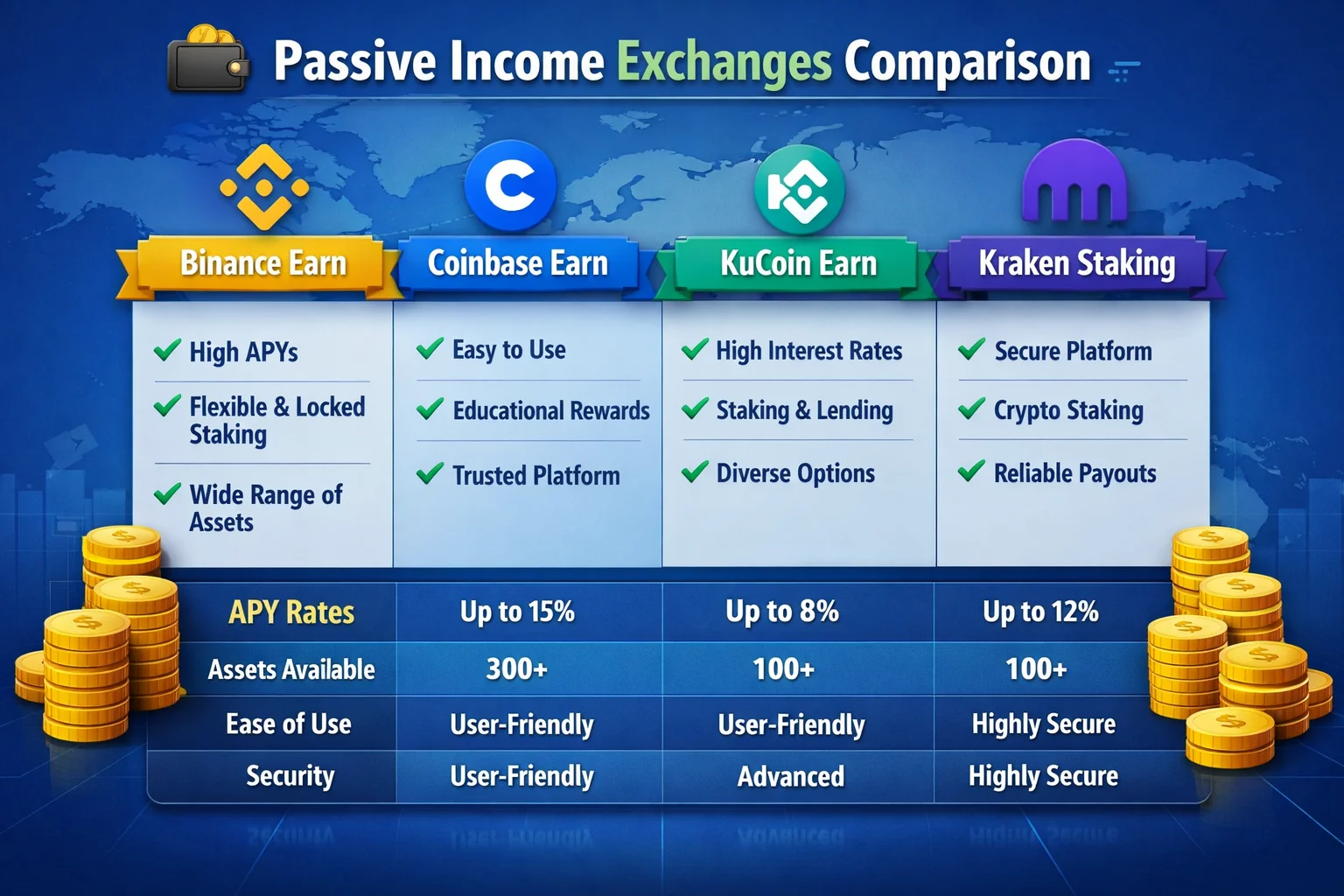
Introduction
Are you looking to earn passive income from your crypto holdings? Cryptocurrency exchanges have transformed from basic trading platforms into full-service financial ecosystems. In 2025, leading platforms offer diverse earning opportunities that can help you generate returns without active trading.
How can you earn passive income with crypto? Modern exchanges provide multiple options: you can use staking services to earn rewards, access flexible savings accounts for instant liquidity, try fixed-term deposits for higher yields, or explore automated strategies that work for you 24/7.
What makes these services valuable for you? The evolution has democratised access to previously complex DeFi strategies. You get the security and user experience you expect while accessing institutional-grade opportunities. Modern exchanges bridge traditional finance with decentralised protocols, making it easier for you to earn.
How do yields compare across different products? The yield landscape on centralised exchanges offers varying risk-reward profiles. Conservative staking options can deliver 4-8% annual returns with minimal risk. More aggressive products can deliver returns of 10-20%, but they carry higher platform and market risks. Understanding these differences is crucial for building your diversified strategy.
What should you consider when choosing earning products? Successful yield generation requires aligning product selection with your risk tolerance and investment goals. The key is maximising your returns across different market conditions while maintaining appropriate risk management. This approach ensures sustainable wealth-building and long-term growth through your cryptocurrency holdings.
Why is security so important for passive income? Security and platform reliability have become paramount considerations when you select exchanges for earning opportunities. You must trust these platforms to keep your assets safe for extended periods. Leading exchanges now implement institutional-grade security, comply with regulations, and provide insurance coverage to protect your funds.
What makes a good passive income exchange? Here are the key factors you should look for:
- High APY rates: Look for competitive staking and savings rates that maximise your returns
- Strong security: Ensure the platform has insurance coverage and proven security measures
- Multiple earning options: Diversify your income streams across different products
- Easy withdrawal: Choose platforms with flexible terms that give you control
- Transparent fees: Understand all costs before you commit your funds
- Regulatory compliance: Select exchanges with proper licensing and trust
How do protection levels vary between platforms? Protection levels differ significantly across exchanges. This comparison examines the top exchanges to help you find the best options for generating returns. We analyse their product offerings, security measures, historical performance, and overall suitability to help you make informed decisions that match your needs.
How does competition benefit you? The competitive landscape has intensified as exchanges compete for your deposits through attractive yield offerings. This competition benefits you with improved rates, innovative products, and enhanced security measures. However, you need careful evaluation to distinguish between sustainable offerings and promotional rates that may not support your long-term goals.
What role do regulations play in your passive income strategy? Regulatory developments continue to shape the passive income landscape. Clearer frameworks are emerging in major jurisdictions, providing greater certainty for both platforms and you. These developments enable more structured product offerings while ensuring appropriate protections for you. Understanding the regulatory environment helps you make informed decisions about platform selection and risk management.
The Yield Revolution in Crypto
How has passive income changed in crypto? The market has matured significantly. Exchanges now offer many ways to earn.
In 2025, earning yield has become a cornerstone of crypto investing. Whether you're staking ETH, locking stablecoins, or using earn vaults, exchanges offer simplified paths to generate returns without active trading. Remember: The maturation of the crypto ecosystem has created numerous opportunities for investors to earn yield on their holdings while maintaining exposure to digital assets.
What types of passive income can you earn?
- Staking rewards from proof-of-stake networks
- Interest from flexible savings accounts
- Fixed-term deposit bonuses
- Liquidity mining rewards
- Lending interest payments
- Promotional campaign bonuses
Market Evolution and Opportunities
The crypto income landscape has evolved dramatically from the early days of simple interest accounts. Modern platforms now offer products like liquid staking, structured deposits, and automated farming strategies. This evolution has made it possible for retail investors to access opportunities previously available only to large players.
How do you compare different platforms? Consider these factors:
- Annual percentage yield (APY) rates: Compare base rates and promotional offers
- Minimum deposit requirements: Check entry barriers for each product
- Lock-up periods and flexibility: Understand withdrawal restrictions
- Supported cryptocurrencies: Verify asset availability
- Platform security and insurance: Review protection measures
- Withdrawal fees and processing times: Calculate total costs
- Customer support quality: Test response times
- Regulatory compliance status: Verify licensing and registration
Types of Earning Products
| Product Type | Description | Typical APY | Risk Level | Liquidity |
|---|---|---|---|---|
| Staking | Earn rewards by participating in network consensus | 4-12% | Low-Medium | Variable |
| Flexible Earn | Deposit funds with instant withdrawal capability | 2-8% | Low | High |
| Fixed-Term Deposits | Lock funds for higher yields | 6-15% | Medium | Low |
| Liquidity Mining | Provide liquidity to earn trading fees and rewards | 10-30% | High | Medium |
| Structured Products | Complex strategies with enhanced returns | 8-25% | High | Low |
| Auto-Investing | Dollar-cost averaging with compound growth | 3-10% | Low-Medium | High |
Comparison Table
| Exchange | Staking | Earn Products | Flexible Yields | Fixed-Term Options | Yield % (typical) | Best For |
|---|---|---|---|---|---|---|
| Binance | ✅ | ✅ | ✅ | ✅ | 2–12% | All-in-one |
| OKX | ✅ | ✅ | ✅ | ✅ | 2–15% | Variety & tools |
| Kraken | ✅ | ❌ | ❌ | ❌ | 4–12% | Simple staking |
| KuCoin | ✅ | ✅ | ✅ | ✅ | 3–20% | DeFi-style access |
| Bybit | ✅ | ✅ | ✅ | ✅ | 2–18% | High APY |
| Coinbase | ✅ | ❌ | ❌ | ❌ | 3–5% | Beginner-friendly |
| Nexo | ✅ | ✅ | ✅ | ✅ | 4–12% | CeFi lending |
| Gemini | ✅ | ❌ | ❌ | ❌ | 2–8% | US regulated |
What coins offer the best staking rewards?
- Ethereum (ETH): 3-5% APY with high security
- Solana (SOL): 5-7% APY with fast transactions
- Cardano (ADA): 4-6% APY with strong community
- Polkadot (DOT): 10-14% APY with parachain rewards
- Cosmos (ATOM): 8-12% APY with IBC ecosystem
- Avalanche (AVAX): 6-9% APY with subnet rewards
- Polygon (MATIC): 5-8% APY with layer-2 benefits
- Tezos (XTZ): 5-7% APY with on-chain governance
- Algorand (ALGO): 4-6% APY with instant finality
- Near Protocol (NEAR): 8-11% APY with sharding
Detailed Exchange Analysis
Which platforms offer the best rates? Let us compare the top exchanges for passive income.
Binance - The All-in-One Platform
Binance dominates the income space with the widest range of earning products. The platform offers staking, flexible earn, fixed-term vaults, and auto-invest features across hundreds of cryptocurrencies.
Key Features
- Binance Earn (2-12% APY): Unified dashboard for all earning products with high flexibility
- Flexible Savings (2-6% APY): Instant access with competitive rates and very high flexibility
- Locked Staking (5-12% APY): Higher yields for committed terms with low flexibility
- DeFi Staking (8-20% APY): Access to yield farming through Binance with medium flexibility
- Launchpool (Variable APY): Earn new tokens by staking existing assets with high flexibility
- Auto-Invest (3-8% APY): Automated DCA with earning integration and high flexibility
Advantages
- Largest selection: Over 200 earning products available
- Competitive rates: Industry-leading APYs across all asset classes
- Strong liquidity: $76 billion daily trading volume ensures stability
- Regular promotions: Weekly campaigns with bonus rewards
- Security measures: SAFU fund with $1 billion insurance coverage
- User experience: Intuitive interface with mobile app support
OKX - Innovation and Variety
OKX's Earn section stands out for its innovative products and competitive yields. Remember: The platform combines traditional staking with advanced DeFi strategies and structured products.
Product Portfolio
- Simple Earn (2-8% APY): Basic staking and flexible savings, $10 minimum, no lock period
- Structured Products (5-25% APY): Dual investment and shark fin products, $100 minimum, 7-30 days lock
- DeFi Hub (8-30% APY): Direct access to major protocols, $50 minimum, variable lock
- Jumpstart (Variable APY): Early access to new project tokens, $100 minimum, 14-30 days
- ETH 2.0 Staking (3-5% APY): Liquid staking with BETH tokens, 0.01 ETH minimum, flexible
Unique Advantages
- Highest yields: DeFi integration provides 8-30% APY opportunities
- Advanced products: Structured products for experienced traders
- Mobile excellence: Award-winning mobile app with full functionality
- User education: Step-by-step learning resources and tutorials
- Trading integration: Direct connection with spot and derivatives trading
- Security features: Multi-signature wallets and cold storage
Kraken - Regulatory Compliance Leader
Kraken focuses on native staking with strong regulatory compliance. Whilst it offers fewer products than competitors, it excels in transparency and security.
Staking Excellence
- Native Staking: Direct participation in network consensus with maximum security and transparency
- Transparent Fees: Clear fee structure with no hidden costs for predictable returns
- Instant Unstaking: Immediate access to staked funds with high liquidity
- Validator Quality: Professional validator operations for reliable rewards
Why choose Kraken for staking?
- Regulatory compliance: Fully licensed in multiple jurisdictions
- Security track record: Never been hacked in 12+ years
- Transparent operations: Regular proof-of-reserves audits
- Customer support: 24/7 live chat and phone support
- Insurance coverage: Full insurance coverage for digital assets
KuCoin - DeFi Integration Specialist
KuCoin bridges centralised and decentralised finance, offering unique access to DeFi yields through a centralised interface.
DeFi-Style Products
- Pool-X (5-15% APY): Staking-as-a-Service platform with medium risk
- KuCoin Earn (3-12% APY): Flexible and fixed-term options with low-medium risk
- Soft Staking (2-8% APY): Earn rewards just by holding with low risk
- Lending (4-18% APY): P2P and platform lending options with medium-high risk
What makes KuCoin unique?
- DeFi bridge: Direct access to decentralised protocols
- Token variety: Over 700 cryptocurrencies supported
- Low barriers: Minimum deposits as low as $1
- Innovation focus: Early access to new DeFi products
- Community rewards: KCS token holders get bonus yields
Bybit - High-Yield Focus
Bybit's Earn Centre emphasises high yields through innovative products and promotional campaigns.
Earning Products
- Flexible Staking (2-8% APY): No lockup with competitive rates and instant withdrawal
- Fixed Staking (6-18% APY): Higher yields for committed terms with 7-90 day periods
- Launchpool (Variable APY): Earn new tokens through staking with early project access
- Dual Asset (10-30% APY): Enhanced yields with structured products and market-linked returns
Why choose Bybit for high yields?
- Competitive rates: Consistently amongst the highest APYs
- Promotional campaigns: Regular bonus reward events
- Trading integration: Direct connection with derivatives
- Security measures: Multi-signature cold wallets
- User rewards: VIP tiers with enhanced benefits
Coinbase - Beginner-Friendly Simplicity
Coinbase offers the most user-friendly staking experience with automatic enrollment and simple interfaces.
How can you protect your investments? Follow these security practices:
- Enable two-factor authentication on all accounts
- Use hardware security keys when available
- Whitelist withdrawal addresses
- Set up withdrawal limits and alerts
- Keep most funds in cold storage
- Regularly review account activity
- Use unique passwords for each platform
- Verify platform URLs before logging in
Simplified Staking
- Auto-Staking: Automatic ETH staking for eligible users with zero effort required
- Educational Content: Beginner-focused learning resources for informed decisions
- Regulatory Compliance: Strong regulatory standing with legal protection
- Insurance: FDIC insurance for USD balances providing fund security
Why beginners choose Coinbase:
- Simplicity: Most user-friendly interface in the industry
- Trust: Publicly traded company with full transparency
- Education: Earn crypto while learning through Coinbase Earn
- Security: 98% of funds in cold storage
- Support: Extensive help centre and customer service
- Regulation: Fully compliant with US regulations
Risk Management and Security Considerations
What are the main risks? Understanding risks helps you protect your funds. Here are the key concerns to watch.
Platform Risks
- Counterparty Risk: Exchange insolvency or operational failures - Mitigation: Diversify across multiple platforms
- Regulatory Risk: Changes in local regulations affecting operations - Mitigation: Choose regulated exchanges
- Rehypothecation Risk: Exchanges lending user funds to third parties - Mitigation: Read terms and conditions carefully
- Technical Risk: Platform outages or security breaches - Mitigation: Use platforms with strong security track records
What are common mistakes to avoid?
- Chasing the highest yields without considering risks
- Putting all funds on a single platform
- Ignoring lock-up periods and withdrawal restrictions
- Not reading terms and conditions carefully
- Failing to track tax obligations
- Using leverage without understanding the risks
- Neglecting to monitor platform health and news
- Investing more than you can afford to lose
- Not maintaining emergency liquidity
- Ignoring regulatory changes in your jurisdiction
Product-Specific Risks
- Staking Risks (Low-Medium Impact): Slashing, validator performance, network changes
- Liquidity Risk (Medium Impact): Inability to withdraw during market stress
- Interest Rate Risk (Low Impact): Fluctuating yields affecting returns
- Smart Contract Risk (Medium-High Impact): DeFi integration vulnerabilities
What 2022 Taught Us About Yield Platform Risk
The 2022 crypto lending crisis destroyed Celsius, BlockFi, and Voyager — platforms that had collectively managed billions in user deposits. The pattern was consistent: platforms offered yields that exceeded what the underlying market could sustain, covered the gap with increasingly risky lending and trading strategies, and collapsed when market conditions reversed. Users who held funds on these platforms lost some or all of their deposits.
The platforms that survived — Nexo, YouHodler, Binance Earn, Kraken — shared common traits: lower advertised yields, transparent reserve reporting, and conservative lending practices. If a yield seems too good to be true relative to the risk-free rate and the platform does not clearly explain where the yield comes from, you should treat it as a warning sign. The safest approach is to diversify across multiple platforms, keep the majority of holdings in self-custody, and use yield products only for capital you can afford to have locked or at risk.
Risk Mitigation Strategies
- Diversification: Spread funds across 2–3 platforms maximum — enough to reduce single-point failure but few enough to monitor actively
- Due Diligence: Check proof-of-reserves reports, security audit history, and regulatory status before depositing
- Position Sizing: Never allocate more than 20% of your total crypto portfolio to any single earning platform
- Regular Monitoring: Track platform health indicators and yield changes weekly — sudden rate increases can signal desperation
- Self-Custody Buffer: Keep at least 50% of your holdings in a hardware wallet, outside of any earning product
How can you maximise your returns? Smart strategies help you earn more. Choose the right approach for your goals.
Yield Optimisation Strategies
Portfolio Allocation Approaches
Conservative Strategy (Focus on Stability)
- 70% Allocation: Regulated platforms (Coinbase, Kraken) - 3-5% APY, Low risk
- 20% Allocation: Established exchanges (Binance) - 4-8% APY, Low-Medium risk
- 10% Allocation: Higher-yield opportunities (OKX, Bybit) - 6-12% APY, Medium risk
- Target Annual Yield: 4-6%
Balanced Strategy (Risk-Reward Balance)
- 40% Allocation: Stable staking products - 4-8% APY, Low-Medium risk
- 40% Allocation: Flexible earn products - 5-10% APY, Medium risk
- 20% Allocation: Structured/promotional products - 8-15% APY, Medium-High risk
- Target Annual Yield: 6-10%
Aggressive Strategy (Maximum Yield)
- 30% Allocation: Established platforms - 5-10% APY, Medium risk
- 50% Allocation: High-yield platforms (KuCoin, Bybit) - 10-20% APY, High risk
- 20% Allocation: Promotional and structured products - 15-30% APY, Very High risk
- Target Annual Yield: 10-15%
Optimisation techniques
- Rate Shopping: Regularly compare rates across platforms for +1-3% APY improvement
- Promotional Hunting: Take advantage of limited-time offers for +2-5% bonus yields
- Compound Strategies: Reinvest rewards for exponential growth, +0.5-2% effective APY
- Tax optimisation: Consider tax implications of different products to save 10-30% on taxes
Which exchange is right for you? Your experience level matters. Different platforms suit different needs.
Selection Guide
Choose Based on Your Profile
Beginners (First Time Earning Yield)
Recommended: Coinbase or Kraken — both are regulated in the US and EU, offer simple staking interfaces, and provide customer support if something goes wrong. Coinbase lets you stake ETH with a single click; Kraken offers staking for 15+ assets including DOT and SOL with clear APY displays. Expect 2.5–5% APY on major assets. The tradeoff is lower yields compared to less regulated alternatives, but you gain regulatory protection and a straightforward experience while learning the mechanics of crypto yield generation.
Intermediate Users (Comfortable with Exchanges)
Recommended: Binance — the widest range of earning products in one place: flexible savings, locked staking, dual investment, liquidity farming, and auto-invest. USDT flexible savings pays 3.5–4.5% APY with instant withdrawal. ETH staking offers 3.2% APY via BETH. The BNB vault combines multiple yield sources into a single product. Binance suits users who want to compare products side by side without switching platforms. If you are outside the US, Binance provides the best balance of yield options and platform stability.
Experienced Users (DeFi-Comfortable)
Recommended: OKX or KuCoin — both offer exchange-based earn products plus integrated DeFi access. OKX's Web3 wallet connects directly to Aave, Curve, and other protocols. KuCoin's trading bots (Grid, DCA) add automated yield strategies beyond simple staking. These platforms suit users who understand smart contract risk, can evaluate APY sustainability, and want to combine CeFi convenience with DeFi yield opportunities in a single ecosystem.
What features should you look for?
- Transparent fee structure with no hidden costs
- Multiple earning products for diversification
- Flexible withdrawal options
- Competitive interest rates
- Strong security measures and insurance
- Responsive customer support
- Mobile app with full functionality
- Regular platform audits and transparency reports
- Clear terms and conditions
- Proven track record and reputation
Yield maximisers
Recommended: Bybit or KuCoin
- Highest advertised yields
- Frequent promotional campaigns
- Innovative product offerings
- Willingness to accept higher platform risk
What are the key benefits of each platform?
- Coinbase: Best for beginners with strong security
- Binance: Most product variety and competitive rates
- Kraken: Excellent for US users with compliance
- OKX: Advanced DeFi integration and high yields
- KuCoin: Innovative products and promotional offers
- Bybit: High leverage and structured products
Tax Implications and Compliance
Tax Considerations
In most jurisdictions, crypto yield earnings are treated as ordinary income at the time you receive them. If you earn 100 USDT in staking rewards, you owe income tax on the fair market value at receipt — even if you do not sell the tokens. This applies to staking rewards, lending interest, and yield farming distributions. Some jurisdictions also treat the subsequent sale of earned tokens as a separate capital gains event. The tax treatment of DeFi yield farming rewards remains unclear in many countries, and you should consult a tax professional before engaging in complex multi-protocol yield strategies.
Compliance Best Practices
- Understand local regulations regarding yield farming
- Use platforms with proper regulatory compliance
- Maintain detailed transaction records
- Report all income according to local tax laws
Start Earning Passive Income Today
Select an exchange based on your preferred yield approach:
- Start with Binance - Highest staking rewards and most options
- Start with OKX - Best for DeFi integration
- Start with Bybit - Competitive rates and user-friendly
- Start with KuCoin - Great altcoin selection
Yield Reality Check: What You Can Actually Earn (March 2026)
Stablecoin Yields Across Platforms
USDT and USDC yields vary significantly by platform and product type. On centralised exchanges, Binance Earn offers 3.5–4.5% APY on flexible USDT deposits with instant withdrawal. KuCoin Earn provides 4.1% APY flexible and up to 6.2% for 14-day fixed terms. OKX Flexible Savings offers 3.2% APY. YouHodler leads with up to 13% APY, though this comes with centralised counterparty risk and no deposit insurance beyond their internal fund.
On DeFi protocols, Aave currently pays 2.8–3.5% APY on USDC supply across Ethereum and Polygon. Compound offers similar rates. Curve stablecoin pools (3pool, FRAX pool) generate 2–5% APY from trading fees plus CRV rewards, though reward token emissions are declining. If you see any platform advertising 20%+ APY on stablecoins without a clear explanation of where the yield comes from, investigate before depositing — unsustainable token incentives often collapse.
ETH and BTC Passive Income
ETH staking yields have stabilised around 3.5–4.2% APY after the Shapella upgrade increased the validator set. Lido's stETH offers 3.8% with liquid staking flexibility. Rocket Pool's rETH provides 3.5% with a more decentralised validator structure. Kraken offers 3.2% ETH staking with a simple interface and no minimum. Coinbase takes a larger cut, offering around 2.8% after their commission.
BTC generates passive income primarily through CeFi lending (3–5% APY on Nexo, YouHodler) or wrapped BTC in DeFi (2–4% APY via Aave or Curve). Native Bitcoin has no staking mechanism, so any BTC yield comes from lending your coins to borrowers or providing liquidity — both carry counterparty or smart contract risk.
Altcoin Staking Yields
Proof-of-stake altcoins offer higher nominal yields: ATOM 10–15% APY, DOT 12–14%, SOL 6–8%, ADA 4–5%. These rates are protocol-level and available through both exchanges and non-custodial wallets. However, you should measure returns in USD value, not token quantity — a token paying 15% APY that drops 40% in price delivers a net loss. Staking higher-cap PoS assets (ETH, SOL, ADA) on established exchanges like Binance or Kraken provides the simplest risk-adjusted approach for most users.
The Fee Impact on Net Returns
Gross APY is not your actual return. If you earn 4% APY on Aave but pay $15 in gas fees to deposit and $15 to withdraw, you need a deposit of at least $750 to break even over a year on Ethereum mainnet. On Polygon or Arbitrum, gas fees drop to $0.01–0.10, making smaller deposits viable. CeFi platforms like Binance and Nexo have zero deposit fees but may charge withdrawal fees (1–5 USDT depending on network). Always calculate your net yield after all fees before committing funds.
Conclusion and Final Recommendations
Best Platforms by Strategy
Staking: If you want a straightforward way to earn yield, Binance and Kraken are the simplest starting points. Both offer native staking with clear interfaces and transparent fee structures. For liquid staking — where you receive a tradeable token representing your staked position — Lido remains the leading protocol, accessible through several exchanges.
Lending: On the DeFi side, Aave and Compound let you lend directly through smart contracts with variable rates that respond to market demand. If you prefer a managed experience without interacting with smart contracts, Nexo and YouHodler handle the complexity for you, though you accept custodial risk in return for convenience.
Yield farming: This carries the highest risk of the three approaches. For stablecoin pools specifically, Curve and Convex offer relatively predictable returns compared to volatile-pair pools. You should understand impermanent loss before committing funds to any liquidity pool.
Realistic Expectations
In the current market as of March 2026, stablecoin yields typically range from 3–8% APY depending on the platform and product type. BTC and ETH staking generally returns 3–6% APY depending on the platform and lock-up period. If you see a product promising 20%+ APY on stablecoins, investigate where that yield comes from — it may involve rehypothecation, token emissions that dilute value, or unsustainable promotional rates.
Rates change with market conditions. During bull markets, borrowing demand pushes lending rates higher. During quiet periods, yields compress. Build your strategy around conservative estimates rather than peak promotional rates.
How to Start
Begin with staking on a major exchange like Binance, Kraken, or Coinbase. This gives you exposure to yield generation with minimal technical complexity. Start with a small amount — enough to learn the mechanics without meaningful financial risk.
Once you understand how staking works and feel comfortable with the platform, explore DeFi lending through Aave or Compound. Before you do, make sure you understand gas fees on Ethereum (or consider layer-2 alternatives) and the smart contract risks involved.
Only move to yield farming after you have direct experience with both staking and lending. Yield farming adds impermanent loss risk and requires active monitoring. It is not a set-and-forget strategy.
Sources & References
Frequently Asked Questions
- Is income guaranteed?
- No. Rates can fluctuate based on market conditions, network parameters, and platform policies. Even fixed products carry counterparty and regulatory risks. Always read the terms carefully and use trusted exchanges with a strong track record.
- Do I need to lock funds?
- It depends on the product type. Flexible products allow instant withdrawals but typically offer lower yields. Fixed-term products require locking funds for a specific period but offer higher returns. Choose based on your liquidity needs.
- Are rewards paid daily?
- Most flexible earn platforms distribute rewards daily or even hourly, allowing for compound growth. Fixed-term products may pay rewards at maturity or distribute them periodically during the term.
- How do exchange rates compare to yield farming?
- Exchange rates are typically lower than yield farming but offer convenience, customer service, and reduced technical complexity. DeFi may offer higher yields, but it requires more technical knowledge and carries additional risks associated with smart contracts.
- What happens if an exchange fails?
- Exchange failures can result in partial or total loss of funds. Important: This is why diversification across multiple platforms and choosing regulated exchanges with insurance coverage is crucial for risk management.
- Can I withdraw my funds anytime?
- For flexible products, yes. However, some platforms may impose withdrawal limits or delays during high-demand periods. Fixed-term products typically do not allow early withdrawal without penalties.