Aave Review: DeFi Lending Protocol
Aave is the largest DeFi lending protocol by total value locked — over $10 billion across Ethereum, Arbitrum, Polygon, Avalanche, and Optimism. This review covers how V3 works in practice: interest mechanics, collateral requirements, liquidation risk, and whether yields are competitive compared to CeFi alternatives.
The protocol launched as ETHLend in 2017 and rebranded as Aave in 2020. V3 (2022) introduced Efficiency Mode for up to 97% loan-to-value ratios on correlated assets, Isolation Mode to safely list experimental collateral, and per-asset supply and borrow caps. It has facilitated over $50 billion in cumulative lending volume and remains the benchmark DeFi lending infrastructure.
Introduction
Aave operates as a non-custodial liquidity protocol: users supply assets to shared pools and receive aTokens representing their deposit plus accrued interest. Borrowers lock collateral worth more than their loan — overcollateralisation is required — and pay algorithmically-determined rates based on pool utilisation. No registration, no KYC, and no counterparty; all terms are enforced by smart contracts.
V3 introduced three meaningful changes from V2. Efficiency Mode (eMode) allows up to 97% loan-to-value ratios when borrowing correlated assets — for example, borrowing USDC against USDT collateral. Isolation Mode limits protocol-wide exposure when a new or volatile asset is first listed, capping how much debt can be backed by that collateral. Supply and borrow caps per asset give governance a lever to manage concentration risk without disabling an asset entirely.
Aave pioneered flash loans — uncollateralised loans that must be repaid within a single transaction. They are primarily used by developers and arbitrageurs for debt refinancing, collateral swapping, and cross-protocol arbitrage. Flash loans charge a 0.09% fee and automatically revert if not repaid, making them risk-free for the protocol while generating fee revenue.
The AAVE governance token gives holders voting rights on risk parameters, asset listings, interest rate model adjustments, and treasury management via the Aave Improvement Proposal (AIP) process. Token holders who stake AAVE in the Safety Module earn rewards but accept slashing risk: up to 30% of staked tokens can be used to cover a protocol shortfall event.
The two practical decisions for any user are: whether to supply assets for yield only, or whether to borrow against collateral — which introduces liquidation risk when collateral values fall. This review covers both use cases, the current yield ranges for major assets, what drives your interest rate, and the realistic risk profile of active borrowing positions on Aave.
What Is Aave?
Aave is a non-custodial lending protocol where you supply crypto to shared pools and earn variable interest, or borrow against deposited collateral. No intermediaries, no sign-up, no KYC. Supply 10,000 USDC today on Ethereum mainnet, and you start earning approximately 3-5% APY immediately (rates fluctuate with demand). Borrow ETH against that USDC at approximately 4-6% variable rate. All terms are enforced by audited smart contracts on-chain.
The protocol launched as ETHLend in 2017, rebranded in 2020, and has since processed over 50 billion USD in cumulative lending volume. It operates on Ethereum, Arbitrum, Polygon, Optimism, Avalanche, and Base. TVL typically ranges between 8-12 billion USD depending on market conditions. Aave introduced flash loans, stable-rate borrowing, and credit delegation, all of which are now replicated across competing protocols.
The practical step-by-step workflow for a new user: connect your wallet (MetaMask, Ledger, or WalletConnect), select a network, choose an asset to supply, approve the token, and confirm the deposit transaction. You receive aTokens that represent your deposit plus accrued interest. To borrow, enable your supplied asset as collateral, select the asset you want to borrow, choose a variable or stable rate, and confirm. Monitor your health factor above 1.0 to avoid liquidation.
Aave V3: Next-Generation DeFi Lending
Efficiency Mode (eMode): Concrete Example
eMode lets you borrow at up to 93% LTV when collateral and debt are correlated. The most common use case: deposit stETH (Lido staked ETH) and borrow ETH against it at 93% LTV, compared to the standard 80.5% for ETH collateral. This lets you effectively leverage your staking yield. Another example: deposit USDC and borrow USDT at up to 97% LTV in stablecoin eMode. Without eMode, the same USDC collateral would only allow borrowing at approximately 77% LTV.
Isolation Mode
When governance lists a new or volatile asset, it enters Isolation Mode with a capped debt ceiling. For instance, when GHO was first listed, isolated collateral could only back a limited amount of stablecoin debt. You can still supply isolated assets to earn yield, but you cannot use them to borrow multiple assets simultaneously. This protects existing depositors from contagion risk if the new asset loses value sharply.
Supply and Borrow Caps
V3 implements per-asset supply and borrow caps to prevent excessive concentration. For example, WBTC on Ethereum mainnet has a supply cap that governance adjusts based on on-chain liquidity. During volatile periods, governance can reduce caps to limit new exposure whilst existing positions remain unaffected. You can check current caps for any asset on the Aave dashboard before depositing.
Cross-Chain Deployment
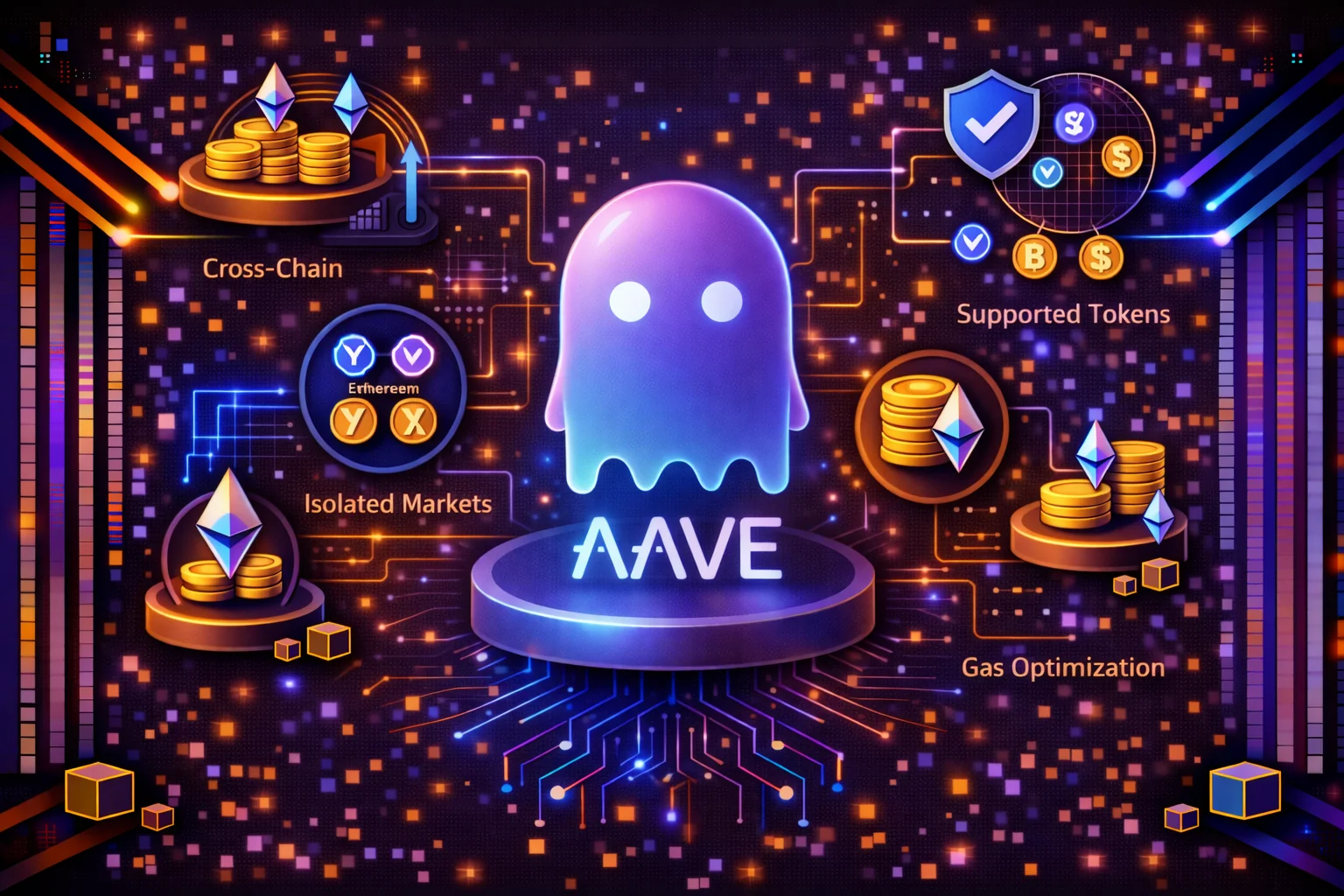
Aave V3 runs on Ethereum, Polygon, Arbitrum, Optimism, Avalanche, and Base with a standardised interface. Gas costs differ significantly: a supply transaction on Ethereum costs 5-15 USD in gas, versus 0.01-0.10 USD on Arbitrum or Polygon. Rates also differ by chain. USDC supply APY on Arbitrum frequently runs 0.5-1% higher than Ethereum mainnet because of lower liquidity and incentive programmes. Choose your chain based on position size: under 10,000 USD, Layer 2 is almost always more efficient.
Flash Loans
Flash loans let you borrow any amount without collateral, provided the loan plus a 0.05% fee (reduced from 0.09% in V2) is repaid within the same transaction. Practical uses include refinancing debt between protocols, swapping collateral to avoid liquidation, and executing cross-DEX arbitrage. Flash loans are developer tools; you interact with them via smart contracts or through front-ends like DeFiSaver that abstract the complexity for collateral swaps and debt refinancing.
How Aave Works: Lending and Borrowing Mechanics
Supply Side: How You Earn Interest
When you supply 10,000 USDC, you receive 10,000 aUSDC. These aTokens accrue interest in real time -- your balance increases every second without you doing anything. At 4% APY, your 10,000 USDC earns roughly 1.10 USDC per day. You can withdraw at any time (no lock-up) by converting aTokens back to the underlying asset. The only cost is the gas fee for the withdrawal transaction, which on Arbitrum is typically under $0.10.
Interest Rate Model: What Drives Your Rate
Aave uses utilisation-based rate curves. For example, when USDC pool utilisation sits at 70%, the variable borrow rate might be 5%. If utilisation spikes to 90%, the rate can jump to 15-20% because the curve has a "kink" designed to incentivise new supply. You should check the current utilisation rate before supplying or borrowing, as your effective APY depends on where the pool sits on this curve. High utilisation means better supply rates but worse borrow rates. Low utilisation means the opposite.
Liquidation: What Happens When Your Position Goes Wrong
Here is a concrete example. You deposit 10,000 USD of ETH and borrow 6,000 USDC (60% LTV). Your health factor starts at approximately 1.37. If ETH drops 25%, your collateral is worth 7,500 USD, and your health factor falls to approximately 1.03 -- still safe but dangerously close. A further 5% drop pushes you below 1.0, and liquidators can repay up to 50% of your debt (3,000 USDC) while claiming your ETH at a 5% discount. You lose approximately 3,150 USD of ETH but keep the 6,000 USDC you borrowed. To avoid this, you should monitor your health factor daily and consider setting up automated protection via DeFiSaver, which can trigger collateral top-ups or partial repayments before liquidation.
Variable vs Stable Rates: Which Should You Choose?
Variable rates fluctuate with pool utilisation and are typically 1-3% lower than stable rates during normal market conditions. For example, USDC variable borrow rate might sit at 5.5% while the stable rate is 7.5%. You should choose variable if you plan to repay within weeks and can tolerate rate spikes. Choose stable if you need predictable costs for months-long positions. You can switch between variable and stable rates at any time via the Aave dashboard for a single gas transaction.
Multi-Asset Collateral: Diversification for Your Positions
You can supply ETH, WBTC, and stablecoins simultaneously as collateral. The protocol calculates an aggregate health factor across all your supplied assets. For example, supplying 5,000 USD in ETH and 5,000 USD in WBTC as collateral is safer than supplying 10,000 USD in ETH alone, because a crash in one asset is partially offset by the other. This diversification approach helps you maintain healthier positions during single-asset drawdowns.
Supported Assets & Networks
Major Cryptocurrencies
Aave supports a comprehensive range of cryptocurrencies, with Bitcoin (WBTC), Ethereum (ETH), and major stablecoins (USDC, USDT, DAI). You can also use liquid staking tokens, such as stETH and rETH. This lets you earn staking rewards while using your assets as collateral for borrowing.
Stablecoins and Yield Optimisation
Stablecoins form the backbone of Aave's lending markets and represent the lowest-risk yield opportunity on the protocol. You can supply 10,000 USDC on Ethereum mainnet and earn approximately 3-5% APY with no lock-up period. For example, at 4% APY, your 10,000 USDC generates roughly 400 USDC annually, or about 1.10 USDC per day. If you want higher yield, you should consider Arbitrum or Polygon deployments, where USDC supply rates often run 0.5-1.5% higher due to incentive programmes. Using eMode, you can borrow USDT against USDC collateral at up to 97% LTV, enabling leveraged stablecoin yield strategies. However, you must factor in the borrow rate (typically 5-7%) versus the supply rate (3-5%) to ensure the spread is profitable after gas costs.
Multi-Chain Deployment
Aave operates on multiple blockchain networks, each offering unique advantages:
- Ethereum: The original and most liquid deployment with the widest asset selection
- Polygon: Lower transaction costs with fast confirmation times
- Arbitrum: Ethereum Layer 2 with reduced fees and faster transactions
- Optimism: Another Ethereum L2 option with growing ecosystem integration
- Avalanche: High-performance blockchain with competitive yields
- Fantom: Fast and low-cost transactions for smaller operations
Asset Risk Assessment
Each supported asset undergoes a risk assessment covering liquidity depth, volatility, and smart contract security. Risk parameters — loan-to-value ratios, liquidation thresholds, and liquidation bonuses — are assigned per asset and adjusted via governance as market conditions change. Higher-risk assets carry lower LTV ratios, requiring more collateral relative to the borrowed amount.
Yield Opportunities & Strategies
Simple Lending Strategies
The simplest approach: supply assets and earn interest without borrowing. Current typical ranges on Ethereum mainnet: USDC supply yields 3-5% APY, USDT 3-4% APY, DAI 3-5% APY. ETH supply yields 1-2% APY (lower because most ETH holders prefer liquid staking at 3-4% via Lido). WBTC supply yields 0.1-0.5% APY. Borrowing costs run higher: USDC borrow rates typically sit at 5-7% variable, ETH at 3-5%. On Arbitrum and Polygon, supply rates for stablecoins often run 0.5-1.5% higher than mainnet due to incentive programmes and lower liquidity. These rates fluctuate daily with utilisation; check the Aave dashboard for live figures before committing.
Leveraged Yield Farming
Advanced users can implement leveraged strategies by borrowing against their collateral to purchase additional yield-bearing assets. This amplifies both your potential returns and risks. You must carefully monitor health factors and market conditions. Leveraged strategies work particularly well with correlated assets in efficiency mode, where you can achieve higher leverage ratios.
Recursive Lending Strategies
Sophisticated users can implement recursive lending by repeatedly supplying and borrowing the same asset to amplify their exposure to interest rate differentials. This strategy requires careful management of liquidation risks and gas costs but can significantly enhance yields when supply rates exceed borrowing rates. Automated tools and protocols have emerged to simplify recursive lending execution.
Cross-Chain Yield Optimisation
Different Aave deployments on Arbitrum, Polygon, and Avalanche often offer different rates for the same assets than Ethereum mainnet. Bridging assets to higher-yield chains is viable but introduces additional risk (bridge security) and complexity. Gas costs on mainnet make small positions uneconomical — Arbitrum or Polygon are generally better choices for positions under $10,000.
Institutional Yield Strategies
Large-scale users can implement advanced strategies, including delta-neutral positions, basis trading, and systematic rebalancing. Aave's deep liquidity and reliable execution make it suitable for professional asset management.
Each supported asset undergoes rigorous risk assessment with liquidity analysis, volatility modelling, and security reviews. Risk parameters are set based on these assessments and adjusted via governance proposals.
AAVE Token & Governance
Governance Participation
AAVE token holders participate in protocol governance via the Aave Improvement Proposal (AIP) process. You can propose modifications to risk parameters, add new assets, upgrade smart contracts, or change protocol fees. The governance system ensures your community control over protocol evolution while maintaining security via time delays and emergency procedures.
Safety Module
The Safety Module functions as protocol insurance. AAVE holders who stake earn rewards (currently a portion of protocol fees) but accept slashing risk: up to 30% of staked tokens can be used to cover shortfall events. There is a 10-day cooldown period before staked AAVE can be withdrawn. This creates aligned incentives — stakers benefit from protocol growth but bear first-loss risk.
Token Utility
Beyond governance and safety module staking, AAVE tokens provide fee discounts for borrowers and can be used as collateral within the protocol. The token's utility continues to expand via governance proposals that enhance its role within the Aave ecosystem.
Tokenomics and Distribution
AAVE has a maximum supply of 16 million tokens, with distribution split amongst the team, the ecosystem reserve, and the community treasury. The protocol generates revenue via borrowing fees and liquidation penalties, with a portion potentially distributed to token holders via governance decisions.
Security & Risk Management
Audit History and Bug Bounties
Aave V3 was audited by Trail of Bits, SigmaPrime, ABDK, Peckshield, and OpenZeppelin before launch. Each major protocol upgrade undergoes independent code review. The Immunefi bug bounty programme offers up to 250,000 USD per critical vulnerability report. Aave's core lending contracts have never suffered a direct exploit since the protocol launched in 2020. The closest incident was a November 2022 market manipulation attempt on CRV markets, which governance resolved by freezing the affected asset. No user funds were lost.
Liquidation Risk: What It Actually Costs You
If your health factor drops below 1.0, liquidators repay up to 50% of your debt and receive your collateral at a 5-10% discount (the "liquidation bonus" varies by asset). For example, if you borrow 5,000 USDC against 10,000 USD of ETH and ETH drops 30%, a liquidator could repay 2,500 USDC of your debt and claim roughly 2,625 USD of your ETH collateral. You keep the remaining collateral minus the penalty. To avoid this, maintain your health factor above 1.5 at minimum. Use DeFiSaver or Instadapp automation to trigger collateral top-ups or debt repayment before liquidation thresholds are reached.
Oracle Dependencies
Aave uses Chainlink price feeds as its primary oracle infrastructure. Price updates trigger on a deviation threshold (typically 0.5-1%) or a heartbeat interval (usually 1 hour for major assets). The protocol includes fallback oracles and a Sentinel system that can pause markets if oracle prices deviate beyond expected bounds. The practical risk: during extreme network congestion, oracle updates can be delayed, potentially allowing liquidations at stale prices. This risk is higher on Ethereum mainnet during gas spikes.
Governance and Regulatory Risks
AAVE token holders control risk parameters, asset listings, and protocol upgrades via on-chain voting. Proposals require a minimum quorum and pass through a 24-48 hour timelock before execution, giving users a window to exit positions. The risk: a governance attack by a large token holder could theoretically alter parameters maliciously, though the timelock and community monitoring mitigate this. Regulatory risk is also real: several jurisdictions are developing DeFi-specific regulations that could restrict access to protocols like Aave. Front-end interfaces may implement geo-blocking, but the smart contracts themselves remain accessible to anyone with a wallet.
Safety Module
The Safety Module holds staked AAVE tokens (currently valued at several hundred million USD) as a backstop against shortfall events. Stakers earn rewards but accept up to 30% slashing risk. There is a 20-day cooldown period before staked AAVE can be withdrawn. If the protocol suffers a loss event, governance can vote to slash staked tokens to cover the deficit. This has never been triggered, but the mechanism creates meaningful first-loss capital that aligns staker incentives with protocol health.
User Experience & Interface
Web Application
The Aave web application provides an intuitive interface for managing lending and borrowing positions. Users can easily view available markets, current rates, and their portfolio health. The interface clearly displays key metrics, with health factors, liquidation prices, and available borrowing power.
Mobile Accessibility
Whilst Aave does not have a dedicated mobile app, the web interface is fully responsive and works well on your mobile device. You can manage your positions, monitor health factors, and execute transactions on your smartphone using mobile wallet apps such as MetaMask or WalletConnect-compatible wallets.
Integration Ecosystem
Aave integrates seamlessly with numerous DeFi protocols and portfolio management applications. Users can access Aave's lending pools via aggregators like 1inch, portfolio trackers like Zapper and DeBank, and yield optimisation protocols like Yearn Finance. This extensive ecosystem integration provides multiple pathways for interacting with Aave's lending and borrowing functionality.
Educational Resources
Aave provides comprehensive documentation, tutorials, and risk disclosures to help you understand the protocol. The community maintains additional educational content, with strategy guides, risk management tips, and market analysis. You should review these resources before using the protocol, as they are essential for safe and effective participation.
Aave vs DeFi Competitors
Aave vs Compound V3
Compound V3 (Comet) simplified its model to single-asset markets: you supply USDC and borrow against ETH, WBTC, or other collateral. Aave V3 maintains multi-asset pools where you can supply and borrow dozens of different tokens. Compound V3 typically offers 0.5-1% higher USDC supply rates because its concentrated model attracts more borrowing demand, but Aave provides more flexibility: eMode for correlated assets, flash loans, stable rates, and credit delegation. Compound has no equivalent to eMode's 93-97% LTV on correlated pairs. For straightforward USDC lending, Compound V3 may edge ahead on yield; for anything involving leveraged strategies, multiple collateral types, or advanced features, Aave is the stronger choice.
Aave vs MakerDAO
MakerDAO focuses specifically on generating the DAI stablecoin via collateralised debt positions (CDPs). Aave offers broader lending markets with multiple assets and more flexible borrowing options. MakerDAO provides deeper liquidity for DAI-related strategies, while Aave offers a broader range of yield opportunities.
Aave vs centralised Lending
Compared to centralised platforms like Nexo or YouHodler, Aave offers true self-custody and transparency but requires more technical knowledge. Centralised platforms may provide higher yields and better user experience, but introduce counterparty risk and require KYC compliance.
Aave vs Newer Protocols
Newer lending protocols, such as Euler and Morpho, offer innovations like permissionless listing and improved capital efficiency. However, Aave's battle-tested security, large liquidity pools, and established ecosystem provide advantages in terms of safety and reliability for most users.
Advantages & Disadvantages
Advantages:
- decentralised & Non-Custodial: Users maintain full control of their assets
- Battle-Tested Security: Extensive audits and proven track record
- Innovation Leader: Pioneered flash loans, stable rates, and efficiency mode
- Multi-Chain Support: Available on multiple blockchain networks
- Transparent Operations: All transactions and parameters are publicly visible
- Strong Governance: Community-controlled development and risk management
- Comprehensive Asset Support: Wide range of supported cryptocurrencies
- Capital Efficiency: Advanced features like eMode maximise capital utilisation
- No KYC Required: Permissionless access for global users
- Competitive Yields: Market-driven interest rates often exceed CeFi alternatives
Disadvantages:
- Smart Contract Risk: Potential for bugs or exploits in protocol code
- Liquidation Risk: Borrowers can lose collateral during market volatility
- Technical Complexity: Requires understanding of DeFi concepts and risks
- Gas Fees: Ethereum transactions can be expensive during network congestion
- No Insurance: No traditional deposit insurance unlike centralised platforms
- Oracle Dependencies: Reliance on external price feeds for liquidations
- Governance Risks: Token holder decisions could negatively impact protocol
- Regulatory Uncertainty: Potential future regulatory restrictions on DeFi
Getting Started with Aave
Wallet Setup
To use Aave, you'll need a compatible Web3 wallet like MetaMask, WalletConnect, or a hardware wallet like Ledger. Ensure your wallet is connected to the correct network (e.g., Ethereum, Polygon) and has sufficient native tokens to cover transaction fees.
First Supply Transaction: Step-by-Step
Here is exactly how to make your first deposit. First, navigate to app.aave.com and connect your wallet (MetaMask, Ledger, or WalletConnect). Next, select your network -- for example, Arbitrum for low gas fees. Then choose USDC from the asset list and click "Supply". Enter your amount (for instance, 500 USDC to start small), approve the token spend, and confirm the supply transaction. You should see aUSDC appear in your wallet within seconds. Your balance will start increasing immediately as interest accrues. The entire process takes under 3 minutes and costs roughly $0.05-0.15 in gas on Arbitrum.
Understanding Health Factors: A Practical Guide
Your health factor is the single most important number to watch if you borrow. A health factor of 2.0 means your collateral is worth twice what is needed to cover your debt -- very safe. A health factor of 1.2 means you are dangerously close to liquidation. You should aim to keep your health factor above 1.5 at all times. For example, if you supply 10,000 USD in ETH and borrow 5,000 USDC, your health factor starts around 1.65. An ETH price drop of 20% would push it to approximately 1.32 -- still safe but requiring attention. A 35% drop would trigger liquidation. You can check your health factor on the Aave dashboard at any time.
Risk Management: What You Must Do Before Borrowing
First, start with a small test position (500-1,000 USD) to learn the interface before committing larger amounts. Second, target 50-60% of the maximum LTV when borrowing, which gives you a buffer of 40-50% price decline before liquidation. Third, set up automated protection via DeFiSaver or Instadapp, which can trigger collateral top-ups or partial debt repayment before your health factor reaches 1.0. Finally, diversify your collateral across ETH and WBTC rather than concentrating in a single asset. You should review your positions at least weekly during volatile market conditions.
User Reviews & Community Feedback
Positive User Experiences
"I use Aave for ETH lending - the rates are better than CeFi, and the experience is smooth. The V3 efficiency mode has really improved my capital utilisation for stablecoin strategies." - Marek, Warsaw
"I borrowed against stETH via Aave V3, and the gas savings on Arbitrum are a game changer. Being able to earn staking rewards while borrowing against my ETH is incredibly powerful." - Leila, Dubai
" As a DeFi veteran, I appreciate Aave's consistent innovation and security focus. The governance process is transparent, and the protocol has handled market stress well over the years." - Chen, Singapore
Common User Concerns
"The interface can be overwhelming for beginners, and understanding all the risks requires significant research. I wish there were better educational resources for new users." - Sarah, London
"Gas fees on Ethereum can make small transactions uneconomical. I mostly use Aave on Polygon now, but the liquidity isn't as deep as mainnet." - Carlos, Mexico City
Community Sentiment
The Aave community is highly engaged and generally positive about the protocol's direction. Users appreciate the continuous innovation, strong security practices, and transparent governance. The protocol maintains high levels of trust within the DeFi community and is often recommended as a safe entry point for newcomers to decentralised lending.
Aave-Specific Protocol Innovations and Unique Features
aToken Economics and Yield Generation
aTokens represent deposits plus accrued interest. Each aToken maintains a 1:1 peg to its underlying asset while continuously increasing in balance as interest accumulates — no manual claiming or compounding required. aTokens can be used as collateral within Aave, transferred to other wallets, and integrated with yield aggregators like Yearn Finance. Interest calculations occur in real time based on utilisation rates.
Flash Loans
Aave pioneered flash loans — uncollateralised loans repayable within a single transaction (0.09% fee). They have become a standard DeFi primitive, enabling: debt refinancing without new capital, collateral swapping to avoid liquidation, cross-protocol arbitrage, and automated liquidation protection services. Developers access flash loans via Aave's smart contracts; the transaction reverts automatically if the loan plus fee is not returned.
Credit Delegation
Credit delegation allows users to delegate borrowing power to other wallet addresses without transferring collateral ownership. This enables institutional use cases — treasury management, structured lending between verified counterparties — and is enforced entirely by smart contract. The collateral owner retains custody; the delegate can borrow up to the delegated limit against that collateral.
Stable Rate Borrowing
Aave's stable rate provides predictable borrowing costs, algorithmically set based on market conditions at the time of borrowing. Stable rates can be rebalanced by the protocol if market rates diverge significantly. Users can switch between stable and variable rates at any time, making it practical to start with a variable rate and lock in stability when conditions favour it.
Ecosystem Partnerships and Strategic Integrations
DeFi Protocol Integrations
Aave serves as foundational infrastructure for numerous DeFi protocols, with yield aggregators, portfolio management platforms, and automated strategy protocols. These integrations create network effects that benefit Aave users by enhancing functionality and offering additional yield opportunities. Strategic partnerships with major DeFi protocols ensure interoperability and foster that strengthen the entire ecosystem.
Integration examples include Yearn Finance vault strategies, Instadapp automation tools, and DeFiSaver portfolio management features. You can access advanced yield strategies through these partnerships while maintaining your exposure to Aave's lending markets.
Institutional Service Provider Partnerships
Aave collaborates with institutional service providers — including custody solutions, compliance platforms, and professional trading tools — to help you access DeFi yields within an enterprise-grade framework. If you represent an institution, these partnerships bridge the gap between DeFi innovation and your compliance requirements.
You can integrate with Fireblocks for custody, Chainalysis for compliance, and institutional trading platforms that support Aave. These tools let you meet enterprise requirements while accessing DeFi yield opportunities.
Blockchain Network Deployments
Aave's multichain strategy means each deployment is optimised for that network's characteristics: Polygon and Arbitrum for low gas cost transactions, Avalanche for institutional liquidity, Optimism for Ethereum-equivalent security with lower fees. Each deployment may list different assets and offer different yield rates depending on local market demand.
Technical Specifications and Protocol Deep Analysis
Governance Process and Proposal Lifecycle
Aave governance follows a structured process: temperature check on the forums, formal Aave Improvement Proposal (AIP) submission, community discussion period, on-chain voting, and time-locked implementation. Each proposal undergoes economic impact analysis and security assessment before going to a vote. Voting power is proportional to AAVE token holdings, with delegation available for token holders who prefer to appoint trusted community members.
Protocol Upgrades and Security Review
Protocol upgrades go through independent code review and security assessment before deployment. Time-lock mechanisms — typically 24–48 hours between vote passing and execution — give users a window to exit positions if they object to a governance decision. Emergency pause mechanisms can halt specific assets or markets rapidly without a full governance vote in critical security situations.
AAVE Token Mechanics and Protocol Economics
Token Supply and Distribution
AAVE has a maximum supply of 16 million tokens. Distribution is split between the team (18%), the Aave Ecosystem Reserve (80%), and initial liquidity. The Ecosystem Reserve funds governance-approved incentive programs, safety module rewards, and grants. Protocol revenue comes from a portion of borrowing interest and liquidation penalties — a share of this revenue flows to Safety Module stakers via governance decision.
Protocol Revenue Model
Aave earns revenue on two streams: the spread between supply and borrow rates (a portion of interest paid by borrowers is retained as protocol reserve), and liquidation penalties (a cut of the discount paid to liquidators). The Aave DAO treasury controls these reserves. How they are deployed — distributed to stakers, used for grants, or retained — is decided by governance vote.
Ecosystem Composability
Aave's aTokens integrate directly with major DeFi protocols. Yearn Finance vaults use Aave pools as a yield source. Instadapp and DeFiSaver automate leverage and debt management on top of Aave positions. Curve and Convex liquidity strategies often deposit into Aave as one of several yield sources. This composability means a large share of Aave's TVL comes from protocol-to-protocol flows, not just direct retail deposits.
Conclusion
Aave remains the benchmark for DeFi lending infrastructure. Its $10B+ TVL, multi-chain presence, and V3 capital efficiency improvements reflect consistent protocol development over seven years. Flash loans, stable-rate borrowing, and credit delegation — features Aave introduced — are now industry standards replicated across competing protocols.
For users seeking passive yield, simple supply positions in USDC, USDT, or ETH on Arbitrum or Polygon offer competitive rates with manageable gas costs. The non-custodial model means no counterparty risk — only smart contract risk, which is mitigated by Aave's audit history and Safety Module backstop.
For borrowers, the health factor system requires active monitoring. The critical risk is collateral price decline triggering liquidation, particularly with volatile assets. Starting with conservative LTV ratios (50–60% of maximum) provides a buffer during market drawdowns. Monitor governance proposals closely — the community continues to adjust risk parameters, onboard new collateral types, and update interest rate models as market conditions change.
Sources & References
Frequently Asked Questions
- How does Aave V3 improve over V2?
- Aave V3 introduces several key improvements, with Efficiency Mode (eMode) for higher capital efficiency with correlated assets, Isolation Mode for safer listing of new assets, supply and borrow caps for better risk management, and enhanced cross-chain capabilities. These features make V3 more capital efficient and secure than previous versions.
- Is Aave safe for beginners?
- Whilst Aave is one of the safest DeFi protocols with extensive audits and a proven track record, it still carries smart contract and liquidation risks. Beginners should start with small amounts, use supported assets with deep liquidity, understand health factors, and enable monitoring tools. Consider starting with simple supply strategies before attempting borrowing or advanced strategies.
- What are the main risks of using Aave?
- The primary risks include smart contract vulnerabilities, liquidation risk for borrowers, oracle manipulation or failure, governance risks from token holder decisions, and regulatory uncertainty. Users should understand these risks and implement appropriate risk management strategies, with position monitoring and conservative collateralization ratios.
- How are interest rates determined on Aave?
- Aave uses algorithmic interest rate models based on supply-and-demand dynamics. When utilisation is low, rates decrease to incentivise borrowing. As utilisation increases, rates rise to encourage more supply and discourage excessive borrowing—creating automatic market balancing between lenders and borrowers.
- Can I use Aave without KYC or registration?
- Yes, Aave is a permissionless protocol that requires no registration, KYC, or personal information. You connect a compatible Web3 wallet to start using the platform. This provides privacy and global accessibility but also means users are fully responsible for their own security and risk management.
- Which blockchain networks support Aave?
- Aave is deployed on multiple networks, with Ethereum (the original and most liquid), Polygon (low fees), Arbitrum and Optimism (Ethereum L2S), Avalanche, and Fantom. Each deployment may have different supported assets and yields, allowing users to choose based on their preferences for fees, speed, and available opportunities.
- What is the AAVE token used for?
- The AAVE token serves multiple purposes: governance, voting on protocol proposals, staking in the Safety Module to backstop protocol risk (earning rewards but facing potential slashing), fee discounts for borrowers, and use as collateral within the protocol. Token holders effectively control the protocol's future development and risk parameters.
- How do flash loans work on Aave?
- Flash loans allow users to borrow assets without collateral as long as the loan is repaid within the same transaction. They're useful for arbitrage, liquidations, and complex DeFi strategies. Flash loans charge a small fee and automatically revert if not repaid, making them risk-free for the protocol while enabling advanced use cases.
- What happens if I get liquidated on Aave?
- If your health factor falls below 1.0, liquidators can repay part of your debt in exchange for your collateral at a discount (liquidation penalty). You lose some collateral, but your remaining position becomes healthy again. To avoid liquidation, monitor your health factor and maintain adequate collateral buffers, especially during volatile market conditions.
- How does Aave compare to centralised lending platforms?
- Aave offers true self-custody, transparency, and often competitive yields compared to centralised platforms like Nexo. Centralised platforms may offer a better user experience, better customer support, and more comprehensive insurance coverage. Choose Aave for decentralisation and transparency; choose centralised platforms for simplicity and support.
- Can I earn rewards beyond interest on Aave?
- Beyond lending interest, users can earn AAVE tokens via Safety Module staking, participate in governance decisions, and potentially receive rewards from ecosystem incentive programs. Some networks also offer additional token rewards for using Aave, creating multiple yield streams for active participants.
- What should I do if Aave's website is down?
- Since Aave is a decentralised protocol, you can interact with it via alternative interfaces, direct smart contract interaction, or integrated platforms like DeFiSaver or Instadapp. The protocol continues to operate even if the main website is unavailable, demonstrating the resilience of decentralised architecture.
Affiliate Disclosure
This page contains affiliate links. When you sign up through our referral links, we may earn a commission at no additional cost to you. This helps support our platform and allows us to continue providing valuable content and recommendations.