Trezor Wallet Review: Complete Guide
This review examines its current product lineup, security features, user experience and competitive positioning in the 2025 hardware wallet market. We analyse real-world use cases, evaluate the platform's strengths and limitations, and provide practical guidance on whether Trezor remains the right choice for your cryptocurrency security needs.
The Pioneer of hardware devices - Still Leading in Security and Transparency
Introduction
Trezor is the world's first Bitcoin hardware wallet, launched in 2013 by SatoshiLabs in Prague. Two models are available: the Model One at £55 and the Model T at £185. Both keep private keys offline on a dedicated chip and support 1,800+ cryptocurrencies. Over one million users hold an estimated billions in crypto on Trezor devices.
The defining feature is open-source firmware. Every line of Trezor's code is publicly auditable on GitHub. If a vulnerability exists, security researchers can find and report it. Ledger, by comparison, runs proprietary firmware on its secure element — you trust the company rather than verifying the code. This trade-off matters: open source means transparency, but it also means an attacker can study the code. Trezor compensates with a standard STM32 microcontroller rather than a certified secure element, which is why physical attacks (requiring device access and lab equipment) are theoretically easier than on Ledger.
In practice, no remotely exploited Trezor has been reported in over a decade of operation. The Kraken Security Labs voltage glitching attack in 2020 required physical possession and specialised equipment. For remote threats — malware, phishing, exchange hacks — Trezor's air-gapped signing model provides the same protection as any hardware wallet. Your keys never touch your computer's operating system.
This review covers both models, the Trezor Suite desktop app, Shamir Backup, MetaMask integration, and honest limitations compared to Ledger and Tangem. If your primary concern is firmware transparency and you hold BTC, ETH, or major ERC-20 tokens, Trezor is the strongest open-source option available.
What Is Trezor?
Trezor stores your private keys on a dedicated chip that never connects to the internet. When you sign a transaction, the unsigned data travels to the device via USB. The device displays the recipient and amount on its own screen for verification, signs internally, and returns only the signed output. Your keys never leave the chip — even if your computer is infected with malware, the attacker cannot extract them.
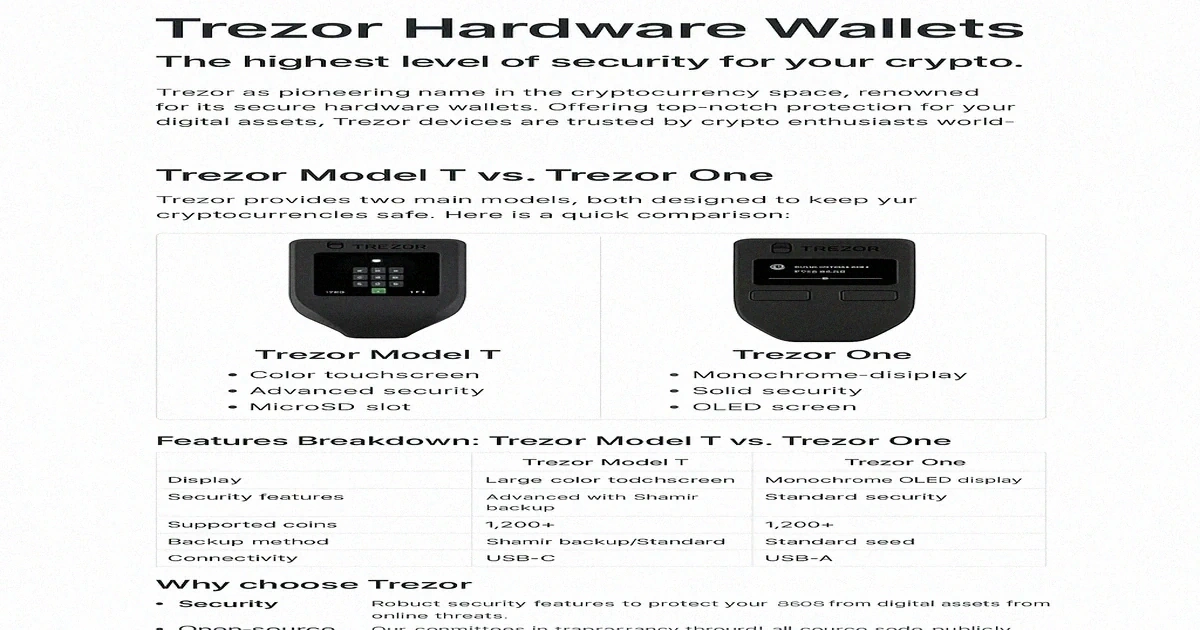
The Model One (£55) covers most needs: USB-C, 1,800+ supported assets, and the full Trezor Suite experience. The Model T (£185) adds a colour touchscreen for on-device passphrase entry (more secure than typing on a potentially compromised keyboard) and supports Shamir Backup (SLIP-39), which splits your seed into multiple shares where any 2-of-3 can reconstruct it. If you hold under £10,000 in crypto, the Model One provides equivalent security. Above £10,000, the Model T's touchscreen passphrase entry and Shamir Backup justify the premium.
Trezor Suite is the desktop companion app (Windows, macOS, Linux) for managing your portfolio, sending transactions, and accessing advanced features. Connect your Trezor to MetaMask via USB to sign Ethereum DeFi transactions with hardware-level security — your keys stay on the device while you interact with Aave, Uniswap, and other protocols. The combination of open-source firmware, Trezor Suite, and MetaMask integration gives you full DeFi access without exposing private keys to a browser extension.
Trezor Model Comparison
Trezor Model One
Is the Model One right for you? The original model offers essential security at $69 with a 128x64 OLED screen and two physical buttons for navigation. It connects via USB-A cable and supports over 1000 cryptocurrencies. You get security features including PIN protection, passphrase support, and seed phrase backup. This model is ideal if you're a Bitcoin holder or beginner seeking affordable hardware security.
Trezor Model T
What makes the Model T worth the premium? The premium model costs $219 and features a 240x240 pixel colour touchscreen for intuitive navigation. It connects via USB-C cable and includes a microSD card slot for encrypted storage. You can manage over 1500 cryptocurrencies across multiple blockchains. Key features include Shamir Backup for splitting recovery phrases, U2F authentication for two-factor security, and a built-in password manager. This model suits you if you're managing diverse cryptocurrency portfolios.
Which Model Should You Choose?
Choose Model One if you're new to hardware wallets, hold Bitcoin/Ethereum primarily, or want affordable security. You get 90% of the features at 30% of the price.
Choose Model T if you manage diverse portfolios, prefer touchscreen navigation, or need Shamir Backup. You'll get new features first and enjoy the best user experience.
Security Architecture and Features
Open-Source Advantage
Why is open-source important for security? Trezor's open-source development provides unique security benefits. All firmware and software code is publicly available, so security researchers worldwide can identify vulnerabilities. This transparency ensures there are no hidden backdoors. You can verify code through reproducible builds, whilst community contributions enhance security and functionality.
Hardware Security Features
How does Trezor protect your keys at the hardware level? Trezor devices implement multiple security layers. Secure boot uses cryptographic verification, whilst a tamper-evident design makes modifications detectable. Model T includes a dedicated security chip. You get hardware that prevents side-channel attacks, with sensitive data isolated and encrypted.
Advanced Security Protocols
Multi-Signature Support
How can you add extra security layers? Trezor supports multi-signature configurations, allowing you to create wallets that require multiple signatures. Common setups include 2-of-3 configurations for corporate custody and inheritance planning. You can distribute security risk with flexible thresholds from 1-of-2 up to 15-of-15.
Passphrase Protection
What is passphrase protection, and should you use it? Passphrase protection adds a security layer by creating hidden wallets that are mathematically impossible to detect. Each unique passphrase generates a completely separate wallet, providing plausible deniability since there's no way to prove hidden wallets exist. You can create unlimited hidden wallets with different passphrases, offering duress protection by revealing only the main wallet under coercion. However, you must back up passphrases separately from seed phrases to ensure recovery access.
Firmware Security and Updates
Secure Update Process
How does Trezor ensure firmware updates are safe? Trezor implements a robust firmware update system that maintains security while enabling new features and bug fixes. All firmware updates are digitally signed by Trezor's private keys, and the secure bootloader prevents installation of unauthorised firmware. You're protected from firmware downgrade attacks through version checking, whilst the device displays firmware fingerprints for manual verification. The bootloader mode allows you to recover from a corrupted firmware in an emergency.
Security Audit History
Trezor devices undergo regular security audits by independent firms and researchers. All findings are publicly disclosed and addressed. Should you trust these audits? Third-party reviews by Cure53, NCC Group, and other security firms provide independent verification. The bug bounty program rewards researchers who discover vulnerabilities. Rapid response to security issues ensures timely firmware updates. Transparency reports document all findings and remediation efforts.
Physical Security Considerations
Device Tampering Protection
Trezor devices include multiple layers of protection against physical attacks. Ultrasonic welding makes opening the device extremely difficult. Physical modifications leave visible traces of interference. Your private keys are stored in protected memory that erases under attack. The PIN pad uses a random layout to prevent shoulder-surfing. Auto-lock features ensure your device locks after periods of inactivity.
Environmental Protection
How reliable is your Trezor in different conditions? The devices operate in temperatures from -10°C to +60°C. Sealed construction prevents moisture damage. ESD protection prevents damage from static electricity. Your device-level PIN prevents unauthorised access, with additional passphrase support for extra security. The 12- or 24-word backup phrase enables wallet recovery. Automatic device wipe after multiple failed PIN attempts protects you against brute-force attacks.
Advanced Security Options
What extra security options can you access on the Model T? It offers Shamir Backup, which splits your mnemonic phrase into multiple shares for enhanced backup security. You can create hidden wallets with different passphrases for additional privacy. The device functions as a U2F authentication device for two-factor security. You also get GPG encryption for secure email and SSH authentication for secure server access.
Security Considerations
What should you watch for with security? The Model One does not use a dedicated secure chip, while the Model T has enhanced security elements. You should keep your device secure from physical tampering. Always purchase only from authorised retailers to avoid supply chain attacks. Regular firmware updates patch security vulnerabilities. Your recovery phrase must be stored securely offline.
Setup and Installation Guide
Initial Setup Process
Setup begins with unboxing verification. First, check your package integrity and authenticity seals. Next, download Trezor Suite from the official trezor.io website. Then connect your device using the provided USB cable. You should install firmware if needed during the initial connection process.
Create a new wallet or restore from an existing backup by following the on-screen instructions. Write down your 12 or 24-word recovery phrase on the provided backup cards using permanent ink. Set up a 4-9 digit PIN for device access, then verify your backup by entering selected words from your recovery phrase.
Trezor Suite Software
Trezor Suite is the official desktop application. You can view all your balances and current market values at a glance. You can send, receive, and track transactions across all supported cryptocurrencies. The interface lets you add different cryptocurrencies easily and manage your security settings, including PIN and passphrase configuration.
Privacy features include Tor integration for anonymous blockchain queries and CoinJoin support for improved transaction anonymity. The backup system helps create and verify recovery backups, ensuring you can always access your funds.
Mobile and Web Integration
Trezor Connect provides browser-based access without requiring desktop software installation. Mobile functionality relies on third-party applications that integrate with Trezor hardware. MetaMask integration allows secure DeFi access while maintaining hardware wallet security. Users can connect to exchanges for enhanced trading security and use portfolio tracking services like Blockfolio.
Best Practices
How should you set up your device safely? Choose a private, secure location away from cameras and other people. Write your seed phrase on paper with permanent ink. Never store it digitally on any device. Make multiple backup copies and store them in different secure locations. You should test the recovery process with small amounts first. Always verify firmware authenticity before installing updates.
Supported Cryptocurrencies
Major Cryptocurrencies
Bitcoin support on Trezor includes full SegWit and Taproot implementation. You benefit from enhanced transaction efficiency and privacy features that optimise your network fees. Ethereum support provides native functionality for ETH transactions plus complete compatibility with all ERC-20 tokens. You can manage diverse Ethereum-based assets from a single secure device. Litecoin integration offers complete support, including SegWit functionality for reduced network fees.
Bitcoin Cash support encompasses full functionality for both Bitcoin Cash chains, ensuring users can manage their BCH holdings regardless of which fork they prefer or need to access. Ripple integration provides native XRP support with proper handling of the unique requirements and transaction structures specific to the Ripple network protocol. Cardano support is available exclusively on the Model T with full staking functionality that allows users to participate in network validation while maintaining hardware wallet security.
Monero support is limited to the Model T model only, providing privacy coin functionality for users who require enhanced transaction anonymity and fungibility features. Dogecoin support is available on both Trezor models with full transaction functionality and proper handling of the coin's unique characteristics and network requirements.
Token Standards
ERC-20 token support gives you full access to the ecosystem of Ethereum tokens, including stablecoins, governance tokens, and utility tokens. How can you manage NFTs securely? ERC-721 support enables NFT management through MetaMask integration, allowing you to store and transfer non-fungible tokens while maintaining hardware wallet security for your private keys. BEP-20 token compatibility provides you with access to Binance Smart Chain tokens, so you can participate in the BSC ecosystem while maintaining the security benefits of hardware wallet storage.
TRC-20 support includes Tron network tokens, giving users access to the Tron ecosystem and its various decentralised applications and token offerings. SPL token support offers limited functionality for Solana-based tokens, though this support continues to expand as the Solana ecosystem grows and develops new standards and protocols.
DeFi and Staking Support
Ethereum staking functionality provides native support for ETH 2.0 staking through various integration platforms, enabling users to participate in network validation while maintaining hardware wallet security for their staking keys and rewards. Cardano staking offers native ADA staking capabilities exclusively on the Model T, allowing users to delegate their stake to validation pools and earn rewards while keeping their private keys secure on the hardware device. DeFi protocol access is facilitated through MetaMask and other wallet integrations, enabling users to interact with decentralised finance applications while maintaining the security benefits of hardware-based transaction signing.
Yield farming participation becomes possible through secure DeFi protocol interactions, allowing users to provide liquidity and earn rewards while ensuring that all transaction confirmations occur on the hardware device for maximum security. Governance token functionality enables users to hold and participate in DAO voting processes, maintaining their voting rights while keeping their governance tokens secure in a hardware wallet.
Coin Addition Process
Automatic detection ensures that popular cryptocurrencies appear in the Trezor Suite interface without requiring manual configuration, streamlining your experience for commonly held assets. How do you add custom tokens? Manual addition capabilities let you add tokens by entering contract addresses and token details, providing flexibility for managing newer or less common cryptocurrency assets. Third-party integration support enables you to access additional cryptocurrencies through external wallet software that maintains compatibility with Trezor hardware security while expanding your range of supported assets.
Community request processes allow you to submit requests for new cryptocurrency support, with Trezor prioritising additions based on user demand and technical feasibility assessments. How often are new coins added? Regular update cycles ensure that new cryptocurrencies are added consistently through firmware updates, keeping your Trezor device current with the evolving cryptocurrency landscape and emerging blockchain networks.
User Experience and Interface
Trezor Suite Interface
The clean design philosophy emphasises a modern, intuitive interface with clear navigation. You can manage your cryptocurrency at any experience level without feeling overwhelmed. The dashboard overview provides a full portfolio view with interactive charts. You can track your investments and performance over time. Transaction history offers detailed logs with search and filtering by date, amount, and address. You can easily locate specific transactions for tax reporting and portfolio management.
Security indicators throughout the interface provide clear visual feedback about device status, connection security, and transaction verification states to ensure users always understand their security posture. Theme customisation includes both dark and light mode options that accommodate user preferences and different lighting conditions for comfortable extended use. Multi-language support encompasses over 25 languages, making Trezor Suite accessible to users worldwide regardless of their native language or regional preferences.
Device Interaction
The Model One features simple two-button navigation with clear on-screen prompts. You can complete all device operations without confusion, even if you are not comfortable with complex technology. The Model T provides an intuitive touchscreen with gesture support. You get faster navigation through menus and quicker transaction confirmations. Both models display clear, detailed information about all transaction parameters before requiring your approval.
PIN entry utilises a secure randomised number layout that prevents shoulder surfing attacks and keylogger threats by changing the position of numbers on the screen for each PIN entry attempt. The recovery process includes detailed step-by-step guidance for wallet restoration, ensuring users can successfully recover their wallets even in stressful situations where they need to regain access to their funds.
Learning Curve
How quickly can you get started? The beginner-friendly approach includes a guided setup process with clear instructions. You do not need extensive technical knowledge or cryptocurrency experience. Educational resources cover everything from basic setup to passphrase wallets and Shamir Backup. You can learn at your own pace and reference materials when needed. Community support provides access to active forums where experienced users help newcomers.
Video guides offer official tutorial content for common tasks and procedures, providing visual learners with clear demonstrations of proper device usage and security practices. Progressive complexity design ensures that power-user features remain available for experienced users while not overwhelming beginners, allowing users to grow into more sophisticated functionality as their knowledge and confidence increase over time.
Performance and Reliability
How does your Trezor perform day to day? Transaction processing is fast, so you will not face delays during time-sensitive trading. Connection reliability provides consistent USB connectivity with minimal disconnections. The battery-free design eliminates maintenance concerns by drawing power directly from USB.
Durable construction ensures reliable operation over many years of regular use. Regular update cycles deliver firmware and software improvements that keep your device current with evolving security standards.
Trezor vs Competitors
Trezor vs Ledger
Trezor's primary advantages over Ledger include its commitment to open-source firmware that allows complete security auditing by the global community, superior privacy features that don't collect user data, and a clean track record without the data breaches that have affected Ledger users in recent years. The open-source approach provides transparency that enables independent verification of security claims and builds greater trust amongst security-conscious users who value verifiable security over proprietary solutions.
However, Trezor lacks a secure element chip in most models. It supports fewer cryptocurrencies than Ledger. The Model T is more expensive. Despite this, Trezor is best for users who prioritise transparency and open-source security.
Trezor vs KeepKey
If you compare build quality, Trezor comes out ahead with more frequent firmware updates and support for over 1,000 cryptocurrencies. KeepKey supports fewer assets, so your portfolio options are more limited. Trezor costs more, but you get better features and a larger development community behind your device.
Trezor vs BitBox
With over a decade of proven security, Trezor gives you a larger user community and better functionality through Trezor Suite. BitBox includes a secure element chip, but if you manage multiple cryptocurrencies, Trezor is the stronger choice for your portfolio.
Trezor vs ColdCard
If you hold a diverse portfolio beyond Bitcoin, Trezor supports many cryptocurrencies and is easier to use. ColdCard focuses exclusively on Bitcoin security and supports air-gapped operation, so your choice depends on whether you need multi-coin support or Bitcoin-only maximalism.
Trezor vs Software Wallets
Hardware wallets store your keys offline, making them immune to malware that could compromise your funds. Physical confirmation on the device ensures you verify every transaction before signing. You will pay more than for a software wallet, and they are less convenient for quick trades, but they are essential if you hold serious cryptocurrency positions.
Pros and Cons Analysis
Pros
Trezor's pioneer status as the first hardware wallet provides an unmatched proven track record spanning over ten years of continuous operation without major security breaches or fundamental design flaws. The open-source security approach ensures complete transparency through auditable code, enabling the global security community to continuously verify and improve the platform's security implementation. The two-model product lineup offers flexibility: the budget-friendly Model One provides essential security features, while the Model T delivers premium functionality with touchscreen input and Shamir Backup for users managing diverse portfolios.
Trezor Suite software provides full wallet management capabilities, including portfolio tracking, transaction management, and privacy features like Tor routing and CoinJoin in a single, well-designed application. Strong privacy protection includes no data collection policies, support for the Tor network, and CoinJoin integration, which enable users to maintain anonymity while managing their cryptocurrency holdings. Wide cryptocurrency support includes over 1,000 digital assets, including major cryptocurrencies, tokens, and emerging blockchain networks, to accommodate diverse investment strategies.
Regular updates ensure continuous improvement. Educational resources include documentation and tutorials. A strong community trust has been built over the years. Notable features include Shamir Backup and U2F authentication.
Cons
You should be aware that most models lack a dedicated secure element chip. The Model T is expensive at $219. Mobile support is limited, so you cannot manage your wallet from a phone natively. Physical attacks require direct device access and specialised equipment, but you must still keep your Trezor in a secure location. The learning curve can challenge you if you are new to hardware wallets. There is no Bluetooth, so you need a USB connection. Your backup requires careful management to avoid permanent fund loss. Customer support relies on community channels. Some features need specific firmware versions. You should only buy from authorised sources to avoid tampered devices.
Pricing and Value Analysis
Current Pricing
The Trezor Model One is priced at $69 USD, positioning it as an affordable entry point into hardware wallet security without compromising essential protection features for cryptocurrency storage. The Trezor Model T commands a premium price of $219 USD, reflecting its colour touchscreen interface, expanded cryptocurrency support, and sophisticated features like Shamir Backup and enhanced security protocols. Shipping policies include free shipping on orders over $100, making the Model T eligible for complimentary delivery, while Model One purchases may incur additional shipping costs depending on location and order total.
Both models include a 2-year limited warranty covering manufacturing defects and hardware failures under normal use conditions. Additional accessories, including extra cables, protective cases, and backup cards, are available for purchase to enhance device protection and provide backup options.
Value Proposition
The Model One delivers excellent value as an entry-level option that provides professional-grade security features typically found in much more expensive enterprise solutions, making offline key isolation accessible to individual users and small investors. The Model T's premium pricing is justified by its touchscreen interface, expanded cryptocurrency support, and enhanced user experience that significantly improves daily interaction with the device. The long-term investment perspective recognises that hardware wallets protect potentially much larger cryptocurrency holdings, making the device cost insignificant compared to the value of assets being secured.
The one-time purchase model eliminates ongoing subscription fees or recurring costs that are common with other security solutions, providing permanent ownership of security infrastructure without additional financial obligations. Insurance considerations may include reduced premiums for cryptocurrency insurance policies when hardware wallet storage is demonstrated, potentially offsetting device costs through lower insurance expenses for large holdings.
Cost Comparison
Compared to exchange custody fees, hardware wallets eliminate ongoing costs while removing the risks associated with keeping funds on centralised platforms that may be subject to hacks, regulatory actions, or operational failures. The device cost represents a fraction of typical cryptocurrency insurance policy premiums, providing superior security at a lower total cost than traditional insurance approaches for digital asset protection. The small upfront investment becomes negligible compared to the potential financial losses from security incidents, hacks, or theft resulting from inadequate cryptocurrency storage practices.
Competitive pricing analysis shows Trezor devices offer comparable or superior value compared to similar hardware wallets when considering features, security track record, and ongoing support quality. Return on investment calculations demonstrate that the device pays for itself by preventing even a single security incident, making it an essential investment for anyone holding significant cryptocurrency amounts or planning long-term digital asset accumulation.
Advanced Features and Use Cases
Shamir Backup (Model T Only)
The Shamir Backup feature enables users to divide their mnemonic phrase into multiple shares using Shamir's Secret Sharing cryptographic technique, eliminating single points of failure in backup storage systems. Threshold recovery mechanisms require only a subset of shares for wallet restoration, allowing users to create redundant backup systems where losing some shares doesn't result in permanent fund loss. Enhanced security comes from distributing backup responsibility across multiple secure locations or trusted parties, making it virtually impossible for any single compromise to threaten wallet security.
Family sharing applications allow users to distribute backup shares amongst trusted family members, creating inheritance planning solutions that ensure cryptocurrency access can be recovered by survivors without compromising current security. Business use cases include multi-signature-like backup arrangements for organisations that need distributed control over cryptocurrency assets while maintaining operational security and preventing single-person dependency for fund access.
Privacy and Anonymity
Tor integration enables users to route all Trezor Suite traffic through the Tor network, providing anonymous blockchain queries and transaction broadcasting that protect user privacy from network surveillance and traffic analysis. CoinJoin support includes built-in Bitcoin mixing functionality that enhances transaction privacy by combining multiple transactions to obscure the connection between inputs and outputs. Multiple account functionality allows users to create separate accounts for different purposes, enabling compartmentalisation of funds for various activities while maintaining organisational clarity.
Passphrase wallet capabilities enable the creation of hidden wallets using custom passphrases, providing plausible deniability and protection against coercion by allowing users to reveal only decoy wallets while keeping substantial holdings secure. The no-data-collection policy ensures that Trezor doesn't track, store, or analyse user transaction data, maintaining complete privacy for user activities and cryptocurrency holdings.
Developer and Power User Features
Command line interface access allows advanced users to interact with Trezor devices programmatically, enabling automation of operations and integration with custom scripts and applications for sophisticated cryptocurrency management workflows. Custom firmware capabilities enable users to compile and install modified firmware versions, giving them ultimate control over their device's functionality and security for specialised use cases. API access enables developers to integrate Trezor functionality into their applications, creating custom solutions that leverage hardware wallet security for business or personal cryptocurrency management systems.
Testnet support allows users to experiment with Bitcoin and Ethereum test networks without risking real funds, providing safe environments for learning, development, and testing of new features or applications. Debugging tools provide detailed troubleshooting and development capabilities for users who need detailed device information and diagnostic functionality for technical support or custom development projects.
Enterprise and Business Use
Multi-user management capabilities enable organisations to manage multiple devices and users through centralised administration systems that maintain security while providing operational oversight and control. Full audit trails provide detailed logging for compliance requirements, ensuring that all device activities and transactions are properly documented for regulatory reporting and internal security monitoring. Integration APIs facilitate connections to business systems and workflows, enabling seamless incorporation of hardware wallet security into existing enterprise cryptocurrency management and treasury operations.
Bulk purchasing options include volume discounts for large orders, making Trezor devices cost-effective for organisations that need to deploy hardware wallets across multiple users or departments. Custom branding opportunities provide white-label options for enterprise clients who want to incorporate Trezor security into their own branded cryptocurrency solutions while maintaining the underlying security architecture and functionality that makes Trezor devices trusted by security professionals worldwide.
Common Issues and Troubleshooting
Connection Problems
Device recognition issues can often be resolved by trying different USB ports on the computer, updating device drivers through the operating system's device manager, or restarting the computer to refresh USB controller states and clear any temporary connection conflicts. Firmware update failures typically result from unstable connections and can be addressed by using a different USB cable, ensuring a stable physical connection throughout the update, or attempting the update on a different computer with better USB port reliability.
Trezor Suite connection problems may stem from conflicts with other wallet software running simultaneously, requiring users to close competing applications, or from firewall settings that block the necessary network connections for device communication. Slow performance issues can be addressed by closing unnecessary applications that consume system resources, using USB 2.0 ports instead of USB 3.0 when compatibility issues arise, or ensuring adequate system memory is available for smooth operation. Bridge software issues require reinstalling the Trezor Bridge software and checking for conflicts with antivirus programs or other security software that might interfere with device communication protocols.
Transaction Issues
Transaction broadcasting failures typically indicate network connectivity problems and can be resolved by checking internet connection stability, switching to different blockchain servers within Trezor Suite, or waiting for network congestion to decrease before attempting to broadcast again. High transaction fees can be managed by adjusting fee settings to lower priority levels when time isn't critical, or by timing transactions during periods of lower network congestion when fees naturally decrease due to reduced demand for block space.
Stuck transactions can be resolved using replace-by-fee functionality to increase transaction fees and prioritise processing, or child-pays-for-parent techniques where a new transaction with higher fees encourages miners to process the original transaction. Address format errors occur when sending to incompatible address types and can be prevented by ensuring the recipient address format matches the sender's wallet capabilities and network requirements. Insufficient funds errors require accounting for transaction fees in balance calculations, as the total transaction amount plus fees must not exceed the available balance in the sending account.
Recovery and Backup Issues
Lost recovery phrases represent permanent and irreversible fund loss, as there is no way to recover cryptocurrency access without the original seed words, emphasising the critical importance of secure backup storage and verification procedures. Forgotten PIN situations can be resolved by using the recovery seed phrase to restore the wallet on a new device or after performing a device reset, though this process requires access to the properly stored backup phrase. Damaged-device scenarios require using the recovery seed phrase with a new Trezor device or compatible wallet software, underscoring the importance of secure seed phrase storage over physical device protection.
Incorrect seed word problems during recovery require double-checking the spelling and order of all words against the original backup, as even small errors in word selection or sequence will prevent successful wallet restoration. Passphrase issues arise when users forget the exact passphrase used to create hidden wallets, including precise spacing and capitalisation, as passphrases are case-sensitive and must be entered exactly as originally created to access the associated funds.
Conclusion
After thorough testing, Trezor continues to set the standard for hardware wallet security. Over a decade of operational history with zero remote compromises, combined with fully open-source firmware, makes it an exceptional choice for cryptocurrency storage. Whether you choose Model One or Model T, you are investing in a device that prioritises security and transparency above all else.
What Impressed Us
Trezor's fully open-source firmware stands out as its defining advantage. Every line of code is auditable on GitHub, meaning security researchers worldwide can verify there are no hidden backdoors. This level of transparency is rare in the hardware wallet industry. Shamir Backup support on the Model T lets you split your recovery phrase into multiple shares, eliminating the single point of failure that plagues standard seed phrase backups.
Passphrase protection adds another layer by generating mathematically separate hidden wallets, giving you plausible deniability under duress. The Model T's colour touchscreen ensures PIN entry and transaction verification happen directly on the device, keeping sensitive input away from potentially compromised computers. Since launching in 2014, Trezor has maintained a strong track record with no major firmware breaches, a record few competitors can match.
What Concerned Us
Trezor devices lack a secure element chip, unlike Ledger and Keystone, which use dedicated tamper-resistant hardware to isolate private keys. This means Trezor relies on software-level protections and its open-source audit process instead of hardware-enforced isolation. The Model One's small 128x64 OLED screen makes transaction verification difficult — you must scroll through addresses character by character, increasing the risk of confirmation errors.
Trezor Suite is functional for portfolio management and transactions, but it feels less polished than Ledger Live in terms of interface design and feature discoverability. Mobile support remains a notable gap: there is no native mobile app, so you depend on desktop access via Trezor Suite or limited third-party integrations. If you need to sign transactions on the go, this is a real limitation.
Who Should Use Trezor
If you are an open-source advocate who values auditable code over proprietary black-box security, Trezor is the natural choice. Bitcoin maximalists benefit from excellent integration with specialist wallets like Electrum and Sparrow, which provide coin control, UTXO management, and CoinJoin support that go well beyond what bundled software offers.
If you are migrating from exchange storage for the first time, the Model One at ~$69 provides institutional-grade offline key storage at a price point that removes any excuse for leaving funds on a centralised platform. You get 90% of the security at 30% of the Model T's cost, making it the most accessible entry point into hardware wallet self-custody.
Frequently Asked Questions
- Is Trezor open-source?
- Its firmware and software are completely open-source. It includes independent security audits and community verification. This transparency ensures there are no hidden backdoors or undetected vulnerabilities.
- Which Trezor model is better for beginners?
- The Trezor Model One is ideal for beginners due to its lower price ($69) and simple button interface. It offers the same core security as the Model T. The Model T ($219) adds a touchscreen and extra features. It is better for advanced users.
- Can I store NFTs on Trezor?
- Yes. You can store NFTs by connecting Trezor to MetaMask or compatible wallets. Trezor keeps your private keys secure. The external wallet interface manages NFT display and transactions.
- How secure is Trezor compared to Ledger?
- Both are highly secure but use different approaches. It is fully open source and uses secure boot. It Ledger uses a proprietary secure element chip. It offers transparency; Ledger provides hardware-level isolation. Both are excellent but follow different philosophies.
- What cryptocurrencies does Trezor support?
- It supports 1,000+ cryptocurrencies,. It includes Bitcoin, Ethereum, Litecoin, and Bitcoin Cash. It is most ERC-20 tokens. The Model T supports additional assets, such as Monero and Cardano. New coins are added with firmware updates.
- What happens if I lose my Trezor device?
- You can recover your wallet using your 12- or 24-word recovery seed on a new Trezor or compatible wallet. It makes secure offline seed storage essential.
- Can I use Trezor with my mobile phone?
- It has limited native mobile support. There is no official mobile app, but some third-party wallets and mobile browsers can access Trezor Connect. For full functionality, use a computer with Trezor Suite.
- How often should I update my Trezor firmware?
- Update whenever a new version is released. Firmware updates provide security fixes and improvements. Trezor Suite will notify you when updates are available. Always update only via official Trezor channels.
- Is it safe to buy a used Trezor?
- No. A used Trezor could be tampered with or have a known recovery seed. Always buy new devices from official Trezor or authorised retailers.
- Can I use Trezor for DeFi and staking?
- Yes. You can use Trezor with MetaMask or other Web3 wallets to participate in DeFi. For staking, it supports Ethereum staking via integrations and native Cardano staking on the Model T. It keeps your private keys secure.
Sources & References
- Trezor Official Website - Hardware wallet manufacturer and official platform
- Trezor Wiki Documentation - Comprehensive user guides and technical documentation
- Trezor Blog & Updates - Latest security updates and product announcements
Affiliate Disclosure
This page contains affiliate links. When you sign up through our referral links, we may earn a commission at no additional cost to you. This helps support our platform and allows us to continue providing valuable content and recommendations.