Crypto Lending vs Staking: 2026 Comparison
Crypto lending pays interest from borrowers on platforms like Aave or Nexo, typically 2–5% on stablecoins. Staking pays protocol rewards for securing proof-of-stake networks, typically 3–4% on ETH. The two yields come from different sources, carry different risks, and suit different holdings — this guide compares them side by side.
Introduction
Crypto lending and staking both pay yield, but the money comes from fundamentally different places. Lending yield is interest paid by borrowers who post collateral on a DeFi protocol such as Aave or Compound, or on a custodial platform such as Nexo or Binance Earn. Staking yield is protocol-issued rewards paid to validators — and the delegators who back them — for securing a proof-of-stake network such as Ethereum, Solana, or Cosmos. One is a credit market between lenders and borrowers; the other is direct participation in running the blockchain itself.
Typical 2026 yield ranges sit in this band: Aave V3 stablecoin supply rates fluctuate between roughly 2% and 5% depending on utilisation, ETH native staking pays around 3–4%, and liquid staking tokens such as Lido's stETH or Rocket Pool's rETH track that figure with a small fee deducted. Rates move daily — check current figures on each platform before committing. Bitcoin has no native staking, so BTC yield exists only via lending or wrapped-token strategies with their own additional risks.
The risk shape is different too. Lending exposes you to smart-contract exploits (Euler Finance lost about $197M in March 2023 before the attacker returned most of it), oracle failures, and liquidation cascades during volatility.
Staking exposes you to slashing if a validator misbehaves — penalties are typically fractions of an ETH rather than full principal loss — plus depeg risk on liquid staking tokens, since stETH traded as low as 0.93 ETH briefly in June 2022. Custodial lending on platforms like Celsius or BlockFi added a third risk (insolvency), which is why self-custody DeFi protocols have become the default for sophisticated users. The right comparison is not "safer" but "different failure modes you can mitigate through platform choice and position sizing".
The short answer most readers want: stake assets you plan to hold long-term on their native chain (ETH, SOL, DOT); lend stablecoins and short-duration positions where you want flexible access. If you hold ETH and want both yields at once, stake through Lido to receive stETH, then deposit stETH as collateral on Aave — Aave's E-Mode lets you borrow stablecoins against it at high loan-to-value.
The rest of this guide explains each mechanism in depth, the specific risks with named historical examples, yield ranges across major assets, and a decision framework that maps your holding period and risk tolerance to a concrete allocation. Tables, worked £-denominated examples, and cluster links to deeper material on each side are included throughout.
Overview: Two Paths to Crypto Passive Income
Lending and staking both produce yield, but the underlying economics sit in different worlds. Lending is a credit market — you supply an asset, a borrower posts collateral worth more than they borrow, and an interest rate balances supply against demand. When utilisation is high, rates rise. When borrowers are scarce, rates fall. Nothing about the underlying network changes; you are simply participating in a two-sided market.
Staking is participation in network consensus. Proof-of-stake chains require validators to lock tokens as an economic bond against misbehaviour. The protocol pays validators (and their delegators) new tokens plus transaction fees for producing valid blocks. Rewards are largely determined by the protocol's monetary policy — Ethereum issues roughly inverse-square-root of total stake, Solana has its own schedule, Cosmos uses a dynamic rate targeting a participation goal — not by demand from external borrowers.
The 2026 landscape for both has matured considerably versus the 2021–2022 peak. Custodial lending has consolidated around a few regulated players (Nexo, YouHodler, exchange-based products) after the CeFi collapse of 2022 removed around $20B of retail deposits from the ecosystem.
DeFi lending TVL has recovered to roughly $40–50B, concentrated in Aave, Compound, Morpho, and Spark. Liquid staking has become the default for ETH — over 40% of all staked ETH flows through LSTs, with Lido and Rocket Pool the two largest providers. Each strategy still carries distinct risks and rewards, which the rest of this comparison details.
Understanding the Fundamentals
What is Digital Asset Lending?
Digital asset lending means you deposit crypto into a platform where borrowers can access it, typically for trading, arbitrage, or opening leveraged positions. You earn interest paid by those borrowers. In DeFi, the process is permissionless and verifiable on-chain: Aave's contracts hold your assets, match them against borrowers who have posted collateral, and credit you a claim token (aUSDC, aETH) that represents your deposit plus accrued interest. In custodial CeFi, a company operates the deposit-and-lend flow off-chain, which means you are trusting that company's balance sheet rather than a smart contract.
The key distinction most beginners miss: in DeFi, every borrower must post overcollateralised loans — typically 150% of the loan value for volatile assets, 125% for stablecoins. If their collateral ratio falls below the liquidation threshold, the protocol automatically sells their collateral to repay the loan, protecting lenders.
In traditional banking and even in failed CeFi platforms like Celsius, loans were often undercollateralised or lent to other market participants without the same automated protections — which is how Celsius depositors ended up as unsecured creditors in bankruptcy.
Types of Digital Asset Lending
- centralised Lending (CeFi): Surviving platforms like Nexo and exchange-based earn programmes (Coinbase, Binance, OKX); the previous-generation cohort (BlockFi, Celsius, Voyager) is no longer accepting deposits after 2022 bankruptcies
- decentralised Lending (DeFi): Protocols like Aave, Compound, or Maker
- Peer-to-Peer Lending: Direct lending between individuals with platform facilitation
- Institutional Lending: Lending to hedge funds, market makers, and trading firms
How Lending Generates Returns
Lending returns come from interest payments borrowers make. Rates fluctuate based on supply and demand dynamics:
- High Demand Periods: Bull markets, high volatility, arbitrage opportunities drive up rates
- Low Demand Periods: Bear markets, low volatility, reduced trading activity, lower rates
- Asset-Specific Factors: Some tokens have higher borrowing demand due to shorting or DeFi usage
What is Crypto Staking?
Crypto staking means committing tokens to a proof-of-stake network so that validators can use them as an economic bond while producing blocks. If validators act honestly, the protocol pays them newly issued tokens plus transaction fees, which they share with delegators who contributed stake. If validators misbehave — double-signing, extended downtime — the protocol slashes a portion of the bonded stake. The yield comes from the network's monetary policy, not from another user paying interest, so it persists even if demand for credit collapses.
For Ethereum specifically, the minimum to run a solo validator is 32 ETH — roughly £80,000 at 2026 prices. That excludes most retail participants, which is why liquid staking services such as Lido and Rocket Pool dominate: they pool ETH from thousands of depositors, run professional validator sets, and issue a tradeable token (stETH, rETH) representing each depositor's share plus accrued rewards. Solana and Cosmos networks have no such minimum and allow direct delegation from any wallet, which is why "native" staking is more common on those chains.
Types of Staking
- Native Staking: Direct staking through blockchain wallets and validators
- Exchange Staking: Simplified staking through centralised exchanges
- LST Protocols: Staking while maintaining liquidity through derivative tokens
- Delegated Staking: Delegating stake to validators while retaining ownership
How Staking Generates Returns
Staking rewards come from protocol-level mechanisms designed to incentivise network security:
- Block Rewards: New tokens created and distributed to validators and delegators
- Transaction Fees: Fees collected from network transactions
- MEV (Maximal Extractable Value): Additional value from transaction ordering
- Protocol Incentives: Additional rewards from ecosystem development funds
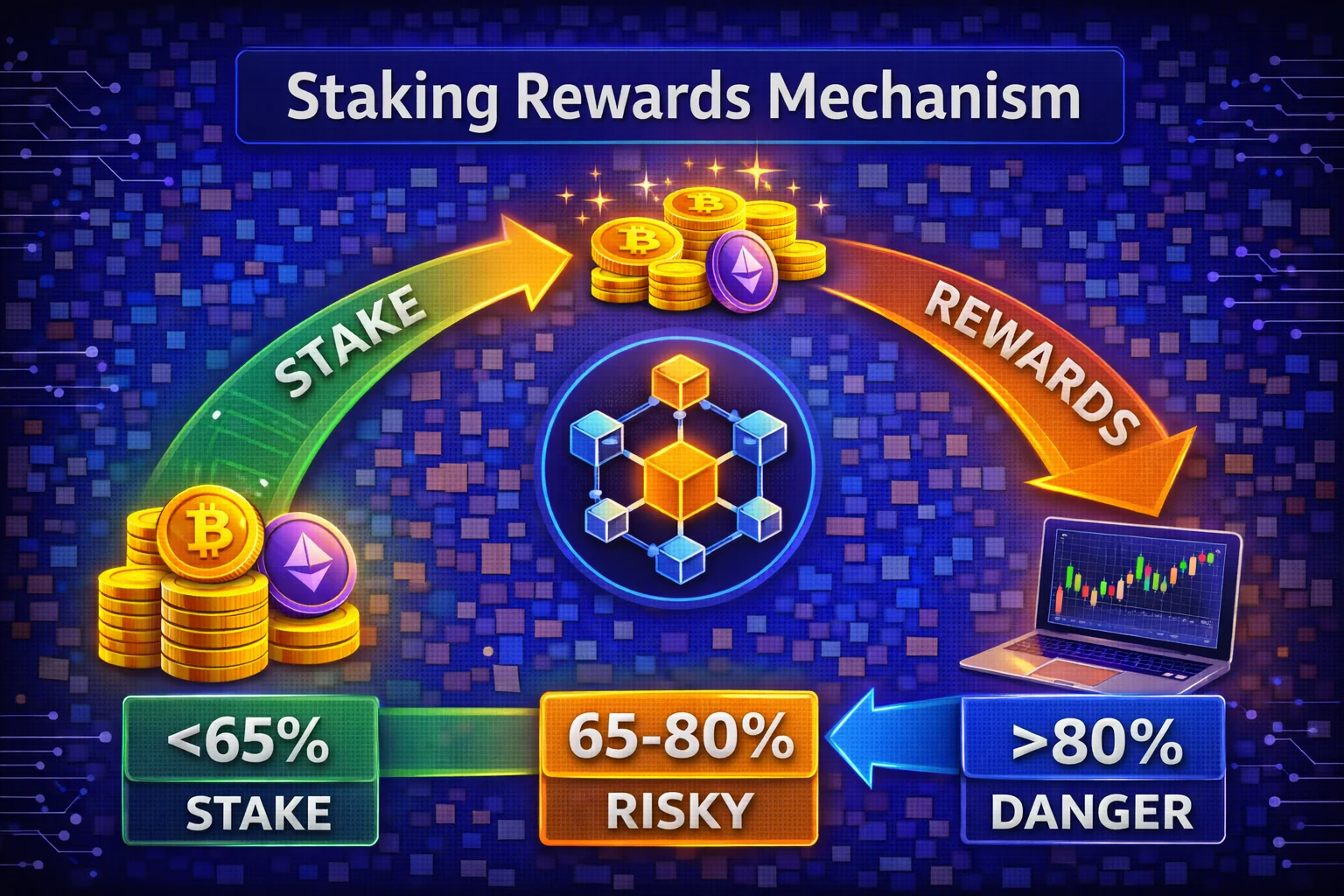
Detailed Comparison: Lending vs Staking
| Factor | Digital Asset Lending | Crypto Staking |
|---|---|---|
| Yield Generation | Interest from borrowers; market-driven rates | Protocol rewards; algorithmically determined |
| Typical Returns (2025) | 2-15% APY (highly variable) | 3-12% APY (more predictable) |
| Volatility of Returns | High rates fluctuate with market conditions | Low-Medium - protocol adjustments are gradual |
| Liquidity | Often flexible, but may have withdrawal queues | Varies: instant (liquid) to 21+ days (native) |
| Minimum Requirements | Usually low or no minimums | Varies: 32 ETH (solo) to no minimum (pools) |
| Technical Complexity | Simple (CeFi) to moderate (DeFi) | Simple (exchange) to high (solo validation) |
| Custody Model | Custodial (CeFi) or self-custody (DeFi) | Self-custody (native) or custodial (exchange) |
| Primary Risks | Counterparty, rehypothecation, liquidity | Slashing, validator performance, protocol changes |
Yield Analysis: What to Expect
Digital Asset Lending Yields
Lending yields are driven by the supply-demand curve inside each protocol, not by a central rate setter. Aave and Compound both use a kinked interest rate model: when pool utilisation (borrowed/supplied) is below an optimal point (typically 80% for stablecoins, 45% for volatile assets), rates rise gently with utilisation; above that threshold, rates rise sharply to push utilisation back down. The practical consequence is that yields spike during borrowing rushes — leveraged long-USDC demand during bull runs, for example — and compress during quiet periods.
A worked example: if you supply 10,000 USDC to Aave V3 when pool utilisation is 85% and the variable supply rate is 4.2%, you earn roughly £35/month in interest, accrued every block. Rates adjust continuously, so the effective APY you realise over a year averages out the fluctuations. Historical Aave data shows USDC supply rates spent most of 2024 between 2% and 5%, with brief spikes above 8% during January and August 2024 volatility.
Stablecoin Lending (USDC, USDT, DAI)
- Typical range: 2–8% APY
- Peak periods: can spike to 15%+ during high borrowing demand
- Low periods: may drop below 2% in bear markets
- Best platforms: Aave, Compound, Morpho, Spark (all audited DeFi); Nexo and exchange earn products for custodial exposure
Stablecoins dominate lending flows because the yield is denominated in the same asset you deposited, so price volatility of the underlying does not eat into the interest. For a £10,000 USDC supply position at a 4% average APY, you earn around £400 over a year, payable continuously and withdrawable at any time on Aave V3.
Bitcoin Lending
- Typical range: 1–6% APY
- Demand drivers: institutional borrowing, derivatives basis trading, cash-and-carry strategies
- Considerations: lower yields but potentially safer collateral, lower utilisation pools
Bitcoin yield exists mainly via wrapped BTC in DeFi or via custodial products on centralised platforms. Native Bitcoin has no proof-of-stake mechanism, so staking does not apply on the base layer. Emerging Bitcoin Layer 2 networks like Stacks do offer BTC-based yield, but these introduce additional smart-contract and bridge risks that need separate evaluation.
Ethereum and Altcoin Lending
- Typical range: 3–12% APY
- Volatility: higher yields but more variable rates
- Use cases: DeFi protocols, shorting, arbitrage, leverage trading
Lending ETH earns you interest denominated in ETH, so the fiat value of that yield rises and falls with the ETH price. This matters for tax and for mental accounting — a 3% ETH supply rate during a year when ETH drops 40% still produces fiat losses overall, even though you ended the year with more ETH than you started. Most strategists treat ETH lending as a yield enhancement on a position they already wanted to hold, not as a standalone income stream. The same logic applies to altcoin lending: the headline APY can look attractive, but if the underlying token halves in price, a 10% yield does not compensate for a 50% drawdown.
Supply rates for wrapped BTC (wBTC, tBTC) on Aave and Compound typically sit below 1% because borrowing demand for BTC is thinner than for ETH. Stablecoin supply remains the highest-utilisation lending market on both protocols, which is why USDC and USDT usually pay the most consistent yields despite being denominated in units that do not appreciate.
Crypto Staking Yields
Staking yields are set by protocol economics rather than free-market demand, so they move more slowly than lending rates. Ethereum's issuance formula is roughly 166.3 × √(validators_active) ETH per year, distributed to all validators pro-rata.
As the total staked supply grows, each validator's share of fixed issuance shrinks — Ethereum paid about 5% in early 2023 when ~15M ETH was staked, and pays around 3–4% in 2026 with ~34M ETH staked. Transaction fees and maximal extractable value (MEV) add another 0.5–1.5% on top of issuance, though that portion fluctuates with network activity.
On Ethereum, MEV is typically captured by specialised builders and shared with validators through MEV-Boost relays such as Flashbots. A validator running MEV-Boost on average earns about 10–30% more than a validator that does not, though the exact uplift depends on fee market conditions. Liquid staking tokens (stETH, rETH) pass most of this through to holders, deducting a 10% node operator fee on Lido and a similar cut on Rocket Pool.
Major PoS Networks (2026 yields, approximate)
- Ethereum (ETH): 3–4% APY base issuance plus 0.5–1% from fees/MEV
- Solana (SOL): 6–7% APY, inflation schedule slowly tapering
- Cardano (ADA): 4–5% APY from treasury and reserve
- Polkadot (DOT): 10–14% APY with nominated proof-of-stake
- Cosmos (ATOM): 8–12% APY, dynamic inflation targeting 66% participation
- Avalanche (AVAX): 7–9% APY, 12-month minimum stake for full rewards
These ranges are ballpark figures for planning purposes. Actual yields shift continuously as stake participation changes; verify current numbers on stakingrewards.com or each protocol's own dashboard before making allocation decisions.
Factors Affecting Staking Yields
- Network participation: higher participation generally lowers yields
- Validator performance: uptime and efficiency affect rewards
- Protocol changes: network upgrades can modify reward structures
- Inflation rate: some networks adjust inflation based on staking participation
A practical note on yield aggregators and "yield-bearing stables" (sDAI, stUSDT): these wrappers take a base yield from a protocol such as Maker's DSR or exchange treasury strategies and pass it through to token holders. They are not staking in the protocol-consensus sense — they are packaged lending exposure. Read the underlying strategy before treating the headline APY as risk-free, especially for products that pay above the risk-free rate on government T-bills.
Risk Analysis: Understanding What Can Go Wrong
Digital Asset Lending Risks
Smart Contract and Counterparty Risk
The primary risk in lending is that the borrower or platform fails to return your assets. The shape of that risk differs sharply between custodial platforms and DeFi protocols, and each category has produced named, documented failures worth studying.
- DeFi protocol exploits: Euler Finance lost approximately $197M in March 2023 when an attacker exploited a flaw in donation/liquidation logic — most funds were later returned, but positions froze for weeks. Cream Finance, Harvest Finance, and bZx have similar exploit histories.
- CeFi insolvencies: Celsius Network filed for bankruptcy in July 2022 with about $4.7B owed to retail customers, following BlockFi in November 2022 and Voyager Digital in July 2022. Deposit insurance, where it existed, did not cover crypto balances.
- Mitigation: diversify across audited protocols, check audit reports on GitHub (e.g., Trail of Bits, OpenZeppelin), monitor TVL trends, prefer self-custody DeFi over custodial CeFi for anything beyond short-duration stablecoin lending.
Oracle and Liquidation Risk
Lending protocols depend on price oracles to decide when collateral is insufficient. Oracle manipulation or sudden market moves can trigger unexpected liquidations. During the March 2020 "Black Thursday" crash on Ethereum, MakerDAO auctions filled with zero-bid liquidations because keepers could not execute fast enough, costing the system around $8M. If you borrow against volatile collateral, keep your loan-to-value well below the liquidation threshold — typically 20–30% buffer — and monitor positions during high volatility.
Rehypothecation Risk
Some custodial platforms re-lend your deposited assets to generate extra yield. This was central to the Celsius failure: the platform pledged user deposits as collateral for leveraged trades on other venues. When the trades failed, deposits were locked. Self-custody DeFi protocols avoid this by design — your assets remain in the protocol's smart contract, not commingled on a corporate balance sheet.
Regulatory Risk
Regulations can force platforms to modify terms, restrict services to specific jurisdictions, or shut down. BlockFi paid $100M in February 2022 to settle SEC and state charges around its Interest Account product; similar enforcement continues against custodial yield products. DeFi protocols face legal uncertainty but are typically harder to shut down because the smart contracts run permissionlessly.
Crypto Staking Risks
Slashing Risk
Validators can lose a portion of their staked tokens for malicious behaviour or extended downtime. On Ethereum, a typical slashing event costs about 1 ETH plus correlation penalties — not the full 32 ETH stake. The largest Ethereum slashing incident to date involved around 75 validators belonging to Staked.us in February 2021, who were slashed about 1 ETH each after a misconfigured load balancer caused double-signing. On Cosmos, penalties are typically 0.01% for downtime and 5% for double-signing.
- Common causes: double signing (validator runs on two machines simultaneously), extended offline periods, misconfigured infrastructure.
- Typical ETH penalty: around 1 ETH (3% of a 32 ETH stake) plus correlation penalty if many validators are slashed in the same epoch.
- Mitigation: if delegating, choose validators with strong uptime records and reasonable commission (5–10%); if solo-staking, use well-tested client software (Prysm, Lighthouse, Teku) and avoid running the same validator keys on two machines.
Validator Performance Risk
Poor validator performance reduces rewards through missed block proposals, attestation failures, or high commission rates. On Ethereum, missing attestations for a full day costs roughly 0.1% of the stake. Validators with 99%+ uptime are the norm; avoid any with uptime below 95% or commissions above 15%.
Protocol and Upgrade Risk
Changes to the underlying blockchain protocol can affect staking mechanics and reward rates. Ethereum's Shapella upgrade in April 2023 enabled staking withdrawals for the first time — a change that went smoothly but took years of development. Unlike a contentious fork, routine upgrades rarely threaten principal; the larger concern is reward rate changes (Ethereum's issuance schedule adjusts based on total stake).
Liquid Staking Token (LST) Risks
LSTs add smart contract risk on top of base staking. The clearest historical example is stETH: during the June 2022 market stress triggered by Three Arrows Capital and Celsius unwinding, stETH traded as low as 0.93 ETH against its 1:1 peg because holders rushed to exit and secondary liquidity was shallow. The peg restored fully after Ethereum enabled withdrawals in April 2023, but anyone using stETH as loan collateral during that period faced liquidation.
- Depeg risk: stETH/ETH and rETH/ETH ratios can deviate briefly during forced-selling events — a serious problem if you borrow against the LST.
- Smart contract risk: LST protocols are additional contracts with their own audit and exploit history.
- Centralisation risk: Lido controls around 28% of all staked ETH as of early 2026, prompting ongoing debate about client diversity and validator distribution.
Platform Comparison: Where to Lend and Stake
Top Digital Asset Lending Platforms
centralised Platforms (CeFi)
- Nexo: EU-regulated, insurance coverage, flexible terms, 4-12% APY on various assets
- YouHodler: Swiss-regulated, multiple products, competitive rates, 1-15% APY depending on product
- Coinbase: US-regulated, FDIC insurance on USD, limited digital asset lending options
- Kraken: Strong security record, transparent operations, staking and lending options
decentralised Platforms (DeFi)
- Aave: Leading DeFi lending protocol, multiple markets, 2-15% APY, instant loans
- Compound: Established money market, algorithmic interest rates, single-asset markets since V3
- Maker (Sky): DAI/USDS stablecoin protocol, DAI Savings Rate (DSR), conservative yields backed by the protocol's collateral pool
Top Crypto Staking Platforms
LST Providers
- Lido: Largest LST provider, stETH for Ethereum, approximately 3–4% APY
- Rocket Pool: Decentralised Ethereum staking, rETH token, community-run validators
- Frax Ether: Algorithmic LST, sfrxETH token, competitive yields
Exchange Staking
- Coinbase: Simple staking for multiple assets, a regulated platform, and competitive rates
- OKX: Extensive staking options, flexible and locked products, and global access
- Kraken: On-chain staking, transparent fees, and multiple PoS networks are supported
Native Staking Solutions
- Solo Staking: Run your own validator, maximum decentralisation, technical complexity
- Staking Pools: Pool resources with others, lower minimums, shared rewards
- Staking-as-a-Service: Professional validator services, white-glove setup
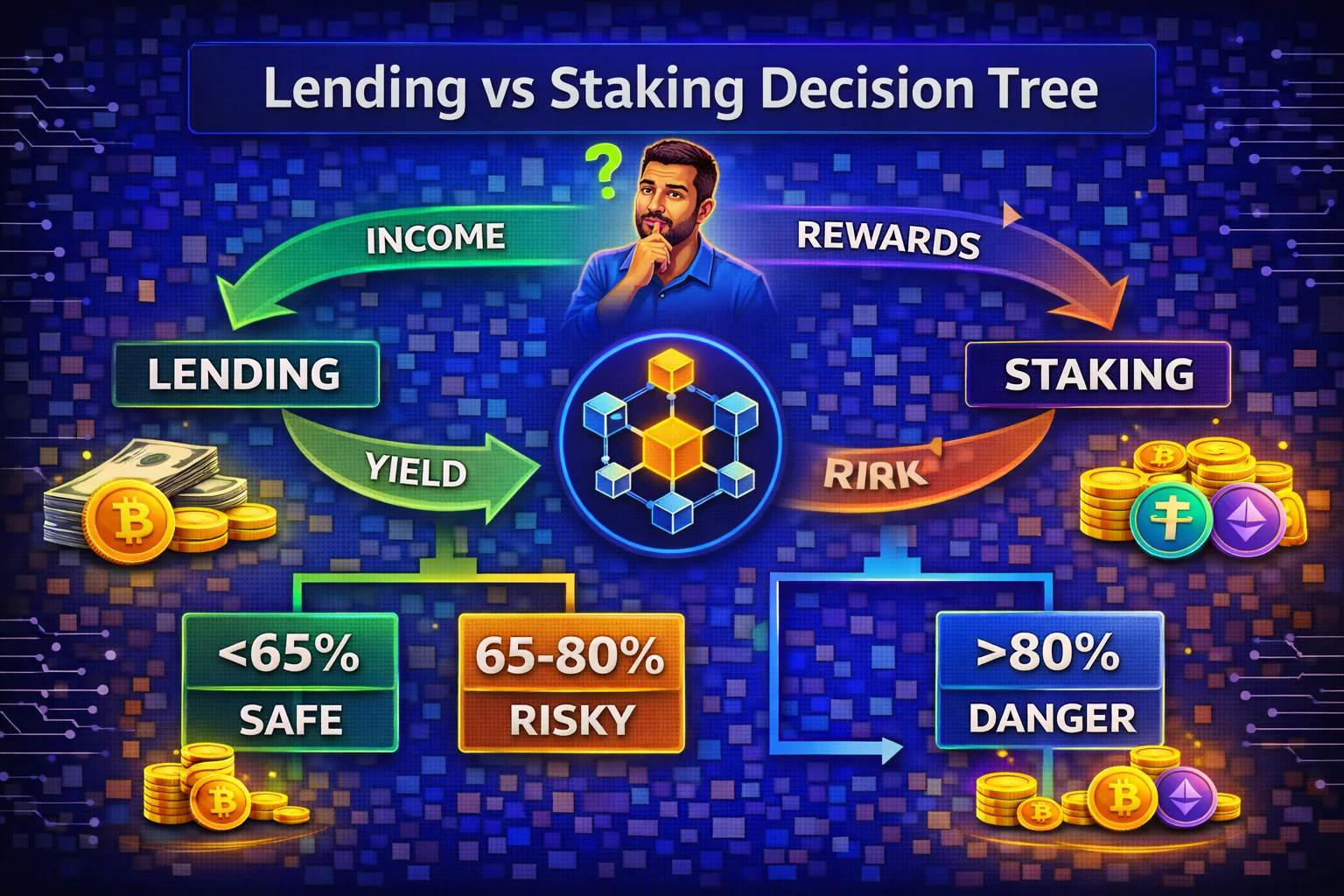
Decision Framework: Choosing Your Strategy
Before choosing sides, answer three questions honestly. First, what is your holding period — weeks, months, or years? Second, do you have a view on the underlying asset, or are you parked in stablecoins while you wait? Third, how do you rate your own willingness to monitor positions, read audit reports, and react to market stress?
Staking rewards accrue to long-term ETH or SOL holders who already want exposure and are comfortable leaving capital in place. Lending suits stablecoin positions, short-duration altcoin holdings, and investors who want flexibility to redeploy.
A concrete worked example: suppose you hold £5,000 in USDC that you will likely need within six months. Staking is not relevant — there is nothing to stake. Aave V3 on Arbitrum or Base is the right venue: variable supply rate around 3%, withdraw any time, gas cost below £1 per transaction. Contrast that with £5,000 of long-term ETH conviction: native staking at 3.3% or Lido at 3.0% (after the 10% fee) both make sense, depending on whether you want the 32 ETH commitment of solo staking or the liquidity of stETH.
Asset Allocation Considerations
Long-term Holdings (1+ years)
For assets you plan to hold long-term, staking often makes more sense as it aligns with your investment timeline and provides steady, predictable returns without counterparty risk.
- Best for Staking: ETH, SOL, ADA, DOT, ATOM
- Strategy: Native or liquid staking depending on liquidity needs
- Considerations: Unbonding periods, validator selection, protocol roadmaps
Tactical Positions (weeks to months)
For shorter-term positions or assets you may need to access quickly, lending provides more flexibility while still generating yield during holding periods.
- Best for Lending: Stablecoins, BTC, liquid altcoins
- Strategy: Flexible lending terms, monitor rate changes
- Considerations: Withdrawal terms, platform reliability, rate volatility
Risk Tolerance Assessment
Conservative Approach
- Staking: Established PoS networks with long track records
- Lending: Regulated platforms with insurance coverage
- Allocation: 70% staking, 30% lending
- Focus: Capital preservation with modest yield enhancement
Moderate Approach
- Staking: Mix of native and liquid staking across multiple networks
- Lending: Diversified across CeFi and DeFi platforms
- Allocation: 50% staking, 50% lending
- Focus: Balanced risk-return optimisation
Aggressive Approach
- Staking: Newer PoS networks with higher yields
- Lending: DeFi protocols with variable rate optimisation
- Allocation: 30% staking, 70% lending
- Focus: Maximum yield with active management
A useful stress test when picking an allocation: imagine a 40% market drop over 30 days (this happened in May 2022 and November 2022). How does each bucket respond? Stablecoin lending on Aave generally survives intact because loans are overcollateralised and liquidations handle the rest. ETH staking principal is unaffected by price — you still hold the same ETH — though the fiat value of rewards drops. LST-backed leverage positions are the danger zone: a sharp ETH drop plus a temporary stETH depeg (as in June 2022) can trigger liquidation on the lending side, locking in losses. If your allocation fails that scenario, reduce leverage before the market moves, not during.
Operational Considerations
Time Commitment
- Low Maintenance: Exchange staking, CeFi lending
- Medium Maintenance: Liquid staking, DeFi lending
- High Maintenance: Solo staking, active DeFi strategies
Technical Expertise
- Beginner: Start with exchange-based solutions
- Intermediate: Explore liquid staking and established DeFi protocols
- Advanced: Consider solo staking and complex DeFi strategies
Tax Implications: What You Need to Know
General Tax Principles
Tax treatment of crypto lending and staking varies by jurisdiction, but most developed tax authorities now publish specific guidance. The two main taxable events are receipt of yield (treated as income) and disposal of the underlying asset (treated as a capital gain or loss). Record-keeping matters: you need the fair market value in local currency at the time each reward is received, because that figure becomes both the income amount and the cost basis for any later sale.
In the UK, HMRC's cryptoasset manual (CRYPTO61000 series) treats staking rewards and lending interest as miscellaneous income at the point of receipt, taxed at your marginal rate. Disposal of rewarded tokens later triggers Capital Gains Tax with a £3,000 annual allowance in the 2024–25 tax year.
Liquid staking tokens raise a specific question: does swapping ETH for stETH count as a disposal? HMRC's current position is that if the LST is a wrapper representing the same underlying, it may not — but this area remains unsettled, and a professional opinion is advisable for large positions.
In the US, IRS Revenue Ruling 2023-14 confirmed that staking rewards are taxable as ordinary income in the year they become accessible to the staker. The rate matches your federal income tax bracket. Later disposal triggers capital gains at short-term (ordinary income rates) or long-term (0–20%) rates depending on whether the token was held over a year from the reward date. Lending interest is treated similarly.
Lending Tax Treatment
Income Recognition
- Timing: Interest typically taxed when received or accrued
- Rate: Usually taxed as ordinary income at marginal rates
- Currency: Must be valued in local currency at time of receipt
- Frequency: Daily accrual may require frequent valuations
Capital Gains Considerations
- Lending Activity: Generally not considered a disposal for capital gains
- Platform Tokens: Rewards in platform tokens may trigger immediate income recognition
- Withdrawal: Converting earned interest to other assets triggers capital gains
Staking Tax Treatment
Income Recognition
- Timing: Rewards typically taxed when received and accessible
- Valuation: Fair market value at time of receipt
- Frequency: May be daily, weekly, or per epoch, depending on the network
- Cost Basis: Received tokens have cost basis equal to income recognised
Special Considerations
- Slashing Events: May be deductible as capital losses
- Liquid Staking: Token swaps may trigger capital gains events
- Validator Rewards: May be treated differently than delegator rewards
Record Keeping Requirements
- Transaction Logs: Detailed records of all staking and lending activities
- Valuation Data: Historical price data for all reward receipts
- Platform Statements: Official records from all platforms used
- Cost Basis Tracking: Maintain accurate cost basis for all positions
Tax optimisation Strategies
- Jurisdiction Shopping: Consider tax-friendly jurisdictions for operations
- Timing Strategies: Harvest losses to offset staking/lending income
- Entity Structures: Corporate structures may offer tax advantages
- Professional Advice: Consult qualified tax professionals for complex situations
Advanced Strategies: Maximising Risk-Adjusted Returns
Once you understand the basic mechanics, you can layer strategies to improve risk-adjusted returns. The three most common patterns are core-satellite allocation (most of your capital in a low-variance base yield, a minority in higher-yield opportunities), yield curve positioning (matching lock-up tolerance to yield term), and cross-platform arbitrage (supplying where rates are highest, borrowing where they are lowest). Each adds operational complexity, and each has specific failure modes worth understanding before size increases.
Hybrid Approaches
Core-Satellite Strategy
- Core (70%): Stable staking positions in major PoS networks
- Satellite (30%): Tactical lending and high-yield staking opportunities
- Benefits: Stability with upside potential, risk diversification
Yield Curve Strategies
- Short-term: Flexible lending for rate volatility capture
- Medium-term: Liquid staking for steady returns with liquidity
- Long-term: Native staking for maximum yields and network participation
Risk Management Techniques
Diversification Strategies
- Platform Diversification: Spread across multiple platforms and protocols
- Asset Diversification: Different cryptocurrencies with varying risk profiles
- Strategy Diversification: Combine lending, staking, and other yield strategies
- Geographic Diversification: Use platforms in different jurisdictions
Hedging Approaches
- Delta Hedging: Use derivatives to hedge price exposure while earning yield
- Basis Trading: Arbitrage between spot and futures while staking/lending
- Cross-Asset Hedging: Use correlated assets to reduce overall portfolio risk
Automation and optimisation
Yield Aggregators
- Yearn Finance: Automated yield optimisation across DeFi protocols
- Beefy Finance: Auto-compounding strategies for various networks
- Harvest Finance: Yield farming automation with gas optimisation
Rebalancing Strategies
- Rate-Based Rebalancing: Move funds based on yield differentials
- Risk-Based Rebalancing: Adjust allocation based on risk metrics
- Calendar Rebalancing: Regular rebalancing regardless of market conditions
Combined Strategies: Using Both Together
You do not need to choose one or the other. The most common combined strategy on Ethereum is this: stake ETH through Lido to receive stETH, then supply that stETH to Aave as collateral. stETH keeps accruing staking rewards in your wallet while Aave treats it as collateral worth close to 1 ETH, and Aave V3's E-Mode lets you borrow stablecoins against it at a loan-to-value of around 93%. The result: staking yield plus a stablecoin loan you can redeploy — at the cost of liquidation risk if stETH depegs from ETH.
For a deeper treatment of the lending side — interest rate models, liquidation mechanics, and collateral factors — see our DeFi lending complete guide. For the staking side — validator selection, LST choices, and yield sources — see the liquid staking yield strategies guide.
A worked example: suppose you hold 10 ETH and want conservative yield. Stake all 10 ETH via Lido at 3.2% and you receive stETH earning about 0.32 ETH per year.
Deposit 8 stETH to Aave V3 as collateral, enable E-Mode, and borrow 15,000 USDC against it (leaving 20–30% buffer before liquidation). Supply that USDC back to Aave at 3% for another £450/year. Total yield on the original 10 ETH position: staking rewards on all 10 ETH plus stablecoin interest — roughly doubled versus staking alone, with added liquidation risk if ETH falls sharply or stETH depegs.
A conservative question to ask before layering strategies: what happens if two risks hit at once? If stETH depegs 10% during a market crash while ETH drops 30%, does your collateral still cover the loan? Stress-test positions before committing size. Tools like DeFi Llama's Aave dashboards and Dune analytics queries on Aave liquidations help quantify historical tail events.
Conclusion
The choice between lending and staking is usually not either/or. Stake assets you plan to hold long-term in their native proof-of-stake network — this aligns your yield with the protocol you already have conviction in. Lend stablecoins and shorter-duration positions where flexibility matters, using audited DeFi protocols rather than custodial platforms where you cannot verify solvency.
If you are starting from scratch with ETH, begin with liquid staking via Lido or Rocket Pool for the staking side and supply stablecoins to Aave V3 for the lending side. Both paths are reversible, the mechanics are transparent on-chain, and you can adjust allocations as rate differences shift.
For the full lending picture — interest rate curves, collateral factors, liquidation mechanics — read our DeFi lending complete guide. For the staking side — validator economics, LST options, restaking — see the liquid staking yield strategies guide.
One principle runs through both strategies: treat headline APY as a starting point, not a promise. Actual returns after platform fees, gas, and taxes are often lower than advertised. Track positions monthly, stress-test combined strategies against a 30% market drop, and never put more capital on any single platform than you are willing to lose to an exploit or insolvency.
Finally, revisit your allocation at least once a quarter. Rate environments shift — a 4% stablecoin supply rate today may be 2% in six months, and staking yields change as total network stake grows. Protocols evolve; Aave V4 and Compound III have already reshaped lending mechanics, and restaking via EigenLayer has introduced entirely new yield layers on top of ETH staking. Your own situation — tax bracket, time horizon, conviction — changes too. The strategies in this guide work because they stay close to audited, established platforms with transparent mechanics, not because any single allocation is optimal for all time. Start small, verify the mechanics on a test deposit, and scale only once you understand every risk your position carries.
Sources & References
- Ethereum.org. Ethereum Staking Guide. Official documentation on Ethereum proof-of-stake consensus, validator requirements, and reward mechanics.
- Aave. Aave V3 Documentation. Technical reference for interest rate models, E-Mode, and liquidation parameters on the leading DeFi lending protocol.
- Lido. Lido Protocol Documentation. Official docs covering stETH mechanics, validator set, and liquid staking architecture.
- Rocket Pool. Rocket Pool Documentation. Reference for rETH mechanics and permissionless node operation.
- CoinDesk. Crypto Staking Explained. Background reading on staking fundamentals.
Frequently Asked Questions
- Is crypto lending safer than staking?
- Neither is universally safer — they have different failure modes. Lending exposes you to platform insolvency (Celsius, BlockFi) and smart-contract exploits (Euler Finance $197M in 2023). Staking exposes you to slashing (typically around 1 ETH on Ethereum, not the full 32) and, for liquid staking tokens, temporary depeg during market stress. Self-custody DeFi lending on audited protocols and native staking on established networks carry comparable risk; custodial lending platforms carry the additional risk of the custodian failing.
- Can I do both lending and staking at the same time?
- Yes — and combining them is common. The most popular combined strategy on Ethereum is: stake ETH via Lido to receive stETH, then deposit stETH to Aave V3 as collateral (E-Mode allows about 93% loan-to-value) and borrow stablecoins against it. You keep earning staking rewards on the stETH while putting the borrowed USDC to use. The added risk is liquidation if stETH depegs from ETH during stress.
- What is the minimum amount needed to start?
- For DeFi lending on Aave or Compound, there is no protocol minimum — any amount works, but Ethereum gas fees make positions under £500 uneconomical on mainnet. Layer 2s such as Arbitrum or Base bring that down to around £50 minimum. For native ETH staking you need 32 ETH to run a validator; liquid staking via Lido or Rocket Pool has no minimum. Custodial platforms (Nexo, Binance Earn) typically accept £10 minimums.
- Which generates higher returns: lending or staking?
- It depends on the asset and market conditions. Stablecoin lending on Aave typically pays 2–5% and spikes above 8% during high-volatility periods when borrowing demand surges. ETH native staking sits around 3–4% and is relatively stable. Higher-yield altcoin staking (Polkadot 10–14%, Cosmos 8–12%) trades off predictable rewards against higher price volatility of the underlying token. Rates change daily — check live figures before committing.
- Do I need technical knowledge for staking vs lending?
- DeFi lending via a browser wallet like MetaMask takes minutes to learn — connect, deposit, done. Liquid staking has the same complexity. Solo staking on Ethereum requires running a validator node (hardware setup, client software, key management) and is materially harder. If you want exposure without running infrastructure, use Lido, Rocket Pool, or an exchange staking service.
- What are the tax implications of lending vs staking?
- In most jurisdictions both generate taxable income. Lending interest is typically taxed as income when received or accrued. Staking rewards are usually taxed as income at the point of receipt, with cost basis equal to the fair market value at that time. Later disposal triggers capital gains. UK investors should note HMRC treats staking rewards as miscellaneous income unless the activity rises to the level of trading. Consult a qualified tax professional — rules vary by country and change frequently.
- Can I lose my principal in lending or staking?
- Yes, in both. Lending principal can be lost to smart-contract exploits, oracle manipulation, or custodian insolvency. Staking principal can be slashed for validator misbehaviour, though Ethereum penalties are typically around 1 ETH rather than full principal. Diversification across protocols and validators, combined with sticking to audited, established platforms, reduces but does not eliminate this risk.
← Back to Crypto Investing Blog Index
Financial Disclaimer
This content is not financial advice. All information provided is for educational purposes only. Cryptocurrency investments carry significant investment risk, and past performance does not guarantee future results. Always do your own research and consult a qualified financial advisor before making investment decisions.