Ethereum L2 Complete Guide 2026
If you have used Ethereum mainnet, paid a $30 swap fee, and heard that Layer 2 rollups bring the same operation to a few cents, this guide is the one you needed. We cover what L2s actually are, how rollups work in plain language, the seven L2s worth knowing in 2026, what happens when an L2 sunsets (Polygon zkEVM is the live case study, with a 1 July 2026 deadline), and a first-bridge walkthrough that uses your existing exchange. The guide does not pick a "best L2" — it gives you a framework for picking the right L2 for your use case.
Why Ethereum Needed Layer 2 — and What Changed
Between roughly 2021 and 2024, Ethereum priced ordinary users out of itself. A simple Uniswap swap during a busy day cost $30 to $150. An NFT mint during a hyped drop could touch four figures. Anyone who tried to learn DeFi by experimenting with $50 of capital had their entire balance eaten by a single failed transaction. The base layer worked — it has not had unscheduled downtime in over a decade — but it worked at a price point that excluded most retail use cases.
The fix was Layer 2. The idea is older than the implementation: do most of the computation off the main Ethereum chain, batch the results, and post compressed proof of correctness back to mainnet. Ethereum keeps its security guarantees; users get cheaper transactions. Rollups, as they came to be called, started shipping production traffic in late 2021 and grew from a curiosity to the default execution venue over the next several years.
By May 2026, the seventy-three active rollups tracked by L2BEAT collectively secure over $48 billion in total value locked. Arbitrum One alone holds roughly $15.9 to $16.9 billion, accounting for around 40 to 44 per cent of all L2 capital. Base sits in second place at $10.7 to $12.8 billion. The remainder is spread across Optimism (around $1.7 to $1.9 billion), Starknet (~$617 million), Linea (~$421 million), zkSync Era (~$404 million) and a long tail of smaller chains. Fees on the major L2s are now consistently sub-cent for routine swaps.
What did not change, despite the maturation, is reader confusion. Search "best Ethereum L2" today and you get a wall of marketing pages from competing chains, each claiming to be the fastest, cheapest or most decentralised. Most are technically accurate at narrow benchmarks and miss the question users actually have: which L2 should I use, and how do I get started safely without losing money to bridge mistakes or sequencer outages?
This guide answers that question. We cover, in order:
- What an L2 is — a separate execution environment anchored to Ethereum, not a sidechain and not a separate blockchain.
- How rollups work — the three jobs of an L2 (sequence, prove, post data), explained without cryptography prerequisites.
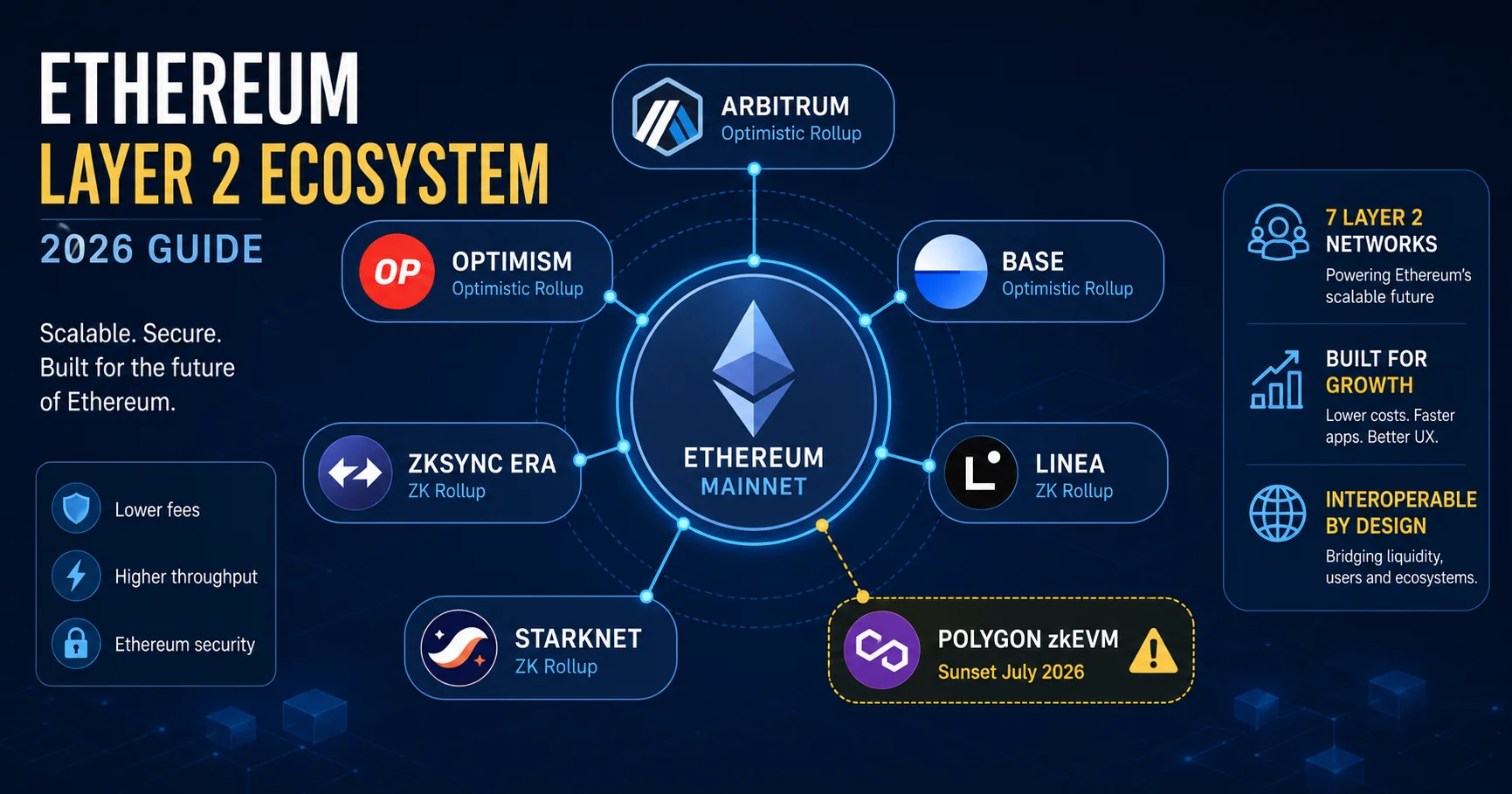
- The seven L2s worth knowing — Arbitrum, Optimism, Base, zkSync Era, Linea, Starknet, plus the Polygon zkEVM case for L2 lifecycle awareness.
- L2 lifecycle — what happens when an L2 sunsets. Polygon zkEVM closes its Mainnet Beta sequencer on 1 July 2026, and the withdrawal mechanics matter for anyone holding capital there.
- Choosing your L2 — a decision tree based on use case, not on chain marketing.
- Common misuses — the wrong-chain bridge, the sequencer trust assumption, the false "L2 equals Ethereum security" framing.
- A worked first-bridge example — exchange to L2 deposit to MetaMask to first swap, end to end.
If you read nothing else in the introduction, internalise this: in 2026, Ethereum L2s are no longer experimental. They are the default execution venue for most retail and an increasing share of institutional flow. The right question is not whether to use one — it is which one fits your use case, what tradeoffs you accept on security, and how to bridge in without losing capital to operator error.
What an L2 Actually Is
An Ethereum Layer 2 is a separate execution environment that processes transactions off the main Ethereum chain and posts compressed proof of correctness back to it. From the user's wallet, an L2 looks like a different network — different chain ID, different RPC endpoint, different block explorer — but the security model anchors back to Ethereum mainnet. Funds posted to an L2 are not on a separate blockchain in any meaningful sense; they are on Ethereum, accessed through a different execution layer.
This distinction matters because L2 is a category, and the category contains things that look superficially similar but behave very differently when something goes wrong.
Three terms travel together in this space and are often confused. A rollup posts both transaction data and state proofs to Ethereum, inheriting Ethereum's security for both execution and data availability. A sidechain is an independent blockchain with its own consensus — Polygon PoS is the canonical example — that bridges to Ethereum but does not inherit its security. A validium posts proofs to Ethereum but keeps transaction data off-chain on a separate availability layer; this lowers fees further but reintroduces a trust assumption for data recovery.
For practical purposes in this guide, we focus exclusively on rollups. Every active L2 in the seven worth knowing is a rollup. Sidechains and validiums exist in 2026 and have their place, but they sit outside the scope of "Ethereum-secured execution" that most readers have in mind when they ask about L2.
Rollups divide into two main categories by how they prove correctness to Ethereum. Optimistic rollups assume each batch of transactions is valid by default; anyone can challenge a batch within a window (typically seven days) by submitting a fraud proof showing the batch was incorrect. If no challenge appears, the state becomes canonical. ZK rollups generate a cryptographic validity proof for each batch up front; Ethereum verifies the proof in a single transaction, and the state becomes canonical immediately.
We give the technology comparison a full satellite of its own, so we do not repeat the mechanics here. If you want the deeper dive into how fraud proofs and validity proofs differ — and what that difference means in practice — see how fraud proofs and validity proofs differ.
The "rollup" name comes from the mechanism: many transactions are rolled up into a compressed batch, which is then posted to Ethereum as a single piece of calldata or, since the EIP-4844 upgrade in March 2024, as a blob. The compression and the batching are what make L2 fees cheap. Ethereum mainnet sees one batch posting transaction containing the data for hundreds or thousands of L2 transactions. The cost of that posting is amortised across all the user transactions in the batch. This is why L2 fees scale with the underlying Ethereum gas price but at a much smaller per-user share.
From the user's perspective, an L2 looks like a separate Ethereum-compatible network. You add a network entry to your wallet — chain ID, RPC URL, currency symbol, block explorer URL — and from then on the L2 appears alongside Ethereum mainnet in your wallet's network selector. The same wallet address works across every EVM-compatible L2; you do not need a new address per chain. (Starknet is the exception in our seven; its non-EVM Cairo virtual machine uses a different account model and a different wallet such as Argent or Braavos. We come back to that in the landscape section.)
Two misuses are worth flagging upfront. First, an L2 is not a sidechain — the security model is fundamentally different, and treating Polygon PoS interchangeably with Arbitrum is a category error. Second, an L2 is not "a separate blockchain" in the way Solana or Avalanche are separate blockchains. L2 funds remain anchored to Ethereum; the security guarantees flow from Ethereum's validator set and finality. If Ethereum mainnet halts, every L2 halts with it. If an L2 halts, Ethereum keeps running and your L2 funds remain recoverable through escape mechanisms that we cover in the security satellite.
New readers who want a glossary-level reference can keep our companion glossary open while working through this guide. New readers who want a glossary-level reference for terms like rollup, sequencer, fraud proof, and validity proof can keep our crypto glossary open in a tab while working through this guide.
How Rollups Work
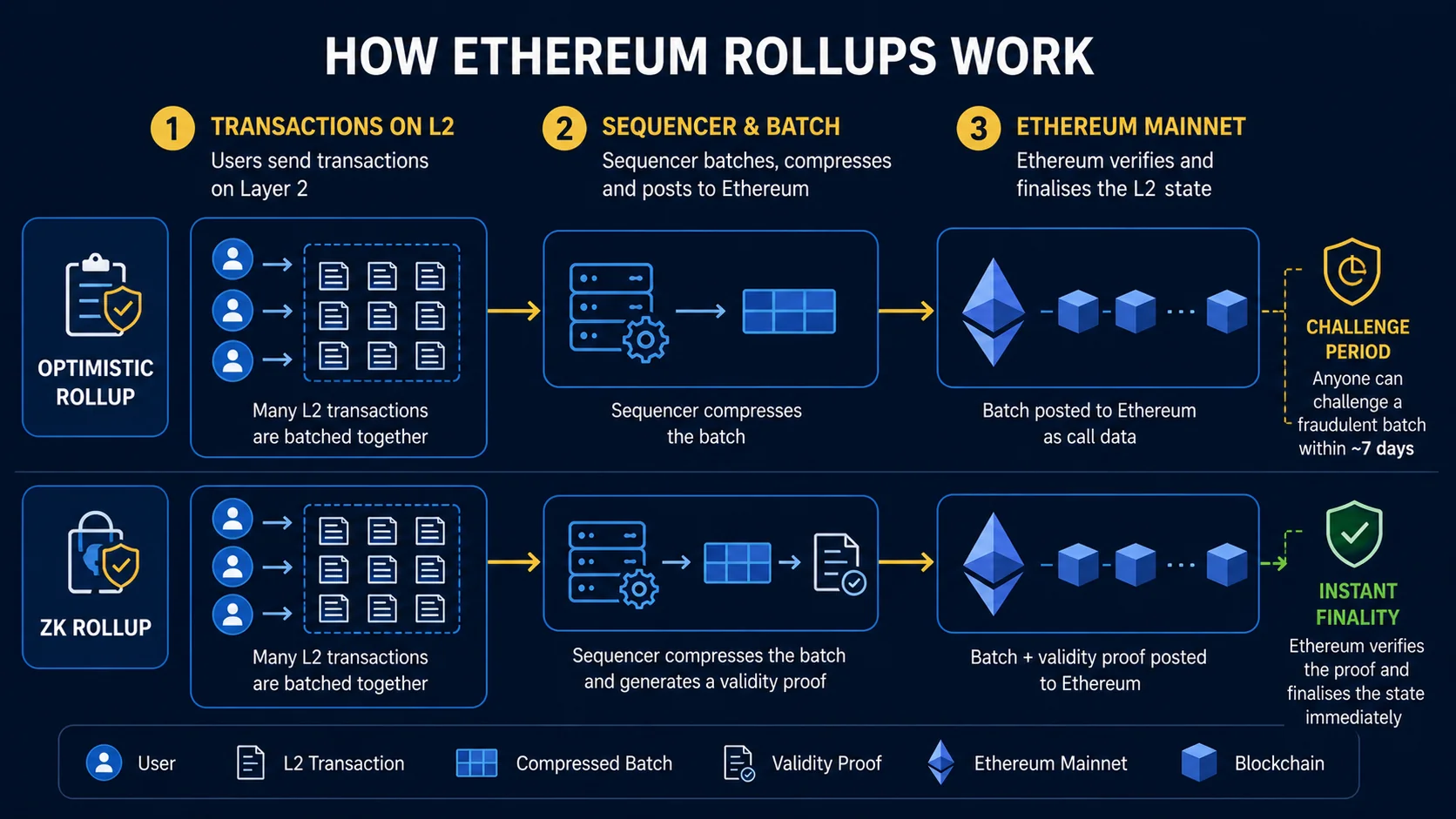
Three jobs define what a rollup does. It executes transactions, it proves the execution was correct, and it posts the underlying transaction data so that anyone can verify or reconstruct state. Different rollups handle these three jobs differently, but the structure is the same across all of them. Understanding it lets you reason about what an L2 can do, what it cannot do, and what happens when one of the three jobs fails or degrades.
Job 1: Execute transactions through a sequencer
The sequencer is the operator that orders incoming transactions, executes them according to the L2's virtual machine, and produces blocks. On every major L2 in 2026, the sequencer is centralised — a single operator (usually the founding company) runs it. This is a known compromise. Decentralised sequencer roadmaps exist for Arbitrum, Optimism (Superchain shared sequencer), zkSync Era and Starknet, but none have shipped at full production scale yet. Linea has shipped Maru client and QBFT consensus components — earlier production progress than the other major L2s, though full sequencer decentralisation remains in progress. Centralised sequencing is fast and reliable when the operator is well-resourced; it introduces censorship and MEV-extraction risks that we treat fully in the security satellite.
The sequencer batches accepted transactions into groups, executes them on the L2's virtual machine, and produces a state root — a cryptographic hash representing the new state of the L2 after the batch. The batch and the state root are then handed to the next stage.
Job 2: Prove the batch was correct
Optimistic and ZK rollups diverge here. Optimistic rollups (Arbitrum, Optimism, Base) post the state root and assume it is correct unless someone proves otherwise. A challenge window — typically seven days — opens, during which any participant can submit a fraud proof demonstrating the batch produced an incorrect state. If no challenge appears, the state becomes canonical on Ethereum. ZK rollups (zkSync Era, Linea, Starknet) generate a cryptographic validity proof for the batch up front.
Ethereum verifies the proof in a single transaction, and the state becomes canonical immediately on proof verification. The seven-day challenge window does not exist for ZK rollups; finality on L1 typically takes hours, not days.
This difference shapes the user experience in one specific way: canonical withdrawal time. Pulling funds from an optimistic rollup back to Ethereum mainnet through the official bridge takes seven days because the challenge window must pass before the withdrawal is final. ZK rollup withdrawals settle in hours.
Third-party fast-bridge services (Across, Hop and others) front the liquidity for optimistic rollup withdrawals so that users can exit in minutes by paying a small fee — at the cost of trusting the bridge service. The fee economics and security tradeoffs of bridging deserve a full treatment, which we give in the L2 fees and bridging deep dive.
Job 3: Post data so that state is reconstructible
Even if a rollup's state root is correct, users need access to the underlying transaction data to verify history, reconstruct state if the sequencer disappears, or force-exit funds in an emergency. This is the data availability question, and it is one of the most consequential design choices a rollup makes.
All seven L2s in this guide post their data to Ethereum mainnet. Since the EIP-4844 upgrade in March 2024 introduced a dedicated blob data format, this posting is roughly ten to one hundred times cheaper than the pre-blob model that used regular calldata. Ethereum data availability is the strongest guarantee available — anyone running an Ethereum node can reconstruct any L2's state from blob data within the retention window.
Some L2s outside our seven explore alternative data availability layers — Celestia and EigenDA being the two most-discussed in 2026 — to drive fees lower at the cost of an additional dependency. The tradeoff is real: alt-DA reduces fees but means your L2's data availability now depends on a separate network's continued operation. We cover the security implications, including which L2s use alt-DA and what happens when an alt-DA layer fails, in the security tradeoffs guide.
The settlement step closes the loop. Once a state root is canonical on Ethereum (after the challenge window for optimistic rollups, or proof verification for ZK rollups), any state-affecting action — particularly withdrawals back to mainnet — can be executed. Until canonicalisation, the L2 state is "soft" from Ethereum's perspective. Users transacting on the L2 see immediate confirmation from the sequencer, but the absolute Ethereum-anchored finality only arrives after the canonicalisation step.
Three takeaways carry through the rest of the guide. First, the sequencer is the trust point you accept when you use an L2 today; centralised sequencers are the norm and the practical risks are operational (downtime, MEV) rather than fund-loss. Second, the proving model determines withdrawal time and shapes the user experience for moving capital back to mainnet. Third, data availability is the unsung security pillar — when L2 commentary talks about "Stage 1" or "Stage 2" decentralisation, what they are largely measuring is how robustly an L2 ensures that data and proof obligations cannot be silently broken by the operator.
The L2 Landscape in 2026
Seven Ethereum L2s are worth knowing in 2026. They divide into two families by proof technology — three optimistic rollups built on the OP Stack, and three ZK rollups with distinct technical positioning — plus Polygon zkEVM, which we cover in the L2 lifecycle section because it is sunsetting on 1 July 2026. We give each platform a short profile here. The full commercial comparisons live in dedicated compare pages: Big 3 OP-stack comparison for Arbitrum, Optimism and Base; ZK trio comparison for zkSync Era, Linea and Starknet.
Big 3 OP-stack: Arbitrum, Optimism, Base
Arbitrum One is the largest L2 by total value locked, holding roughly $15.9 to $16.9 billion in May 2026 — around 40 to 44 per cent of all L2 capital. Built by Offchain Labs and governed by the Arbitrum DAO, Arbitrum runs the Nitro stack (a custom OP-stack adaptation) and uses interactive fraud proofs with binary-search dispute resolution. The platform sits at L2BEAT Stage 1 with permissionless exits live.
Arbitrum is the deepest DeFi venue across all L2s — GMX perpetuals, Camelot, Aave Arbitrum and dozens of smaller protocols anchor the ecosystem. Operational reality: Arbitrum experienced a state-update lag of nearly 13 hours on 9-10 May 2026 (typical interval is around one hour), with a separate one-hour-fifty-two-minute gap on 30 April. We treat both events in the security satellite — they were degraded-mode incidents, not exploits. See the security satellite for the operational detail.
Optimism (OP Mainnet) is the OP-stack progenitor. Stage 1 with Cannon fault proofs live on mainnet. Roughly $1.7 to $1.9 billion in TVL on the canonical Optimism chain, but the strategic significance is broader: Optimism anchors the Superchain — Base, Ink, Unichain and Soneium all share the OP-stack codebase and are progressing towards shared sequencing. The OP token underwrites a buyback programme funded by 50 per cent of Superchain sequencer revenue, approved by the Token House in February 2026. Synthetix derivatives, Aave Optimism and Uniswap on Optimism anchor the DeFi side. Operationally clean record across the recent twelve-month window.
Base is Coinbase's L2, built on the OP-stack. Holds the second-largest TVL across all L2s at $10.7 to $12.8 billion in May 2026, and routinely posts the highest daily active address count of the Big 3. The strategic differentiator is Coinbase smart wallet integration — passwordless and passkey-based wallets that lower onboarding friction substantially compared to MetaMask-first L2s. Aerodrome (a Velodrome-derived ve(3,3) DEX that absorbed the Velodrome Optimism ecosystem in the Q2 2026 Aero merger) holds about 70 per cent of Base DEX liquidity.
Uniswap on Base and Aave Base round out the major DeFi anchors. Base does not have a native token; the chain is Coinbase-governed in the current configuration. The most recent material incident was a 33-minute sequencer halt in August 2025 caused by a backup-system failure — no funds lost, infrastructure improvements were committed and shipped.
ZK leaders: zkSync Era, Linea, Starknet
zkSync Era is built by Matter Labs and runs the largest ZK L2 ecosystem by TVL — around $404 million in May 2026. The Era VM is a Type-4 zkEVM: Solidity contracts compile to Era bytecode rather than running unchanged, which means most contracts deploy fine but require testing before production use. The proof system is Boojum — a STARK proof wrapped inside a SNARK, shipped in December 2023.
Boojum's significance is operational: provers can run on consumer hardware (16 GB GPU RAM), which lowers the cost and centralisation pressure of proof generation. Era is at L2BEAT Stage 0 — operator retains upgrade authority. SyncSwap is the dominant Era DEX with around $8 million in TVL on Era. Matter Labs publicly pivoted towards institutional deployments in Q1 2026.
Linea is ConsenSys's zkEVM. The headline development of 2026: Linea completed its upgrade to a full Type-1 zkEVM in Q1 2026, achieving 100 per cent Ethereum equivalence. This is a meaningful milestone — Type-1 means Solidity contracts deploy unchanged with identical gas semantics, identical state trees, identical hash functions. The same upgrade introduced "L1 soft finality" of approximately 15 minutes and lifted throughput targets to 5,000 transactions per second.
Roughly $421 million in TVL, a substantial share of which is institutional capital that values the MetaMask channel integration. Linea joined the Linux Foundation in May 2026, moving its core ZK-rollup technology to a neutral, foundation-led governance model. L2BEAT Stage 0 currently — sequencer decentralisation is on the published roadmap with the Maru client and QBFT consensus already in production.
Starknet is StarkWare's L2 and the only major Ethereum L2 that does not run an EVM. Starknet uses the Cairo virtual machine, with a different account model (account abstraction is native rather than bolted on) and a different developer experience entirely. Solidity contracts do not deploy to Starknet — the migration story is "rewrite, do not port". The proof system is zk-STARKs natively (no trusted setup, post-quantum secure).
TVL is the smallest of the three at under $200 million, but the ecosystem includes notable Cairo-native applications — Ekubo (a concentrated-liquidity AMM) and JediSwap (a Uniswap V2-like AMM). The Starknet token (STRK) staking ratio grew through 2025, finishing the year with over 1.1 billion STRK staked (more than 23 per cent of circulating supply).
Starknet has reached L2BEAT Stage 1 — permissionless exits are live, narrowing the security gap with the OP-stack Big 3. The platform did experience operational events in early 2026 — a 4-hour sequencer meltdown during the Grinta upgrade and an 18-minute block-production rollback on 5 January — which we treat in the security satellite as case studies in operational maturity rather than exploits.
Passing reference: Scroll
Scroll is an additional Type-2 zkEVM option that experienced significant TVL contraction across 2024-2026 (roughly 96 per cent down from its October 2024 peak after Ether.fi migrated approximately $200 million in assets to OP Mainnet) and is not currently recommended for new deployments.
Vitalik's February 2026 reframing
Ethereum co-founder Vitalik Buterin reframed the role of L2s in a 3 February 2026 post, noting that L2 decentralisation has progressed slower than originally expected while the Ethereum base layer scaled faster than anticipated. As of Buterin's February 2026 post, only Arbitrum, Optimism and Base had reached Stage 1; Starknet joined them shortly after, narrowing the gap further. Most L2s outside that group remained at Stage 0 at the time of his analysis.
The reframing is not an abandonment of the rollup-centric direction — Buterin's argument is that an L2 should advance to Stage 1 minimum to be considered a true Ethereum extension; below that bar, the chain is operating closer to "L1 with a bridge" than to a security-anchored execution layer. His analysis reinforces the L2BEAT stage framework that we use throughout this guide; for the full Stage 0 / Stage 1 / Stage 2 framework discussion, see the L2BEAT maturity stages section of the security satellite.
When L2s Sunset — Polygon zkEVM as Case Study
Not every L2 survives. Some sunset, and users with funds left on the network at the deadline face a non-recoverable loss. The Polygon zkEVM sunset is the live 2026 case study — a Type-3 zkEVM that Polygon Labs is closing on 1 July 2026, with mechanics that every L2 user should understand before deploying capital with long withdrawal periods.
Why Polygon zkEVM is sunsetting
Polygon Labs announced the sunset roughly twelve months in advance. The proximate cause is strategic: Polygon's product focus shifted to the AggLayer (cross-chain settlement) and to its long-running Proof-of-Stake sidechain. Polygon zkEVM never adopted the EIP-4844 blob format, which left it at a structural fee disadvantage versus competing zkEVMs that did adopt blobs.
By 2026, Polygon zkEVM was running at an estimated $1 million annual operating loss — a clear signal that the team was unlikely to keep funding the chain indefinitely. The sunset is not a security failure; the protocol worked. It is a commercial outcome from a product that did not maintain a meaningful strategic role within the Polygon ecosystem.
Withdrawal mechanics — what counts and what does not
Withdrawal mechanics are the part that matters for users. At the 1 July 2026 sunset, an exit snapshot will be taken of all wallet balances on Polygon zkEVM Mainnet Beta. Funds held directly in externally-owned accounts (EOAs) will be migrated to Ethereum L1 and made claimable through a dedicated interface that remains open until 31 December 2027. Funds locked in DeFi protocols, multi-signature contracts or bridges at the moment of sunset cannot be claimed — only EOA-held balances are eligible for the migration.
This asymmetry is the practical hazard: a reader who deposited capital into a lending protocol on Polygon zkEVM and forgot to withdraw before 1 July 2026 will lose access to that capital, regardless of whether the underlying smart contract is technically sound.
Sunset notice (added 15 May 2026): Polygon zkEVM Mainnet Beta is scheduled to sunset on 1 July 2026. Users with funds on Polygon zkEVM must withdraw before this deadline; assets locked in DeFi protocols, multisigs, or bridges at sunset cannot be reclaimed. See Polygon Labs' official claim guide.
The reader takeaway is broader than Polygon zkEVM specifically. L2 lifecycle is real, and the timing of fund recovery matters when picking where to deploy capital. The two structural questions to ask before bridging meaningful capital to any L2 are: how committed is the team and the underlying ecosystem to keeping this chain operational, and what is the worst-case fund-recovery timeline if the chain were to wind down.
For an L2 backed by a well-resourced team with strong commercial momentum (Arbitrum, Optimism, Base, the active ZK trio), these questions have reassuring answers in 2026. For a chain in declining usage with no clear funding path, they have less reassuring answers, and the right response is to either avoid that chain or to keep position sizes inside what you can afford to walk away from. The Polygon zkEVM case is a useful calibration point — a technically capable L2 with a serious parent organisation can still wind down, and the withdrawal deadline is not negotiable.
Choosing Your L2
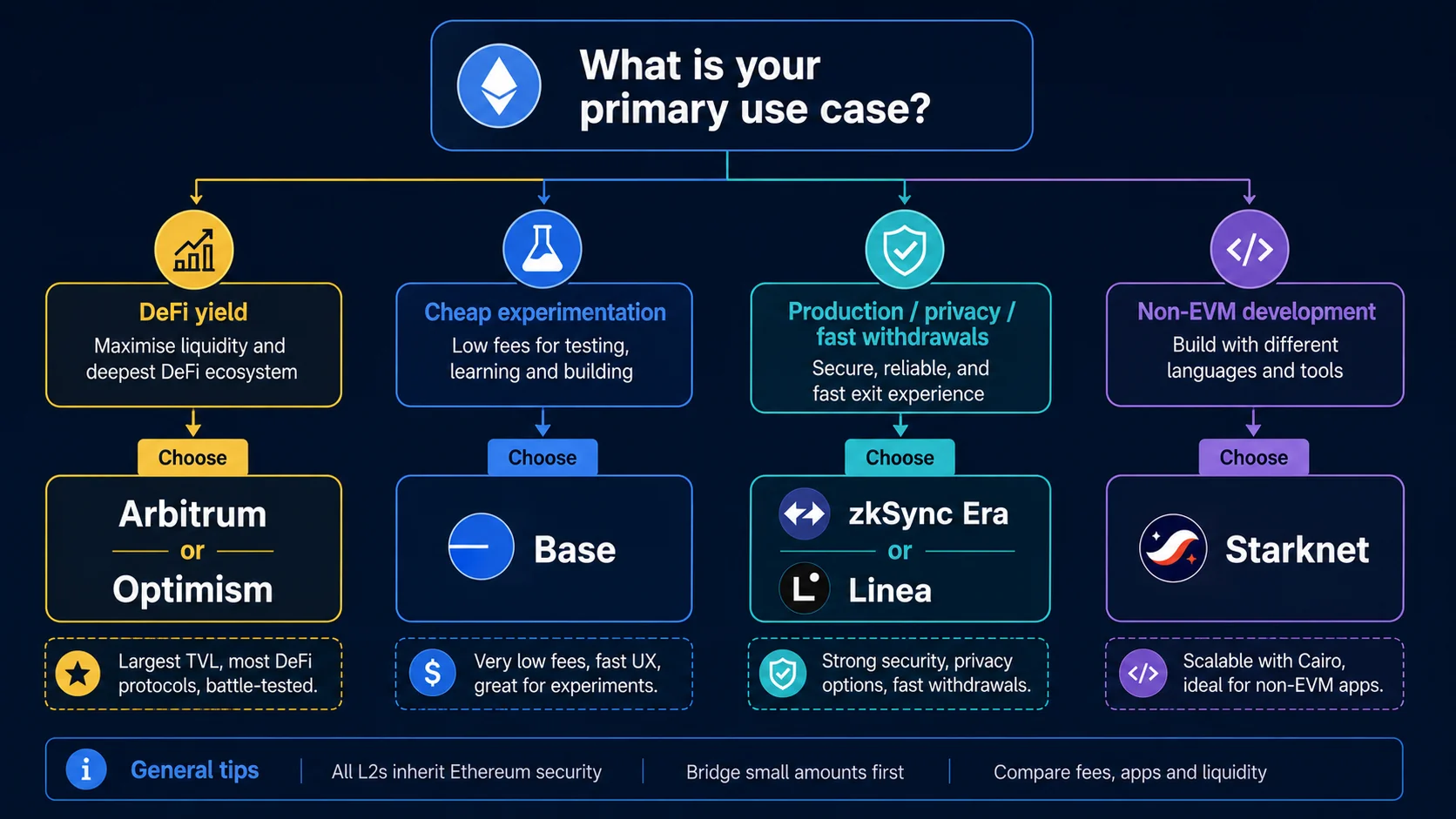
"Best L2" is the wrong question because the answer depends entirely on what you intend to do with the chain. A trader running concentrated perpetual positions has different needs than a beginner experimenting with their first DeFi swap, and a developer building a non-EVM application has different needs than either. Our guidance is structured around use case, not around absolute chain ranking. The relevant decision input is what you want to do; the right L2 follows from that.
The five primary use-case branches
Five primary branches cover most reader situations:
- For DeFi yield, perpetuals or lending at meaningful capital: Arbitrum or Optimism. Both sit at L2BEAT Stage 1 with mature DeFi liquidity — Arbitrum for perpetuals depth (GMX) and the broadest token coverage on AMMs and lending markets, Optimism for derivatives (Synthetix) and Superchain ecosystem participation if you expect to use Base, Ink, Unichain or Soneium alongside. Either choice gives you sub-cent transaction costs, multiple billion-dollar protocols and a clean recent operational record. For protocol-by-protocol picks see our DeFi protocols on each L2.
- For learning DeFi cheaply, first crypto wallet, or onboarding non-technical users: Base. Coinbase smart wallet integration removes the seed-phrase friction that historically locked many newcomers out of self-custody. Aerodrome and Uniswap on Base give you a real DeFi venue without paying Ethereum mainnet gas. Sub-cent fees mean a $20 experimentation budget actually buys you twenty experiments rather than one failed transaction.
- For fast withdrawals back to mainnet (institutional cash flow, capital efficiency): a ZK rollup — zkSync Era or Linea. ZK rollup canonical withdrawals settle in hours rather than the seven-day challenge window that optimistic rollups require. If you regularly move capital between L2 and mainnet rather than holding positions for weeks at a time, the time-value of faster settlement is real. Linea's Q1 2026 Type-1 upgrade removed the last EVM-compatibility caveats; zkSync Era ships a slightly different developer experience but offers the deepest ZK ecosystem by capital.
- For non-EVM development, native account abstraction, or Cairo-specific applications: Starknet. The Cairo virtual machine is not Solidity-compatible and account abstraction is built in rather than implemented as a layer on top. The migration cost is real (rewriting contracts in Cairo), but the upside is a cleaner developer experience for applications that benefit from those primitives. Most readers will not be in this branch — non-EVM is a niche that pays off for specific application categories rather than for general-purpose use.
- For multi-L2 portfolios: there is no single "right" combination. The most common pattern is anchor capital on Arbitrum or Base and use one of the ZK L2s as a fast-withdrawal staging chain. Cross-L2 strategy considerations and bridging cost trade-offs deserve a dedicated treatment, which lives in the cross-L2 DeFi strategies section of the DeFi satellite.
Cross-cluster cases: liquid staking and Bitcoin
Two cross-cluster cases deserve specific mention. If your primary interest is liquid staking — earning ETH staking yield without locking the position — your decision is less about which L2 and more about which liquid-staking protocol to deploy on the L2 you have already picked. We treat liquid staking comprehensively in our liquid staking yield strategies hub; the L2-specific deployment guidance overlays cleanly on whichever L2 you pick by the use cases above. If your primary interest is Bitcoin exposure rather than ETH-denominated DeFi, L2 is largely orthogonal — the Bitcoin investment fundamentals guide covers the ETF-vs-direct decision and custody framework that drives Bitcoin allocation decisions independently of L2 selection.
One framing point worth holding through the rest of the guide: the decision between L2s in 2026 is no longer high-stakes for typical retail use. The Big 3 OP-stack chains are commercially close enough that picking Arbitrum versus Optimism versus Base is closer to choosing between Coinbase and Binance than between Ethereum and Solana. The differences are real, but they are second-order. The bigger leverage points are getting the use-case match right, understanding the security tradeoffs at the chosen L2's stage, and avoiding the bridge mistakes covered in the next section.
Common Misuses
Most L2 mistakes fall into a small number of categories. Pre-empting them is more useful than working backwards from a lost balance, so we cover them explicitly here. Each misuse below comes from a real pattern observed across help-channel traffic and post-mortem write-ups, not from theoretical concern.
- Wrong L2 for the use case. The most common version is depositing perpetual-trading capital onto Base, where the GMX-equivalent venue does not yet exist at meaningful scale. The reader picked Base because the smart-wallet onboarding looked easier, then discovered that the protocol they actually wanted to use lives on Arbitrum. Cost: a round-trip bridge to move capital. Avoidable by reading the use-case branches before bridging.
- Bridging to the wrong L2. Most major exchanges (Binance, OKX, Kraken) let you withdraw ETH directly to several L2s. The networks are listed in a dropdown that is easy to misclick. An ETH withdrawal sent to "Optimism" instead of "Arbitrum" lands on the wrong chain — same EVM address, but the funds are on a different network than you intended. Recovery requires a third-party bridge transaction (or, in some configurations, official customer support). Cost: time plus a small bridging fee. Avoidable by triple-checking the network selector before confirming a withdrawal.
- Treating "L2 inherits Ethereum security" as absolute. The phrase is true with caveats. L2s inherit Ethereum's data availability and settlement security, but the sequencer is centralised on every major L2 today, the validity-or-fraud-proof system can have implementation bugs, and the L2BEAT stage matters for what happens when something fails. Stage 1 means fault proofs or validity proofs are live with a security council that can override under transparent conditions; Stage 0 means the operator retains broader upgrade authority. The practical distinction matters when you deploy capital that exceeds your "I can walk away from this" threshold. The full security treatment lives in the security tradeoffs satellite.
- Ignoring the seven-day withdrawal window on optimistic rollups. If you bridge ETH to Arbitrum, Optimism or Base and want to move it back to mainnet through the canonical bridge, you wait seven days. This catches users who treat L2 as a parking spot for capital they expect to redeploy quickly. Workaround: third-party fast bridges (Across, Hop) front the liquidity and settle in minutes for a small fee. Plan capital moves with the canonical timing in mind, or budget the fast-bridge fee as a known cost.
- Confusing the L2 native token with a network revenue claim. ARB, OP, STRK and similar tokens are governance tokens — they confer voting rights and, in some cases, share in a discretionary buyback or fee-redistribution programme that the DAO can change at any time. They are not equity in the L2's transaction-fee revenue in the way an exchange token might claim a fee share. Treat them as governance instruments first; any token-economic upside should be a secondary consideration that you can quantify. This guide is not investment advice on those tokens specifically — readers interested in the tokenomics should read the individual chain's documentation rather than relying on third-party summaries.
Worked Example: Your First Bridge to L2
The cleanest first L2 experience uses a centralised exchange's native L2 withdrawal as the on-ramp, then opens the L2 in MetaMask (or Coinbase Wallet, if you picked Base) for the first transaction. Five steps, end to end. We use Arbitrum as the example chain because it is the largest L2 and supports the broadest DeFi venue selection — the same flow applies to Optimism, Base or zkSync Era with the network selector swapped accordingly.
Step 1 — Buy ETH on a centralised exchange
If you already hold ETH on Binance, OKX or Kraken, skip this step. If you are starting from cash, an exchange purchase is the simplest on-ramp — typically lower fees than a fiat-to-L2 bridging service and faster settlement than buying ETH on mainnet then bridging. Choose an exchange that supports direct withdrawal to the L2 you want; this saves you a separate mainnet-to-L2 bridge transaction that would otherwise add cost and complexity.
Step 2 — Add the L2 network to your wallet
MetaMask's "Add network manually" flow needs four values: chain ID, RPC URL, currency symbol, and block explorer URL. Rather than hardcoding values that change over time, we recommend using Chainlist — a community-maintained directory that auto-populates the configuration for any EVM-compatible chain. Search "Arbitrum One" (chain ID 42161), "Optimism" (chain ID 10), "Base" (chain ID 8453) or "zkSync Era" (chain ID 324), click "Add to MetaMask", and confirm the prompt.
Chainlist surfaces the currently-recommended public RPC endpoint, which is the safer pattern than hardcoding URLs that may change. If you picked Base and prefer a passkey-based wallet rather than a seed-phrase one, Coinbase Wallet auto-adds Base on first use.
Step 3 — Withdraw ETH from the exchange directly to L2
On Binance: navigate to Wallet → Withdraw → Crypto, select ETH as the asset, paste your MetaMask address, then in the Network dropdown select "Arbitrum One" (or "Optimism", "Base", "zkSync Era" depending on your target chain). Confirm the withdrawal. Most exchanges process L2 withdrawals in a few minutes. The same flow on OKX uses Funding → Withdraw → On-chain withdrawal with the same network selector pattern.
One small but consequential confirmation step: verify the network selector before confirming the withdrawal. The dropdown lists multiple L2s alongside Ethereum mainnet, and the addresses are identical across chains. Sending to "Optimism" when you intended "Arbitrum" lands the funds on the wrong chain. Recovery is possible (a separate bridge transaction) but unnecessary friction. Triple-check the network before clicking confirm.
Step 4 — Verify funds arrived on L2
Switch your MetaMask to the L2 network you chose. The ETH balance should appear within a few minutes of the exchange withdrawal completing. If nothing shows after 15 minutes, paste your address into the chain's block explorer (Arbiscan, Optimistic Etherscan, Basescan) and confirm the transaction status. Almost every "missing funds" report from this step is either a delayed exchange withdrawal (still pending on the exchange side) or a wrong-network selection in Step 3.
Step 5 — Try a first L2 transaction
The simplest sanity check is a small swap on Uniswap, which is deployed on every major L2. Visit the Uniswap interface, connect your wallet, confirm the network selector matches your L2, then swap a few dollars of ETH into USDC. The transaction should confirm in a few seconds and cost a few cents. That is the L2 user experience working as designed: fast, cheap, and indistinguishable from interacting with Ethereum mainnet other than the fee.
From here, the rest of the L2 ecosystem is open to you. Aave for lending, GMX (on Arbitrum) for perpetuals, Aerodrome (on Base) for AMMs, the various liquid-staking and restaking protocols documented in the liquid staking guide. Same wallet address, lower fees, the same self-custody guarantees as Ethereum mainnet for everything that does not depend on the L2's specific sequencer or stage classification.
Practical Takeaways
L2s are the default Ethereum execution venue in 2026. The seven chains worth knowing — Arbitrum, Optimism, Base, zkSync Era, Linea, Starknet, plus the Polygon zkEVM lifecycle case — collectively secure the bulk of practical Ethereum activity. Mainnet remains the settlement layer and the place high-value, low-frequency operations belong. L2s are where the interactive, cheap, day-to-day usage happens.
Pick by use case, not by chain marketing. Arbitrum or Optimism for serious DeFi capital. Base for low-friction onboarding. zkSync Era or Linea for fast withdrawals or production ZK use. Starknet for non-EVM development. Polygon zkEVM for nothing — withdraw any remaining funds before 1 July 2026, then leave it.
Understand the security tradeoff your chosen L2 represents. L2BEAT's stage classification is the right reference. Stage 1 (Arbitrum, Optimism, Base, Starknet) means fault or validity proofs are live with a transparent security council; Stage 0 (zkSync Era, Linea) means the operator retains broader upgrade authority. Buterin's February 2026 reframing makes the same point we make throughout this guide: L2s should advance to Stage 1 minimum to be considered a true Ethereum extension. The full stage framework, sequencer trust model and force-exit mechanics live in the security tradeoffs satellite.
Plan capital moves with the right withdrawal-time expectations. Optimistic rollups have a seven-day canonical withdrawal window; pay the fast-bridge fee or wait. ZK rollups settle in hours. Both models are viable; the difference matters most for capital that needs to move frequently. The bridging mechanics — canonical versus third-party, fee economics, the April 2026 LayerZero/Kelp incident that reshaped which cross-chain protocols major DeFi has migrated to — all live in the L2 fees and bridging explained satellite. For the rollup-mechanics deep dive — fraud proofs versus validity proofs, EVM equivalence types, withdrawal-time fundamentals — see optimistic vs ZK rollups.
One closing note. L2 lifecycle is real — Polygon zkEVM is the live 2026 case study, and it will not be the last. Treat L2 selection as a decision that benefits from periodic review rather than a one-time setup. Six-month and twelve-month checkpoints on TVL trajectory, sequencer roadmap progress, ecosystem health and team commitment are reasonable hygiene for any L2 that holds meaningful capital for you. The chains we recommend in this guide for active mention all pass that hygiene check today; the same review applied a year from now may shift the picture.
Three concrete next steps if you are starting from a cold position. First, pick the L2 that matches your dominant use case from the choosing section above — do not over-research; the differences between the leading chains are smaller than the upside from picking any of them and getting started.
Second, run the worked example end-to-end with a deliberately small balance ($20 to $50 of ETH) on your chosen L2. The point is to surface any wallet-configuration or exchange-network-selector mistakes while the cost of mistake is trivially small, before you scale up to capital that matters.
Third, schedule a calendar reminder for six months out to revisit your L2 selection — check L2BEAT for stage progressions, check DefiLlama for TVL trajectory on the chain you picked, and check whether any sunset-style announcements have appeared on the protocol's official channels. That review takes ten minutes and substantially reduces the chance of being the reader who deposited capital into a sunsetting chain and forgot to withdraw before the deadline.
Sources
- L2BEAT — scaling summary: primary reference for L2 maturity stages, TVL, sequencer status and proof system classification across all tracked rollups.
- DefiLlama — Rollup chains: TVL data per L2 chain, fee data, and protocol-level deployment tracking.
- Vitalik Buterin — An incomplete guide to rollups: foundational rollup-centric roadmap reference for the conceptual framework underlying L2 design.
- Ethereum.org — Layer 2 documentation: neutral foundation reference for L2 fundamentals, network configuration details and the broader ecosystem context.
- Polygon Labs — Sunsetting Polygon zkEVM Mainnet Beta in 2026: official sunset announcement and timeline, the primary citation for the L2 lifecycle case study above.
Frequently Asked Questions
- Is an L2 safer than Ethereum mainnet?
- No, L2s inherit Ethereum security only partially. The settlement layer and data availability are anchored to Ethereum, but the sequencer is centralised on every major L2 today, and the fault-proof or validity-proof system can have implementation bugs. L2BEAT's stage classification is the right reference: Stage 1 (Arbitrum, Optimism, Base, Starknet) means proofs are live with a transparent security council; Stage 0 (zkSync Era, Linea) means the operator retains broader upgrade authority. Treat L2 security as a tradeoff to understand, not as an absolute equivalence with mainnet.
- Can I lose money bridging to an L2?
- Yes, three main risks. First, wrong-network selection on an exchange withdrawal lands funds on the wrong chain (recoverable but inconvenient). Second, third-party bridges have been exploited historically, with the April 2026 LayerZero/Kelp DAO incident as the most consequential recent example. Canonical bridges (run by the L2 itself) are safer than third-party but slower. Third, force-exit recovery from a halted sequencer is technical and not a substitute for using a healthy L2 in the first place. The full bridging risk treatment is in our L2 fees and bridging satellite.
- What happens to my funds if an L2 sunsets?
- Polygon zkEVM is the live case study. At the 1 July 2026 sunset, an exit snapshot is taken of all wallet balances. Funds held directly in externally-owned accounts (EOAs) migrate to Ethereum L1 and are claimable through a dedicated interface until 31 December 2027. Funds locked in DeFi protocols, multisigs, or bridges at sunset cannot be reclaimed — only EOA balances are eligible. The lesson generalises: factor potential lifecycle exits into deployment decisions for any L2 with declining usage or unclear funding, and check announcements before deploying capital with long withdrawal periods.
- Which L2 has the lowest fees?
- All seven major L2s deliver sub-cent fees for routine swaps after the EIP-4844 blob upgrade in March 2024, with ranges shifting based on Ethereum gas price and per-L2 congestion. Base sometimes carries a slightly higher congestion premium during peak demand because of its higher transaction volume. The differences are small enough that fee should not be the primary L2 selection criterion for typical retail use; pick by use case, then accept the fee range.
- How long does it take to withdraw from an optimistic rollup?
- Seven days through the canonical bridge. The challenge window must pass before the withdrawal becomes final on Ethereum mainnet — this is the security mechanism that makes optimistic rollups work. If you need faster settlement, third-party fast-bridge services (Across, Hop and others) front the liquidity and settle in minutes for a small fee. The fee economics make sense for time-sensitive moves; for long-horizon capital, the canonical bridge wait is acceptable.
- Do ZK rollups withdraw faster than optimistic rollups?
- Yes. ZK rollup canonical withdrawals settle in hours rather than days because the validity proof is verified on Ethereum at the time of state submission — there is no equivalent of the optimistic challenge window. zkSync Era, Linea and Starknet all settle to mainnet within hours. This time-value advantage is one of the main reasons institutional capital and frequent-rebalance strategies favour ZK rollups when the underlying use case allows.
- Are L2 native tokens (ARB, OP) good investments?
- This guide is not investment advice. Frame ARB, OP, STRK and similar tokens as governance tokens — they confer DAO voting rights and, in some cases, share in a discretionary fee-redistribution programme that the DAO can change. They are not equity in the L2's transaction-fee revenue in the way exchange tokens might claim a fee share. Read each chain's tokenomics documentation rather than relying on third-party summaries, and treat governance-token exposure separately from your decision about which L2 to use for transactions.
- Why is Polygon zkEVM sunsetting if ZK is the future?
- The Polygon zkEVM sunset is a commercial outcome, not a verdict on ZK technology. Polygon Labs strategically pivoted towards the AggLayer and PoS sidechain. Polygon zkEVM never adopted the EIP-4844 blob format, leaving it at a structural fee disadvantage versus competing zkEVMs that did. By 2026, the chain ran at an estimated $1 million annual operating loss. zkSync Era, Linea and Starknet remain healthy and continue to advance. Technology choices are necessary but insufficient — commercial sustainability and ecosystem support matter independently.
- What is a sequencer and why does it matter?
- The sequencer is the operator that orders incoming L2 transactions, executes them on the L2's virtual machine, and produces blocks. On every major L2 in 2026, the sequencer is centralised — typically run by the founding company. Centralised sequencers are fast and reliable but introduce censorship risk (the sequencer can ignore transactions) and MEV-extraction risk (the sequencer captures sandwich-attack and frontrunning revenue). Decentralised sequencer roadmaps exist for Arbitrum, Optimism, zkSync Era and Starknet, but none have shipped at full production scale yet. Practical implication: trust the sequencer not to censor or extract excessively, and rely on the force-exit mechanism as the safety backstop if it does.
- Can I use the same MetaMask wallet across multiple L2s?
- Yes for every EVM-compatible L2 (Arbitrum, Optimism, Base, zkSync Era, Linea). The same address works across all of them — you just add each L2's network configuration (chain ID, RPC URL, currency symbol, block explorer) to MetaMask once and switch between networks as needed. Starknet is the exception in our seven; its non-EVM Cairo virtual machine uses a different account model and a separate wallet (Argent or Braavos). Coinbase Wallet auto-adds Base on first use and is a passkey-based alternative for users who want to avoid seed-phrase management on Base specifically.
← Back to Crypto Investing Blog Index
Financial Disclaimer
This content is not financial advice. All information provided is for educational purposes only. Cryptocurrency investments carry significant investment risk, and past performance does not guarantee future results. Always do your own research and consult a qualified financial advisor before making investment decisions.