Multisig Wallets Complete Guide 2026: M-of-N, Setup, Risks
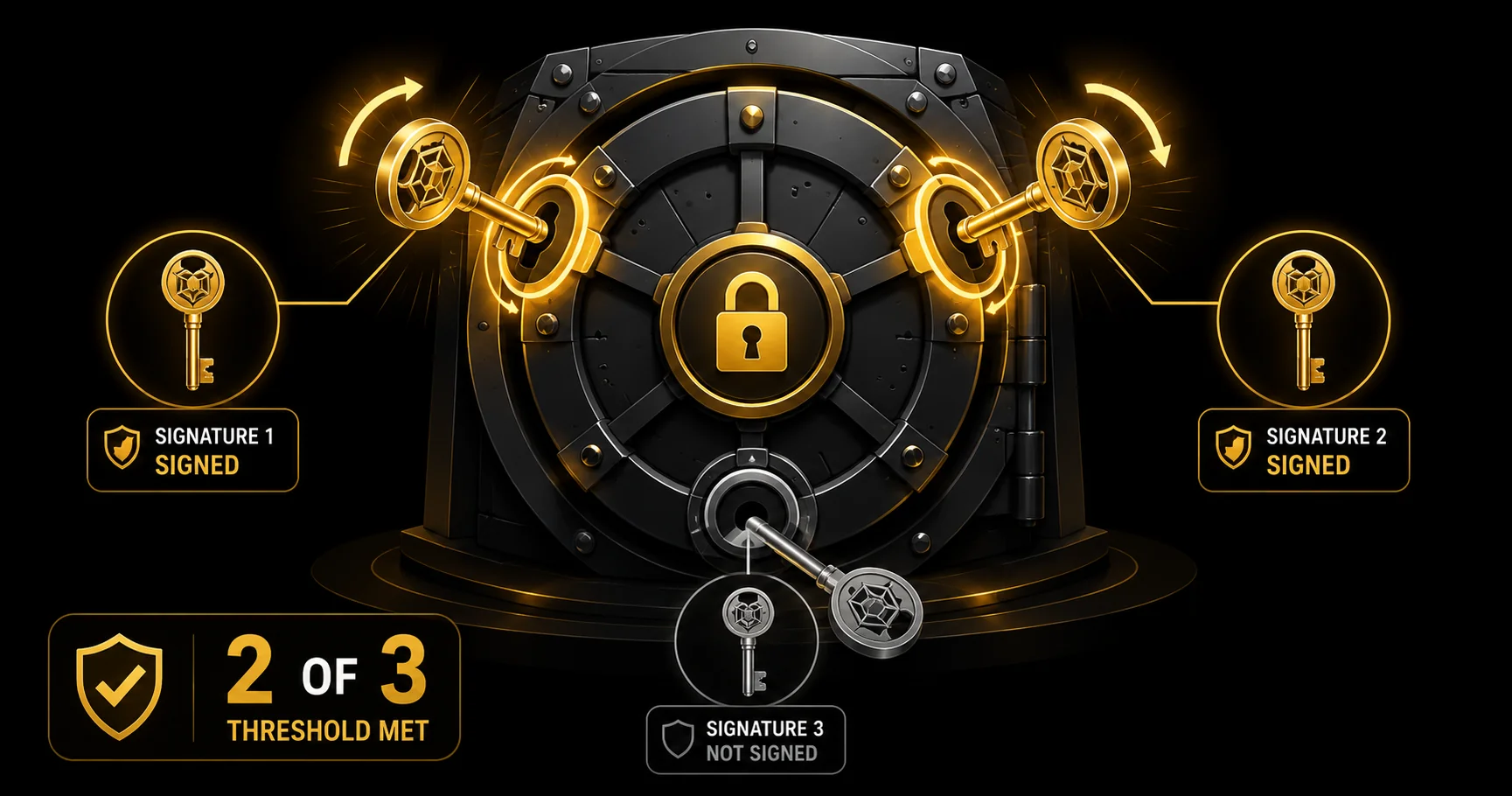
A multisig wallet requires M of N keys (e.g. 2-of-3) to authorise a transaction, so no single key can move funds. If the single hardware wallet that has carried you so far now feels under-engineered for the portfolio sitting on it, this guide is the calibrated tour: what multisig actually is at the M-of-N level, when it is worth the operational cost (and when it is not), how Bitcoin and EVM multisig differ at a conceptual level, where the model has failed catastrophically in production (one cautionary paragraph on the February 2025 Bybit incident), and how to think about signer selection. Six cluster satellites then go operational on each piece.
Introduction
A single hardware wallet with a properly stored backup is sufficient for most self-custody holders for most of their crypto-investing life. The case for multisig arrives when that single device starts to feel under-engineered against the value sitting on it. A phished seed, a stolen device, a fire that takes both the home safe and the off-site backup, a single moment of coercion — any one of these becomes an extinction event for the portfolio under a single-key model. Single-sig is robust against routine failure and fragile against tail risk; once the portfolio is large enough that tail risk matters, the model is no longer the right one. Before considering multisig, your single-key baseline before multisig custody needs to already sit on hardware with a disciplined backup — this guide is the next chapter in the C4 to C8 to C10 self-custody chain, not the first.
Multisig is the next step. A multisig wallet requires M of N independent keys to authorise a transaction, so no single compromised key can move funds. In 2026 the tooling has matured to the point where this is tractable for non-technical holders. Safe (formerly Gnosis Safe) currently secures over $100 billion across more than 30 networks under SafeDAO governance, dominating EVM multisig. Nunchuk and Sparrow have made Bitcoin multisig setup tractable for holders who would never have managed it in 2020. Collaborative-custody services such as Casa and Unchained offer a managed path for holders who want the threshold model without the full operational discipline of running it solo. The question is not whether multisig exists — it does, it works, and it is widely deployed — but whether your portfolio has actually outgrown the single-key model and whether you are ready for the operational discipline multisig demands.
The honest framing this guide defends throughout is that multisig is not automatic safety. The February 2025 Bybit hack drained approximately $1.4 billion to $1.5 billion from a 2-of-3 cold multisig — the most expensive demonstration in the industry's history that multisig fails identically to single-sig when every signer approves a transaction they cannot verify. We cover that caution in one paragraph below; the full case study, attribution, and operational lessons live in our security-risks satellite.
What follows: M-of-N mechanics, then a decision framing (most holders do not need multisig, with concrete value thresholds where the trade-off makes sense), the conceptual Bitcoin-versus-EVM distinction, signer selection at a high level, the Bybit caution paragraph and link, a conceptual 2-of-3 walkthrough, common misuses, and forward pointers to the six cluster satellites that take each operational piece deeper.
What Is a Multisig Wallet? M-of-N Mechanics
A multisig wallet is configured so that M of N total keys must sign a transaction before it can broadcast to the network. The "M" is the threshold — the minimum number of signatures required. The "N" is the total number of keys (signers) authorised on the wallet. The most common consumer configuration is 2-of-3: three total keys, any two of which together can authorise a transaction. The wallet itself does not move funds without those two signatures, and no single key has any authority on its own. A phished seed phrase, a stolen device, or a coerced individual signer is not enough to drain the wallet on its own. The threshold model is the structural property that makes multisig meaningful.
Configurations vary by use case, and not every M-of-N choice is sensible. The combinations below cover almost every honest deployment:
- 2-of-3 — the most common consumer setup. Loss of one key still leaves the wallet recoverable with the remaining two. Compromise of two independently held keys is a much harder attack than compromising one. This balances redundancy against attacker friction and is the default starting point for holders moving beyond a single hardware wallet.
- 3-of-5 — institutional or family-office setup. Higher attacker friction (three independent compromises required) at the cost of more keys to manage. Suitable for treasuries, family offices, and any structure where the operational discipline can sustain five independent storage locations.
- 2-of-2 — used in some merchant or co-signing scenarios where two distinct parties must always agree. Loss of either key is permanent loss of funds, with no redundancy. Not recommended for individual holders.
- 1-of-2 or 1-of-N — these are not multisig in the security sense. Any single key can sign on its own, so the threshold provides no attacker resistance. Useful as redundancy mechanisms but should never be treated as multisig for security purposes.
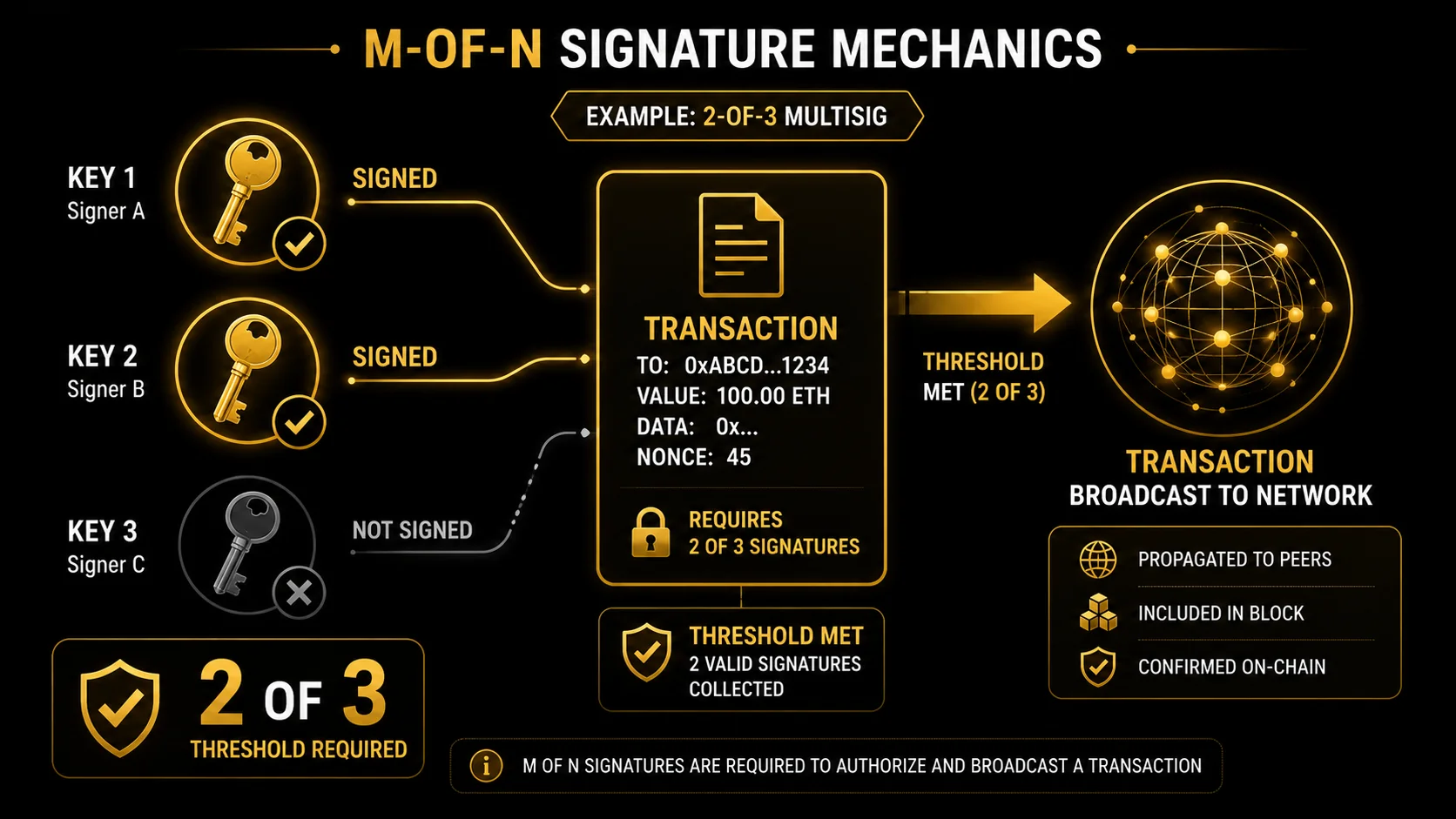
Why M-of-N matters in practice is a story about the failure surface. A single hardware wallet protects against most online attacks because the private key never touches a networked device. It does not protect against a single seed-phrase compromise, a single device theft when the passphrase is weak or absent, or a single coercion event when the holder is forced to sign. Multisig adds the threshold layer: even if one seed is exposed, the attacker still needs to compromise another independent key. Even if one device is stolen, the threshold applies. Even if one signer is coerced, the threshold remains intact as long as the other keys are out of reach. Multi-point-of-failure problems are much harder to solve simultaneously than single-point-of-failure ones.
Independence is the load-bearing word in that sentence, and it is where most home-grown multisig setups quietly fail. Three seed phrases written on three sheets of paper and stored in the same fireproof safe is not three-key multisig in any meaningful sense — a single fire, burglary, or household-level disaster compromises all three keys at once. Three Ledger devices kept on three shelves of the same desk fail the same way. The threshold model only delivers its security property when each key is held with a non-overlapping threat surface relative to the other keys — different physical locations where the threat model warrants, different signers (different humans) where coercion is a concern, and different manufacturers across the device set so that a single supply-chain attack or firmware vulnerability cannot compromise the entire wallet at once.
The vocabulary the rest of this guide uses: a signer is the holder of one of the N keys (a hardware device, a person, or the combination of both); a threshold is the M in M-of-N (the minimum number of signers who must approve); a co-signer is a colloquial term for one of several signers on the same wallet; a descriptor is the Bitcoin-specific text representation of a multisig wallet's structure (script type plus extended public keys plus derivation paths plus threshold), critical to recovery in ways that have no EVM equivalent; an owner is the Safe-specific term for one of the addresses authorised on a Safe smart contract.
Clear-signing means a hardware device renders the human-readable transaction (destination, value, token, contract function) on its screen before requesting approval; blind signing is the absence of that property — the device shows an opaque hash, and the signer cannot verify what they are about to approve. For broader self-custody vocabulary, see our jargon: threshold, signer, descriptor, PSBT — full glossary.
When You Need Multisig (and When You Do Not)
Most self-custody holders do not need multisig, and the few who do should adopt it deliberately rather than as a default upgrade. A correctly configured single hardware wallet with a properly stored backup is sufficient up to a value threshold that varies by personal risk tolerance, household structure, geography, and threat model. The framing that travels best is not portfolio size in dollars but portfolio size relative to your life: when the loss of the entire crypto position would materially change your financial life — fund housing, a child's education, retirement, replace lost income for a meaningful period — the single-key model starts to feel under-engineered. When the loss would be painful but recoverable from salary or other assets, the operational simplicity of single-sig with a disciplined backup is usually the right answer. Anyone who tells you "$50,000 is the multisig threshold" is overfitting their situation onto yours.
Three concrete holder profiles cover the spectrum. The dollar figures are illustrative, not prescriptive — your personal inflection point may sit higher or lower.
Holder A — $15,000 portfolio, single hardware wallet. Single-sig with a Trezor Safe 7 or a Ledger Nano X, the seed split into two halves stored in geographically separated locations (home safe and a bank deposit box, or two trusted family locations in different cities), and a passphrase memorised rather than written down. Multisig is overkill here — managing three independent devices, three backup locations, and (for Bitcoin) the descriptor maintenance discipline carries an operational cost that exceeds the marginal security gain. The honest upgrade for Holder A is not multisig but disciplined single-sig: verify the backup actually works by performing a recovery dry run on a clean device, then leave the system alone for years.
Holder B — $250,000 portfolio, 2-of-3 multisig. Three signers from three different manufacturers (a Keystone 3 Pro, a Ledger Nano X, and a Trezor Safe 7), held in three locations (home safe, office or trusted second residence, a trusted family member's safe in a different city), with descriptor backups stored independently of the seed phrases. A single seed-phrase exposure no longer puts the portfolio at risk; a single device theft does not either; a single coercion event at home leaves the off-site key out of reach. The operational cost — periodic firmware updates across three vendors, descriptor maintenance, occasional dry-run signing — is now justified on a quarter-million-dollar portfolio. This is the default profile the rest of the cluster assumes.
Holder C — $1,000,000+ portfolio, 3-of-5 with collaborative-custody backstop. Three personal signers plus two service-provider signers, structured so that the user holds enough personal keys to spend without the service provider in normal operation, and the service provider can provide a recovery path if multiple personal keys are lost or destroyed. A common pattern is an Unchained 2-of-3 vault (BTC only) where the user holds two of three keys and Unchained holds the third, paired with a self-managed Safe on EVM for non-BTC assets. The trade-off between full self-custody and partial delegation is covered in the self-managed vs collaborative custody decision compare page.
There are also clear cases where multisig is the wrong tool, regardless of portfolio size:
- Active trading capital. Multisig signing latency is incompatible with rapid-fire moves. Keep operational capital in a fast single-sig hot or warm wallet and reserve multisig for the cold-storage portion.
- Funds under approximately $10,000 to $20,000. The operational overhead exceeds the marginal security benefit at small portfolio sizes.
- No tested backup-recovery plan. Multisig multiplies the surface area for backup-and-loss failures. If you do not maintain a tested recovery for your single-sig wallet, you are not ready to maintain one for three.
- Cannot sustain the discipline over years. Multisig is not setup-once-and-forget — firmware updates, periodic dry runs of the third signer, descriptor reverification, and inheritance documentation are ongoing. Collaborative custody (Casa, Unchained) is a more durable alternative than a self-managed multisig that quietly decays.
The trade-off cuts both ways. Multisig multiplies security against compromise and multiplies surface area for loss-by-error. The Bybit case below demonstrates that even institutionally configured multisig can fail catastrophically when the signing interface is compromised. The next section covers the conceptual distinction between Bitcoin and EVM multisig, because the choice of mechanism is a separate decision from the choice to adopt multisig at all.
Bitcoin vs EVM Multisig: Two Different Mechanisms
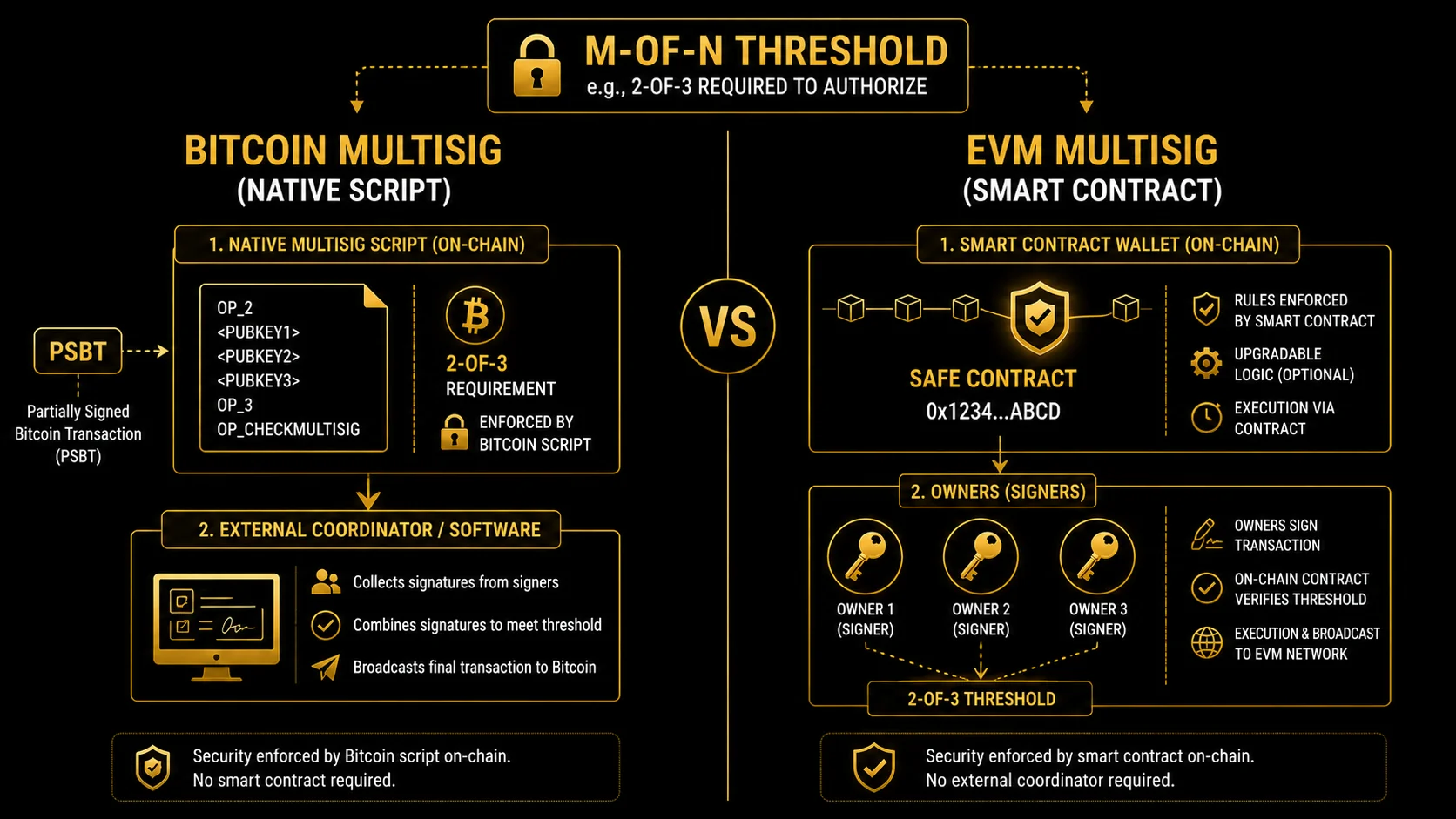
Bitcoin multisig and EVM multisig are not variants of the same mechanism. They are two structurally different ways of expressing the threshold model — one at the script level, one at the smart-contract level — and the operational disciplines they demand are different enough that holders running both networks should think of them as two independent systems that happen to share a conceptual name. This section establishes the distinction at a conceptual level; the two operational satellites in this cluster take each side into the practical depth that running it actually requires.
Bitcoin multisig — native script-level
Bitcoin multisig is implemented at the script level, the same primitive that powers single-sig Bitcoin transactions. The "wallet" is not a contract or an account but a script structure: a P2SH, P2WSH, or P2TR address whose redeem script encodes the M-of-N requirement and the extended public keys of the signers. Coordination happens off-chain through coordinator software (Sparrow, Nunchuk, Electrum, Specter), which assembles partial signatures into a complete transaction via the PSBT format. The wallet structure itself — script type, extended public keys, derivation paths, threshold — is recorded in a text artefact called the descriptor; lose the descriptor and the seed phrases alone cannot reconstruct the wallet, which is the BTC multisig footgun the setup satellite covers operationally. The BTC multisig setup operational walkthrough covers descriptor mechanics, coordinator choice, and the PSBT QR workflow.
EVM multisig — smart-contract level
EVM multisig is implemented as a smart contract deployed on the L1 or L2. Safe (formerly Gnosis Safe) is the dominant implementation — over $100 billion secured across more than 30 networks under SafeDAO governance. The "wallet" is the contract address. The "owners" are externally owned addresses authorised on the contract to sign on its behalf; the threshold and the owner set are stored as contract state. Coordination happens through the Safe{Wallet} UI — each owner connects to the same Safe address from their own wallet (typically MetaMask paired with a hardware device) and the UI batches signatures off-chain until the threshold is met. There is no descriptor backup problem because the wallet configuration lives on-chain — losing the contract address is recoverable from any signer wallet's transaction history. The Safe deployment and owner management satellite covers the per-chain deployment workflow and the L2 considerations operationally.
Side-by-side framing
The comparison reduces cleanly to four axes:
- Backup surface: Bitcoin requires seeds plus the descriptor — two independent items per signer. EVM requires only the seeds plus the contract address, recoverable from on-chain history. Bitcoin's backup surface is structurally larger, and the descriptor failure mode is the most common cause of "lost multisig" anecdotes in the long tail.
- Coordination workflow: Bitcoin signers pass a PSBT between each other asynchronously, via QR code or file. EVM signers all connect to the same Safe contract through Safe{Wallet} and sign on-chain proposals through a shared UI. Bitcoin's workflow is more flexible for fully air-gapped setups; EVM's workflow is faster and more standardised across signers.
- Cross-chain reach: Bitcoin multisig is one wallet on one network. EVM multisig is per-chain — running Safe across Ethereum mainnet, Arbitrum, Optimism, and Base requires four separate deployments. This complicates EVM operations but also enables cheap L2-native multisig that has no Bitcoin analogue.
- Failure modes: The Bitcoin-specific failure is lost descriptor — a unique footgun with no EVM equivalent. The EVM-specific failure is signing-interface compromise (the Bybit class of attack), which the smart-contract model exposes in a way that Bitcoin's PSBT workflow partially mitigates by keeping the coordinator off-chain. Both ecosystems share the broader failure modes covered in the security-risks satellite.
With the mechanism clear, the next decision is which hardware signers to use across whichever structure you choose.
Choosing Signers
Signer selection is where the threshold model meets hardware reality. Three criteria matter for any multisig signer, regardless of whether you are running Bitcoin, EVM, or both: clear-signing capability, manufacturer diversity across the signer set, and air-gap option where the threat model warrants it. Brand identity matters far less than these capabilities — a multisig built around three identical premium devices that all blind-sign is worse than one built around three modest devices that all clear-sign. The per-ecosystem operational satellites cover specific picks for Bitcoin-only and EVM-only setups; this section frames the criteria.
Clear-signing versus blind signing
A clear-signing hardware device renders the human-readable transaction on its screen before requesting approval: destination address, value, token, and for contract calls the function name and decoded arguments. The signer can read what they are about to sign, line by line. A blind-signing device shows an opaque hash — no ability to verify destination, value, or function. Clear-signing is the operational antidote to the substitution attack that drained Bybit (covered in one paragraph below). Every signer in a multisig should be capable of clear-signing every transaction the wallet will produce; any device that falls back to blind signing on a given transaction should refuse to sign that transaction rather than approve an unread hash.
Manufacturer diversity
If all three signers in a 2-of-3 are Ledger Nano X devices, a supply-chain attack or firmware vulnerability affecting Ledger compromises all three keys simultaneously — the threshold collapses to "one vendor". The structural defence is to mix manufacturers across the signer set. A 2-of-3 built from a Keystone 3 Pro, a Ledger device, and a Trezor Safe 7 requires an attacker to compromise two of three different firmware codebases, supply chains, and update mechanisms simultaneously — a much harder attack than a single-vendor compromise. The cost is moderate operational overhead in exchange for materially stronger defence in depth.
Air-gap as a separate dimension
Air-gapped signers — devices that never connect to a networked machine via USB or Bluetooth, communicating only via QR code or microSD — materially reduce the attack surface against malicious software on the host. Keystone 3 Pro is the canonical air-gapped option in 2026, with a four-inch touch screen that renders clear-signing for both Bitcoin and EVM transactions via QR. Coldcard Mk5 and Coldcard Q are the air-gapped Bitcoin-only specialists. Air-gap is not a substitute for clear-signing (a blind-signing air-gapped device is still blind), but it is a meaningful additional layer when the host machine sits outside your trust boundary.
2026 hardware lineup worth considering
The current generation of multisig-capable hardware as of mid-2026:
- Keystone 3 Pro — air-gapped (QR-only), clear-signing for both Bitcoin and EVM, four-inch touch screen. Primary recommendation when clear-signing emphasis matters most.
- Ledger Nano X, Stax, and Flex — USB plus Bluetooth, widely supported across both Bitcoin coordinators and the Safe{Wallet} UI. Strong general-purpose signers. The Nano S is discontinued for new buyers.
- Trezor Safe 7 — launched April to May 2026 with the TROPIC01 fully auditable secure element. Strong option for holders who want auditability of the secure element itself.
- Coldcard Mk5 and Coldcard Q — Bitcoin-only specialists with dual secure elements and air-gapped operation. Strong BTC-only alternative; operational depth in the BTC setup satellite.
One exclusion is worth pinning down explicitly. Tangem's multi-card system is not M-of-N multisig. Tangem's two-card or three-card backup product clones the same private key onto multiple cards — losing one card leaves the others able to unlock the same accounts, which is wallet redundancy with backup, not independent keys with a threshold. Any single card can spend on its own. Tangem cards are useful single-sig devices with a built-in backup story, but they should not be considered as signers in a multisig setup. The device selection: hardware wallet comparison covers the single-sig device landscape including the Tangem framing.
Even Multisig Is Not Automatic Safety (Bybit Caution)
The February 2025 Bybit incident drained approximately $1.4 billion to $1.5 billion from a 2-of-3 cold Safe multisig — the largest crypto theft on record. The wallet was defensively configured; the failure was at the signer layer. A compromised Safe{Wallet} developer machine injected malicious JavaScript into the UI served to Bybit's signers, who blind-signed a substituted transaction their hardware devices showed only as an opaque hash. The Safe protocol contracts were not breached; the operational lesson is that multisig fails identically to single-sig when every signer approves a transaction they cannot verify. The full case study, attribution (Lazarus Group, FBI-confirmed), and the failure-mode taxonomy live in our Bybit case study and failure-mode taxonomy.
Worked Example: Setting Up a 2-of-3
The conceptual walkthrough below is end-to-end at the framing level — enough for you to know what running a 2-of-3 multisig actually entails before committing to it, without duplicating the per-ecosystem operational depth that the satellites own. Treat this as the architectural sketch; the BTC and Safe setup satellites are the construction documents.
Step 1: Decide Bitcoin, EVM, or both. You pick the multisig stack based on what assets you actually hold and where they live. Bitcoin-only holders pick a BTC multisig path. ETH, L2, and stablecoin holders pick a Safe-based EVM path. Holders with both run two separate multisigs in parallel, one per asset class, because a single multisig wallet cannot span both networks. The signer hardware can overlap (the same Keystone 3 Pro can participate in both), but the multisig structures and the coordination workflows are independent.
Step 2: Configure the multisig wallet. The operational depth differs by ecosystem and lives in the satellites. The Bitcoin path covers coordinator choice (Sparrow vs Nunchuk), xpub import, descriptor generation and backup, and the PSBT QR workflow. The EVM path covers Safe deployment, owner management, threshold configuration, and per-chain considerations. Both satellites also cover signer sourcing and initialisation discipline operationally.
Step 3: Test the configuration before funding. Send a small amount to the multisig — 0.001 BTC, 0.01 ETH, $20 of stablecoin, whatever is large enough to be a real transaction but small enough that losing it is not painful. Initiate an outbound test transaction from the multisig back to a personal single-sig wallet. Verify that two of the three signers can approve together and the third can stay offline. Then verify, separately, that the third signer can also approve if one of the other two is unavailable — all three pairs of signers must produce a valid transaction independently, because that is the recovery guarantee a 2-of-3 is supposed to deliver. The 2-of-3 you have not tested under all three pair combinations is functionally a 2-of-2 with a ceremonial third signer.
Step 4: Fund the multisig at scale. Only after Step 3 succeeds — meaning all three signer pairs have been confirmed to work — move the bulk of the portfolio into the multisig in a single transaction from your existing single-sig wallet. Most holders keep the single-sig as the operational hot wallet, with the multisig as the cold storage. The transition is one transaction at the protocol level and a behavioural shift at the user level — any meaningful move now requires coordination, and that operational reality is what the threshold model is buying you.
Common Misuses
The threshold model only delivers its security property when the surrounding operational discipline holds. The list below covers the most common ways new multisig users undermine the structure they have just built.
- Storing all three seeds in the same physical location. Three seeds in one fireproof safe is not three-key multisig — a single theft, fire, or natural disaster compromises all three keys at once. Threat-model the storage geography honestly: three rooms in the same house is weak independence, three different cities is stronger, three different jurisdictions is the institutional standard.
- Skipping the descriptor backup (Bitcoin). Backing up the three seeds without the descriptor means losing the wallet permanently even though all keys are intact. The descriptor is small text and fits on each of the three steel backups alongside the seed phrase. Back it up, on every signer's backup medium, every time.
- Using three signers from the same manufacturer. Same-vendor sets share supply-chain attack surfaces and firmware-vulnerability surfaces. Mix at least two different vendors, ideally three, so single-vendor compromise is insufficient to break the threshold.
- Blind-signing on EVM multisig (the Bybit class of error). Approving a transaction whose on-device rendering does not match what the wallet UI shows, or whose on-device rendering is an opaque hash. Always use clear-signing-capable devices, always cross-check the device screen against an independently rendered transaction summary, and refuse to approve any transaction the device cannot clear-sign.
- Treating the third signer as ceremonial. A 2-of-3 in which signer C is "for emergencies only, never tested" is functionally a 2-of-2 with a third key that may not actually work. Periodically rotate which signers participate in routine transactions to confirm signer C still functions, the firmware is up to date, and the holder still remembers how to operate the device. Verify annually.
- Not planning for inheritance from day one. Without an inheritance plan, multisig funds can become permanently unrecoverable on the death of the primary holder even with intact keys. The inheritance and estate planning for multisig satellite covers documentation patterns, key-distribution choices, and the executor handoff.
Conclusion
Multisig is a deliberate engineering choice with a different failure profile than single-sig — it is not automatically safer, and it is not the right next step for every self-custody holder. The right question is not whether everyone should use multisig but whether your particular portfolio has outgrown the single-key model and whether you are ready for the operational discipline multisig demands across years. Holders whose portfolio loss would materially change their financial life, whose single-sig setup is already disciplined, and who can sustain the ongoing operations are the natural users.
Three takeaways carry the cluster's framing. First, M-of-N is meaningful only when the keys are independently held — different signers, different locations, ideally different manufacturers. The threshold collapses to single-point-of-failure the moment independence is violated. Second, Bitcoin and EVM multisig have structurally different failure surfaces — lost descriptor on the Bitcoin side, signing-interface compromise on the EVM side — and the operational discipline you commit to needs to match the path you actually run. Third, the Bybit hack is the most expensive demonstration in industry history that multisig is not invincibility; clear-signing on independent devices is the operational antidote, and it is non-negotiable.
The cluster's six satellites take each piece of this hub into operational depth — see the Related Resources section below for the four primary forward anchors.
Self-custody is a discipline you build over years, not a setup you complete in a weekend. If, on honest reflection, your portfolio is not yet at the size where multisig's operational cost pays for itself, the right next step is not multisig but a tighter single-key baseline — disciplined hardware-wallet custody that is sufficient for most holders for most of their crypto-investing life. Choose the tool deliberately, run it carefully, and revisit it as the portfolio grows.
Sources
- Safe — official protocol overview: ecosystem scale ($100B+ across 30+ networks) and SafeDAO governance.
- Bitget Web3 — Safe as the industry standard for multisig: industry analysis citing AUM and chain coverage.
- Nunchuk — Bitcoin multisig coordinator: official site for the Nunchuk BTC coordinator.
- Sparrow Wallet — Bitcoin desktop coordinator: official site for the Sparrow BTC desktop coordinator.
- Keystone Guide — Bitcoin multisig with Nunchuk: practical multisig setup walkthrough reference.
- Chainalysis — Lazarus Group tracking: independent attribution for the Bybit February 2025 incident.
- FBI IC3 — Lazarus Group PSA: federal law-enforcement attribution of the Bybit incident.
- The Block — Casa multi-asset collaborative custody expansion: 2026 coverage of Casa's multi-asset expansion.
- Unchained — about the service: official service overview for the Bitcoin-only collaborative-custody provider.
Frequently Asked Questions
- What is a multisig wallet?
- A multisig wallet requires M of N independent keys to authorise a transaction before it can broadcast. The most common consumer configuration is 2-of-3 — three total keys, any two of which sign together. No single key has authority on its own, so a phished seed, a stolen device, or a coerced signer does not put the portfolio at risk by itself. The threshold model only delivers that property when the keys are independently held — different manufacturers, different locations.
- Is multisig safer than a single hardware wallet?
- Against single-key compromise, yes. Against every threat, no. The Bybit February 2025 incident drained roughly $1.4 billion to $1.5 billion from a 2-of-3 cold multisig because every signer approved a transaction they could not verify on their hardware. Multisig prevents one attacker with one seed from draining the wallet; it does not prevent multiple signers approving the same compromised transaction. Clear-signing on independent devices, descriptor backups, and verified destinations are what make the threshold model actually safer.
- How much money should I have before I move to multisig?
- There is no universal number. Most holders are well-served by a single hardware wallet with a properly stored backup up to a value where loss would materially change their financial life. Many self-custody holders move to multisig in the $100,000 to $250,000 range; others wait considerably longer. The honest framing is the operational discipline you can sustain over years — multisig multiplies protection against compromise and multiplies surface area for backup-and-recovery error.
- What is the difference between BTC multisig and Safe (EVM multisig)?
- Bitcoin multisig is implemented at the script level — the wallet is a script structure (P2SH, P2WSH, or P2TR) carrying a redeem script, and coordination happens through PSBT files via Sparrow, Nunchuk, or Electrum. Backup requires the seed phrases plus the wallet descriptor. EVM multisig (Safe, formerly Gnosis Safe) is a smart contract on L1 or L2: the wallet is the contract address, owners sign through the Safe{Wallet} UI, and configuration lives on-chain so descriptor loss is not a failure mode. Different failure surfaces — lost descriptor for BTC, signing-interface compromise for EVM.
- Can I use one multisig wallet for both BTC and ETH?
- No. Bitcoin and EVM chains use different signing mechanisms — a single multisig wallet cannot span both. Holders with both asset classes run two separate multisigs: one Bitcoin multisig coordinated through Sparrow or Nunchuk, and one Safe deployment on Ethereum (plus additional Safes per L2 chain) for ETH, stablecoins, and other EVM assets. The signer hardware can overlap — the same Keystone 3 Pro or Ledger device can participate in both — but the multisig structures and coordination workflows are independent.
- What is a descriptor and why does it matter for BTC multisig?
- A Bitcoin multisig descriptor is a text representation of the wallet's script type, extended public keys (xpubs) from each signer, derivation paths, and the M-of-N threshold. Without that descriptor, even all of the seed phrases cannot reconstruct the multisig wallet — the seeds alone generate single-sig wallets that do not own the multisig UTXOs. This is the Bitcoin multisig footgun: back up three seeds but skip the descriptor and the funds are operationally lost even though the keys still exist. Back the descriptor up on every steel backup, every location, alongside the seeds.
- Which hardware signers work with Safe?
- Ledger (Nano X, Stax, Flex), Keystone 3 Pro, and Trezor Safe 7 all integrate with Safe{Wallet} as owners on a Safe contract. Each connects through a hot wallet such as MetaMask (or directly via Ledger Live in some flows) and signs on the device. Avoid blind-signing modes — every Safe transaction should render on the device screen with destination, value, token, and function name visible before approval. If the device cannot clear-sign a contract call, decline rather than approve an opaque hash.
- Should I use Casa or Unchained instead of running my own multisig?
- Collaborative-custody services hold one or more keys on your behalf inside an M-of-N structure that you still control overall. Casa covers BTC, ETH, and major stablecoins as of 2026; Unchained is Bitcoin-only with a 2-of-3 vault model where an independent third-party agent holds the third key. The trade-off is third-party trust plus ongoing service fees against full self-custody plus inheritance and recovery support run as part of the service product. For holders who cannot sustain the discipline of a fully self-managed multisig over years, the trade can be worth it.
- Can multisig protect me from someone forcing me to sign?
- Only if the threshold cannot be met under coercion. A 2-of-3 with two keys at home is not coercion-resistant — an attacker who controls the premises controls enough keys to meet the threshold. The stronger profile is one key held off-site by an independent party (trusted family member in another jurisdiction, lawyer, or collaborative-custody provider), making local coercion structurally insufficient. Coercion-resistance is a deliberate design choice on top of multisig, not a property the threshold model gives you for free.
- What happens to multisig funds when I die?
- Inheritance is materially harder with multisig than with single-sig — more keys, more locations, more documentation to preserve. Multisig requires inheritance planning from day one: beneficiaries need to know which keys exist, where they are stored, how to access each one, and what coordination software to use. Without that plan, multisig funds can become permanently unrecoverable even with intact keys. Our multisig inheritance satellite covers the documentation patterns and key-distribution choices in operational depth.
← Back to Crypto Investing Blog Index
Financial Disclaimer
This content is not financial advice. All information provided is for educational purposes only. Cryptocurrency investments carry significant investment risk, and past performance does not guarantee future results. Always do your own research and consult a qualified financial advisor before making investment decisions.