PAXG vs XAUT Tokenised Gold Compared 2026
Head-to-head comparison of the two leading tokenised-gold products in 2026 — Paxos Gold (PAXG) and Tether Gold (XAUT) — across backing standard, vault custody jurisdiction, attestation cadence, audit class, regulatory standing, market size, fees, redemption mechanics, and chain support. Scenario-driven "which fits whom" guidance at the end. Both products use one-token-per-troy-ounce backing in LBMA-accredited vaults; the differences are in the wrapper, not the underlying.

PAXG vs Tether Gold (XAUT) in 2026 — Which Tokenised Gold Fits Whom
This page is the head-to-head product picker for the two leading tokenised-gold products in 2026.
PAXG (Paxos Gold) sits at approximately $1.98B market cap against 456,894 PAXG circulating (CoinGecko live snapshot, June 2026), under an OCC-regulated national trust (Paxos converted its NYDFS limited-purpose trust charter to an OCC national charter on 12 December 2025) and publishing monthly third-party attestations issued by KPMG LLP (since 28 February 2025; previously WithumSmith+Brown PC) with bar serial numbers and vault locations. XAUT (Tether Gold) backs 707,747.139 fine troy ounces of allocated gold under Swiss vault custody and the LBMA Good Delivery standard, at a market value of $3.303B as of the 31 March 2026 BDO Italia attestation (approximately 36% expansion in fine troy ounces backing over Q1 2026; market value retraced from ~$4B Q4 2025 as gold spot pulled back).
Both products use the same denomination convention — one token represents one fine troy ounce of allocated physical gold — and both use LBMA-accredited vault custody as the underlying-bullion baseline.
The differentiation lives in the wrapper: custody location (London Brink's LBMA-accredited vaults for PAXG versus Swiss vault for XAUT), attestation cadence (monthly for PAXG with serial-level granularity versus quarterly point-in-time for XAUT), audit class (PAXG: regulated trust plus monthly attestation versus XAUT: attestation only, with full audit engagement in progress for US compliance), and regulatory standing (PAXG: OCC-regulated national trust since the 12 December 2025 conversion from a prior NYDFS limited-purpose trust charter versus XAUT: Tether's broader corporate context).
This page is intra-product comparison only. The mechanic depth — how the four-layer backing chain works at the vault, custodian, attestation, and token-contract level — lives on the cluster's tokenised-gold satellite guide rather than being duplicated here. The operational access path — entry exchange, wallet choice, deposit mechanics — lives on the cluster's how-to-invest companion. The matrix in the head-to-head matrix and the per-product breakdowns that follow are the product-picker layer between those two reads.
Each cell in the matrix is anchored to a single named source with a date stamp, per the cluster's per-cell single-source rule. The XAUT figures throughout this guide use the Q1 2026 Tether attestation (31 March 2026 BDO Italia) as the canonical source; older market-cap snapshots that circulated in early 2026 are not mixed in. Verify each cell against the issuer's current disclosures before sizing a position.
Comparison Criteria
The dimensions that distinguish PAXG from XAUT, in the order in which they drive actual selection decisions:
- Backing standard — what physical specification underlies the token. Both products use LBMA-accredited vault custody; the distinction is in the operational rails around that standard.
- Custody jurisdiction — where the vault sits and which regulator's perimeter applies. PAXG's gold is custodied in London under Brink's LBMA-accredited vaults; the trust issuer (Paxos Trust Company) is OCC-regulated in the US. XAUT uses Swiss vault custody under the LBMA Good Delivery framework.
- Attestation cadence and class — how often the supply-versus-backing equation is verified, and at what depth. PAXG publishes monthly third-party attestations with serial-level granularity; XAUT publishes quarterly BDO Italia point-in-time attestations.
- Regulatory standing — the supervisory layer above the issuer. PAXG carries OCC national trust regulation (Paxos Trust Company converted its NYDFS limited-purpose trust charter to an OCC national trust charter on 12 December 2025); XAUT operates under Tether's broader corporate context with full audit engagement in progress for US compliance.
- Market size and circulating supply — the scale indicator. XAUT at $3.303B as of 31 March 2026 (Tether Q1 2026 attestation) is larger than PAXG at approximately $1.9B as of January 2026.
- Fees — the operational cost stack. Both products carry no annual holder-side storage fee at the token level in mid-2026.
- Redemption mechanics — the exit-path detail. PAXG offers retail-tier fiat redemption alongside physical redemption (the physical-bar path requires one full London Good Delivery bar at 430 PAXG); XAUT physical redemption is structured around LBMA Good Delivery bar-size minimums (one full bar, approximately 400-430 XAUT per Tether's product disclosure) calibrated for large-position holders.
- Chain support and exchange-listing depth — the operational liquidity surface. PAXG has historically had broader Western CEX listing depth; XAUT has more concentrated listing around Bitfinex with growing presence elsewhere.
Head-to-Head Matrix
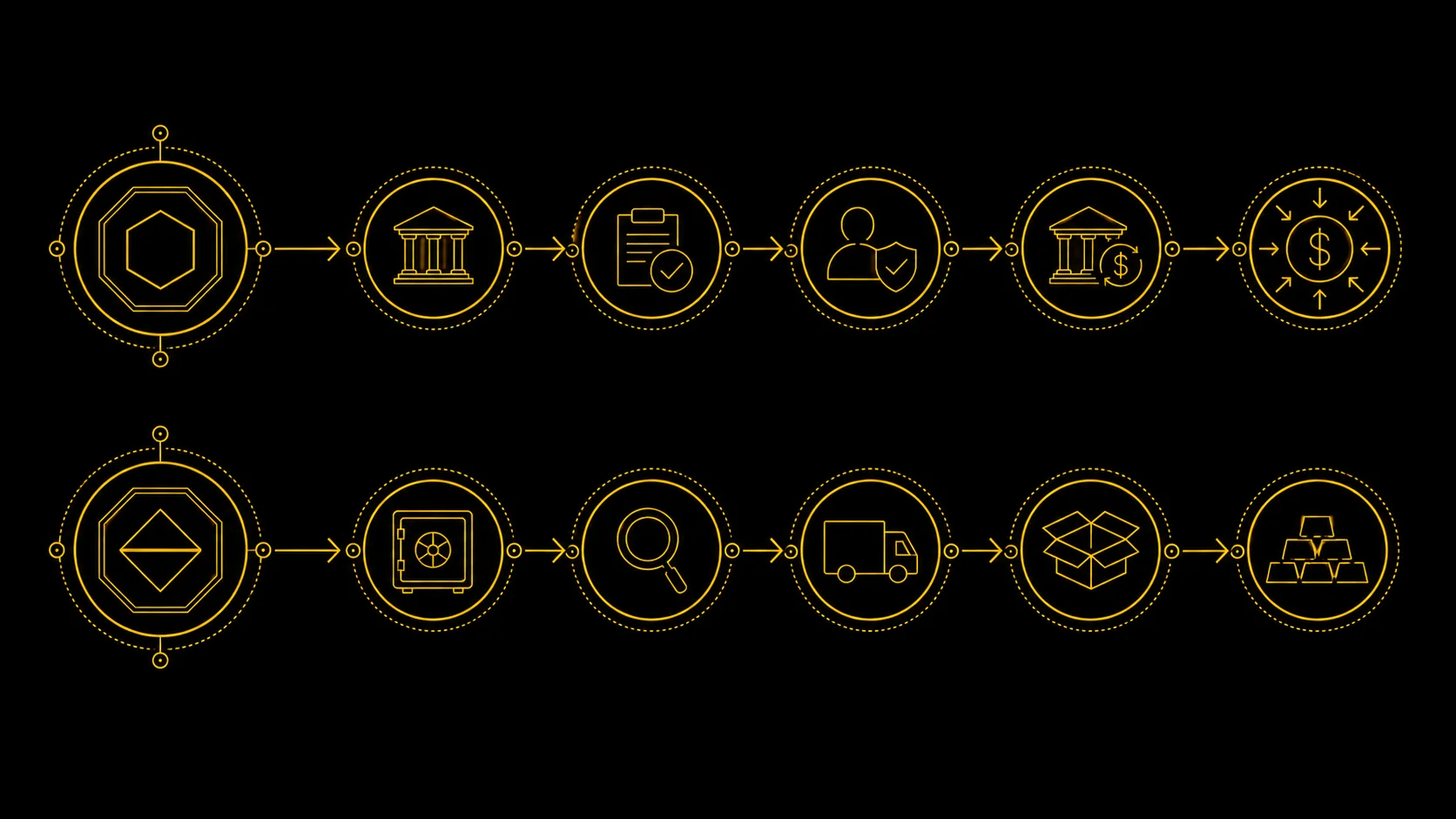
The matrix below covers PAXG and XAUT across the dimensions identified in the previous section. Each cell cites a single named source with a date stamp.
| Dimension | PAXG (Paxos Gold) | XAUT (Tether Gold) |
|---|---|---|
| Issuer | Paxos Trust Company | TG Commodities, S.A. de C.V. (El Salvador; relocated from BVI in January 2025; Tether-affiliated, registered Stablecoin Issuer under El Salvador's Digital Asset Issuance Law) |
| Backing standard | LBMA-accredited vault, one troy ounce per token | LBMA Good Delivery standard, one troy ounce per token |
| Custody jurisdiction | London (Brink's LBMA-accredited vaults); US-issued trust (Paxos Trust Company) | Swiss vault custody (per Tether's disclosure; no independent third-party Swiss custodian publicly named) |
| Attestation cadence | Monthly third-party attestations listing bar serial numbers and vault locations (Paxos) | Quarterly BDO Italia point-in-time attestation; most recent 31 March 2026 (Tether) |
| Audit class | Regulated trust plus monthly attestation | Attestation only; full audit engagement in progress as part of preparations for US market entry (Tether) |
| Regulatory standing | OCC-regulated national trust (converted from NYDFS limited-purpose trust on 12 December 2025) | Tether's broader corporate context |
| Market cap / circulating supply | ~$1.9B market cap (Paxos / industry data, January 2026) | 707,747.139 fine troy ounces; $3.303B market value as of 31 March 2026 (~36% expansion in fine troy ounces backing over Q1 2026; market value retraced from ~$4B at Q4 2025 as gold spot pulled back); single source: Tether Q1 2026 attestation |
| Annual holder-side storage fee | 0% annual storage; 0.02% on-chain transfer fee at smart-contract level; mint/redeem fees per Paxos schedule | 0% (no on-chain transfer fee, no annual storage fee at token level) |
| Redemption mechanics | Retail-tier fiat redemption at consumer-facing settlement venues; physical redemption with bar-size minimums by destination jurisdiction | Physical redemption structured around LBMA Good Delivery bar sizes (one full bar minimum, approximately 400-430 XAUT per Tether's product disclosure) — calibrated for large-position holders rather than retail |
| Chain support | Primarily Ethereum; broad CEX and DEX listing depth | Primarily Ethereum; concentrated CEX listing around Bitfinex with growing presence elsewhere |
Three high-level observations from the matrix. First, the backing-standard baseline is shared — both products use LBMA-accredited vault custody with one-token-per-troy-ounce denomination, so the differentiation lives entirely in the wrapper rather than in the underlying.
Second, the attestation-class differential is the single largest signal: PAXG's monthly serial-level attestation pairs with OCC national trust regulation to provide a transparency-and-regulator stack that XAUT's quarterly point-in-time attestation does not yet match. Tether's March 2026 KPMG engagement covers USDT reserves, not XAUT — no separate XAUT-specific full-audit timeline has been publicly disclosed as of mid-2026. Third, the scale differential goes the other way — XAUT is meaningfully larger by total backing value at the close of Q1 2026, reflecting different growth trajectories rather than a quality difference between the two products.
Per-Product Breakdowns
The narrative depth that the matrix cannot carry — operational history, recent material events, and the specific structural quirks of each product — covered in three to four paragraphs per product.
PAXG (Paxos Gold)
PAXG is issued by Paxos Trust Company, an OCC-regulated national trust as of 12 December 2025 — Paxos converted its prior New York Department of Financial Services (NYDFS) limited-purpose trust charter to an Office of the Comptroller of the Currency (OCC) national trust charter on that date (Paxos newsroom); OCC examination of trust companies covers stablecoin issuance, custody, brokerage, and settlement services across all 50 states — broader in scope than the prior state-level NYDFS oversight that PAXG operated under from 2019 through 2025.
The product launched in 2019, making it one of the longest-running operational tokenised-gold issuances in the live market, and as of January 2026 it held approximately $1.9B market cap with over $600M in average daily trading volume across the major exchanges that list it.
The most distinctive feature of PAXG is its transparency posture. Monthly third-party attestations document the bar serial numbers, vault locations, and total allocated tonnage against the published token supply. A holder who wants to verify the backing chain can do so against the published attestation document each month, and the granularity of the disclosure means that an external party can mechanically check the supply-versus-backing equation. The OCC national-trust regulatory footprint adds a federal-level supervisory layer on top of the attestation cadence — broader in scope than the prior state-level NYDFS oversight that PAXG operated under from 2019 through 2025 — and is unusual for a crypto-asset issuer.
On the redemption side, PAXG offers retail-tier redemption into fiat at most consumer-facing settlement venues, with physical-bar redemption available subject to bar-size minimums and the destination jurisdiction. The combination of retail fiat redemption, deep CEX and DEX listing depth, and the OCC-regulated issuer profile makes PAXG the default starting point for retail investors entering the tokenised-gold category — particularly for US-resident investors who value the familiar US-regulatory profile.
XAUT (Tether Gold)
XAUT is issued by TG Commodities, S.A. de C.V. (El Salvador; relocated from BVI in January 2025; Tether-affiliated, registered Stablecoin Issuer under El Salvador's Digital Asset Issuance Law), with Swiss vault custody (per Tether's disclosure; no independent third-party Swiss custodian publicly named) under the LBMA Good Delivery framework.
The Q1 2026 attestation conducted by BDO Italia and published on 31 March 2026 documents 707,747.139 fine troy ounces of allocated gold backing XAUT in circulation, at a market value of $3.303B (approximately 36% expansion in fine troy ounces backing over Q1 2026; market value retraced from ~$4B Q4 2025 as gold spot pulled back). This makes XAUT the larger of the two tokenised-gold products by total backing value at the close of Q1 2026, though PAXG retains the longer operational track record and the deeper retail-fiat-redemption mechanic.
XAUT's attestation framework merits explicit attention. BDO Italia provides quarterly point-in-time attestation of reserves on XAUT specifically, not a full audit. The KPMG engagement Tether announced in March 2026 (Tether newsroom; CoinDesk, 27 March 2026) covers USDT reserves, not XAUT — and no separate XAUT-specific full-audit timeline has been publicly disclosed as of mid-2026.
This is not a fatal weakness — point-in-time attestation by a recognised firm is a meaningful disclosure layer, and the LBMA Good Delivery standard on the underlying bullion is independent of the attestation framework. But it is a structural difference from PAXG's monthly serial-level attestation paired with the NYDFS-then-OCC regulatory chain, and any honest evaluation of XAUT should name the distinction rather than treat the two products' transparency postures as equivalent.
On the redemption side, XAUT physical redemption is structured around the bar sizes used in the underlying vault — one full LBMA Good Delivery bar (approximately 400-430 XAUT per Tether's product disclosure). The redemption mechanic is calibrated for large-position holders rather than retail-size positions seeking physical-bar delivery; for retail-size holders, secondary-market exit on a CEX or DEX is the operationally simpler path. The combination of substantial total backing value, the LBMA Good Delivery standard on the underlying bullion, and the BDO Italia attestation framework makes XAUT a credible alternative to PAXG for investors comfortable with the quarterly attestation cadence and the Swiss-vault-custody jurisdiction.
PAXG vs XAUT side-by-side narrative summary
Reading the two product profiles next to each other, the operational distinction reduces to a transparency-and-regulator stack versus a scale-and-growth stack. PAXG's stack — OCC-regulated national trust (since the 12 December 2025 conversion from a prior NYDFS limited-purpose trust charter), monthly attestations listing bar serial numbers and vault locations, retail-tier fiat redemption, broad Western CEX listings — is the operationally cleaner profile for investors whose first filter is regulatory clarity, particularly US-resident retail. The trade-off is a smaller market-cap signal (approximately $1.9B as of January 2026) relative to XAUT's larger backing value, and a less aggressive recent growth trajectory.
XAUT's stack — Swiss vault custody under LBMA Good Delivery, quarterly BDO Italia point-in-time attestation, larger total backing value ($3.303B as of 31 March 2026 per the Tether Q1 2026 attestation; ~36% expansion in fine troy ounces backing over Q1 2026 with market value retraced from ~$4B at Q4 2025 as gold spot pulled back), redemption mechanic calibrated for large-position holders — is the operationally suited profile for investors whose first filter is scale and who accept the attestation-versus-audit distinction explicitly. The trade-off is the less familiar US-regulatory footprint relative to PAXG's OCC-regulated national-trust structure, and the more concentrated CEX listing depth that has historically clustered around Bitfinex.
Neither stack is universally better than the other. An investor whose use case is set entirely by US-regulatory clarity is going to find PAXG the operationally cleaner choice regardless of size; an investor whose use case is set by scale and growth trajectory is going to find XAUT the more compelling choice regardless of regulator. The matrix and the per-product detail above support both readings; the choice is the investor's, and the scenario section below translates the dimensions into worked examples by investor profile.
Exchange Availability
Both tokenised-gold products trade on most major centralised and decentralised exchanges with deep secondary liquidity. The listing matrices differ in concentration: PAXG has historically had broader Western CEX listing depth, including Kraken, Coinbase, OKX, and several other major venues; XAUT's exchange listing has historically been more concentrated around Bitfinex (Tether-affiliated) with growing presence across other CEXs over time.
For retail-size buyers in non-US jurisdictions, both products are typically reachable through one of the major exchanges that list them. The choice of secondary venue rarely affects execution at retail size because the bid-ask spreads on both products are tight enough that the venue-specific difference is small compared to the broader gold-price movement during the trade window. Verify the current listing matrix on each exchange before transacting; listing availability changes.
In February 2025, OKX's parent entity Aux Cayes FinTech pleaded guilty to operating an unlicensed money-transmitting business and paid $504.4 million in penalties to the US Department of Justice (CNBC, 24 February 2025); the exchange operates under a three-year independent compliance monitorship through 2027. The settlement does not bar OKX from operating in non-US jurisdictions, and the exchange continues to be widely used by non-US retail and institutional traders. Verify your jurisdiction's eligibility on OKX directly before signing up.
For the operational step-by-step on actually buying PAXG or XAUT in a self-custody wallet — entry exchange selection, stablecoin acquisition, wallet choice, deposit flow — see the cluster's how to invest in RWA guide, which holds the jurisdiction-and-KYC matrix and the four-step access path.
Which Fits Whom
Three scenarios translate the dimensions and per-product detail into worked examples by investor profile.
Scenario 1 — US-resident retail investor wanting fully-regulated tokenised gold
A US-resident retail investor whose first filter is US-regulatory clarity has a clear primary fit: PAXG. The combination of OCC-regulated national trust status (since the 12 December 2025 conversion from a prior NYDFS limited-purpose trust charter), monthly third-party attestations with serial-level granularity, and broad Western CEX listing depth (Kraken, Coinbase, OKX, and others) makes PAXG the operationally clean US-retail choice. The retail-tier fiat redemption mechanic adds an additional layer of accessibility that XAUT's bar-size-calibrated physical redemption does not match for retail-size positions. For US-resident investors prioritising regulatory familiarity, PAXG is the default.
Scenario 2 — Non-US investor prioritising scale and lower regulatory friction
A non-US investor whose first filter is scale and lower regulatory friction faces a more balanced choice. XAUT is larger by total backing value at the close of Q1 2026 ($3.303B) and may carry lower per-jurisdiction regulatory friction depending on the investor's specific location. PAXG retains the transparency and operational-history advantages discussed above. The marginal-cost calculation tips towards XAUT for investors who value the larger market-cap signal and accept the quarterly point-in-time attestation cadence, and towards PAXG for investors who value the monthly attestation cadence and the regulated-trust structure regardless of geography. Either route is defensible; the choice rests on the investor's specific transparency-versus-scale preference.
Scenario 3 — DeFi-composability seeker
An investor whose primary use case is on-chain composability — using the tokenised-gold position as collateral in DeFi lending, as a swap-pair input on a DEX, or as a yield-strategy component — typically finds PAXG the operationally cleaner choice. PAXG is collateral-listed on Aave V3 on Ethereum following the protocol's risk-parameter governance approval (Aave governance ARFC), and trades in PAXG/USDC and PAXG/WETH pools on Uniswap V3.
The PAXG/USDC 0.05% pool showed approximately $9.6M TVL as of June 2026 (GeckoTerminal); the PAXG/WETH pool is a thinner companion at the same protocol layer. Beyond Aave and Uniswap, the broader DeFi integration set includes Compound and Curve Finance, reflecting both the product's longer operational history and the cleaner regulatory profile that some DeFi protocols prefer when listing collateral. DeFi liquidity figures move daily; verify current depth against the live Uniswap and Aave interfaces before sizing a meaningful composability position.
XAUT's DeFi integration is growing but more concentrated. Verify each protocol's current support for PAXG or XAUT before sizing a DeFi-composability use case, because listing availability changes on the protocol side as well as on the exchange side.
Scenario 4 — Long-term cost-conscious holder weighing tokenised against ETF
An investor whose primary filter is the multi-year carrying cost of the position faces a comparison that is structurally tighter between PAXG and XAUT than between either tokenised product and a gold ETF. Both tokenised products carry no holder-side annual storage fee at mid-2026, so the carrying-cost differential between PAXG and XAUT is effectively zero on the annual-fee dimension.
The cost differential against a US-registered gold ETF (GLD at approximately 0.40% per year, IAU at approximately 0.25%) is material over a five-to-ten-year holding window — on a $25,000 position over ten years at 0.40%, the cumulative ETF expense is roughly $1,000 against zero on the tokenised-gold side, holding the underlying gold price constant.
The right choice between PAXG and XAUT for this profile reduces to the round-trip secondary-market cost (which is similar between both at retail size) and the redemption-mechanic compatibility with the holder's planned exit (which favours PAXG for retail-tier fiat-redemption needs and XAUT for institutional-scale physical-redemption needs). For a pure buy-and-hold position with no current exit plan, either product delivers the cost-advantaged outcome relative to the ETF baseline, and the choice often reduces to which product the holder finds easier to verify on a quarterly check.
The cost-conscious framing also clarifies what tokenised gold is not. It is not a yield-bearing asset — neither PAXG nor XAUT pays distributions, and the position simply tracks the spot price of gold. An investor who needs the position to generate income should pair the tokenised-gold sleeve with a separate income-generating allocation (tokenised treasuries are the natural counterweight) rather than expecting the gold position itself to compound. The carrying-cost advantage compounds against the ETF baseline only because tokenised gold has no annual drag, not because it produces a positive return stream on top of the gold-price exposure.
For the cluster context — how tokenised gold fits against tokenised treasuries, private credit, and real estate — the tokenised gold and commodities guide covers the broader category mechanics, the four-layer backing-chain framework, and the portfolio role comparison versus physical bullion and gold ETFs.
Conclusion
PAXG and XAUT both deliver one-troy-ounce-per-token exposure to allocated physical gold under LBMA-accredited vault custody, but they differ at the wrapper layer in ways that materially affect the right choice for different investors.
PAXG (~$1.98B market cap against 456,894 PAXG circulating, CoinGecko live snapshot June 2026) pairs an OCC-regulated national-trust structure (converted from a prior NYDFS limited-purpose trust charter on 12 December 2025) with monthly third-party attestations issued by KPMG LLP (since 28 February 2025; previously WithumSmith+Brown PC) listing bar serial numbers and vault locations, broad Western CEX listing depth, and retail-tier fiat redemption. XAUT (707,747.139 fine troy ounces / $3.303B market value as of 31 March 2026) pairs Swiss vault custody under the LBMA Good Delivery standard with quarterly BDO Italia point-in-time attestation, larger total backing value, and a redemption mechanic calibrated for large-position holders.
The scenario section translates the matrix into worked recommendations: US-resident retail investors typically map to PAXG for the OCC-regulatory clarity (national-trust charter since 12 December 2025); non-US investors prioritising scale find the choice more balanced between XAUT (larger backing value, quarterly attestation) and PAXG (smaller but monthly attestation and regulated-trust structure); DeFi-composability seekers typically find PAXG the cleaner choice on listing depth and integration history. Either product is operationally credible at its respective scale; the choice rests on the transparency-versus-scale preference and on whether US-regulatory familiarity is a hard filter or a soft preference.
Two final framing notes. First, the audit-versus-attestation distinction for XAUT — point-in-time attestation rather than full audit — is a structural difference from PAXG that should be named explicitly rather than glossed over; Tether's March 2026 KPMG engagement covers USDT reserves, not XAUT, and no separate XAUT full-audit timeline has been publicly disclosed as of mid-2026. Second, the cluster context matters: for readers who want the mechanic depth behind the backing chain (vault, custodian, attestation, token contract) the tokenised-gold satellite guide is the next read; for the operational access path on actually buying either product, the cluster's how-to-invest companion holds the four-step path and the jurisdiction matrix.
One closing operational reminder. The matrix above is built from issuer disclosures verified at draft time; every cell is anchored to a single named source with a date stamp. Live market-cap figures, listing matrices, and redemption-fee schedules change quickly, and the difference between the matrix as written here and the issuer's current disclosure can move within weeks.
The honest position is that this page is the framework for product selection, not the live pricing terminal. Read your row in the matrix, cross-check against the linked sources, and verify the current state on the issuer's product page before sizing meaningful capital. The same discipline applies to the scenario section: the worked examples translate the framework into investor-profile fits, but the right choice for any specific reader depends on circumstances the matrix cannot see.
For the broader cluster context — how tokenised gold fits alongside tokenised treasuries, on-chain private credit, and the tokenised-real-estate category — the cluster hub maps the four categories with the verified-2026 AUM figures and the six-category risk taxonomy.
The tokenised-treasuries satellite holds the cluster's only cross-asset yield-route comparative table (treasuries versus liquid staking versus DeFi lending), which is the most useful single read for an investor weighing tokenised gold against an income-bearing alternative. The how-to-invest satellite holds the cluster's jurisdiction-and-KYC matrix, which is the most useful single read for an investor confirming that the product they want is actually available where they live. Both reads complement the picker on this page rather than duplicating it.
Sources and References
Each cell in the matrix cites a single named source with a date stamp. The XAUT figures use the Q1 2026 Tether attestation as the canonical source; older market-cap snapshots are not mixed in.
- Tether Gold (XAUT) product page and Q1 2026 attestation — 707,747.139 fine troy ounces, $3.303B market value as of 31 March 2026 (BDO Italia point-in-time attestation)
- Paxos Gold (PAXG) product page — OCC-regulated national trust (converted from NYDFS on 12 December 2025), LBMA-accredited London vault custody, monthly third-party attestations
- LBMA Good Delivery standard — institutional bullion specifications underlying both PAXG and XAUT custody
- New York Department of Financial Services (NYDFS) — prior regulator of Paxos Trust Company through 12 December 2025 (Paxos converted to OCC national-trust charter on that date)
- Office of the Comptroller of the Currency (OCC) — federal oversight layer applicable to Paxos Trust Company
- OKX parent Aux Cayes FinTech DOJ settlement (CNBC, 24 February 2025) — $504.4M penalty and three-year independent compliance monitorship through 2027
- Paxos OCC trust conversion announcement (Paxos newsroom, December 2025) — Paxos Trust Company's conversion from NYDFS limited-purpose trust to nationally chartered OCC trust
- Tether KPMG audit announcement (Tether newsroom, March 2026) — Tether's engagement of KPMG for a full audit of USDT reserves
- Tether KPMG and PwC engagement (CoinDesk, March 2026) — context on the audit and US-expansion preparation
- PAXG on Aave V3 governance ARFC — risk-parameter governance approval to list PAXG as collateral on Aave V3 Ethereum
- PAXG/USDC Uniswap V3 pool (GeckoTerminal) — live TVL snapshot for the 0.05% PAXG/USDC pool on Ethereum (verify against the live pool page; figures move daily)
Disclaimer: Tokenised-gold products carry meaningful risk, including the possibility of total loss of capital. This head-to-head comparison is for educational purposes only and does not constitute financial, legal, or tax advice. The matrix, market-cap, attestation, fee, and redemption-mechanic figures cited above are point-in-time references anchored to mid-2026 issuer disclosures; cross-check against the named primary sources before sizing a position in either product. Always consult a qualified professional for advice specific to your jurisdiction and personal circumstances.
Frequently Asked Questions
- PAXG vs XAUT in 2026 — which tokenised gold fits whom?
- PAXG (Paxos Gold) fits investors who prioritise regulatory clarity and transparency cadence: it sits under an OCC-regulated national trust (Paxos converted its NYDFS limited-purpose trust charter to an OCC national charter on 12 December 2025), uses LBMA-accredited London vault custody, and publishes monthly third-party attestations issued by KPMG LLP (since 28 February 2025; previously WithumSmith+Brown PC) listing bar serial numbers and vault locations. Approximately $1.98B market cap against 456,894 PAXG circulating (CoinGecko live snapshot, June 2026). XAUT (Tether Gold) fits investors who prioritise scale and accept a quarterly point-in-time attestation cadence: 707,747.139 fine troy ounces of allocated gold under Swiss vault custody and LBMA Good Delivery standard, with a market value of $3.303B as of the 31 March 2026 BDO Italia attestation (approximately 36% expansion in fine troy ounces backing over Q1 2026; market value retraced from ~$4B Q4 2025 as gold spot pulled back). BDO Italia provides quarterly point-in-time attestation of reserves, not a full audit; Tether announced engagement with KPMG in March 2026 for a full audit of USDT reserves, but a separate XAUT-specific full-audit timeline has not been publicly disclosed as of mid-2026.
- What is the difference between the PAXG and XAUT backing chains?
- Both products use one-token-per-troy-ounce backing in LBMA-accredited vault custody. The differences live in custody location (PAXG gold is custodied in London under Brink's LBMA-accredited vaults; XAUT vaults are Swiss), attestation cadence (PAXG monthly with bar serial numbers and vault locations; XAUT quarterly point-in-time by BDO Italia), audit class (PAXG: regulated trust plus monthly attestation; XAUT: attestation only, with full audit engagement in progress for US compliance), and regulatory standing (PAXG: OCC-regulated national trust since the 12 December 2025 conversion from a prior NYDFS limited-purpose trust charter; XAUT: Tether's broader corporate context). The mechanic depth — vault, custodian, attestation, token contract — is covered in the cluster's tokenised-gold guide; this page compares the parameters.
- Which product is more regulatorily clear in 2026?
- PAXG carries the more familiar US-regulatory footprint: an OCC-regulated national trust charter (Paxos converted from a NYDFS limited-purpose trust charter to an OCC national charter on 12 December 2025) and a monthly attestation cadence with serial-level granularity. XAUT operates under Tether's broader corporate context and Swiss vault custody, with BDO Italia point-in-time attestation rather than full audit. Both are credible products, but for an investor whose first filter is US-regulatory clarity, PAXG is the operationally cleaner choice in 2026.
- Which product is larger by backing value?
- XAUT is larger by total backing value as of the close of Q1 2026: 707,747.139 fine troy ounces backed at a market value of $3.303B, per the 31 March 2026 BDO Italia attestation (+36% quarter on quarter). PAXG was approximately $1.9B market cap as of January 2026. The size differential reflects different growth trajectories rather than a quality difference; both products are operationally credible at their respective scales.
- What are the storage fees on PAXG vs XAUT?
- Both products carry no annual holder-side storage fee at the token level in mid-2026, but the on-chain-fee dimension differs: PAXG's smart contract levies a 0.02% on-chain transfer fee (plus mint/redeem fees per Paxos's published schedule), while XAUT carries no on-chain transfer fee. Storage costs are absorbed into the issuer's operating model in both cases. Compared to gold ETFs (GLD historically around 0.40% per year, IAU around 0.25% per year), tokenised gold is materially cheaper to hold on an annual basis. Verify the current fee schedule directly on each issuer's product page before sizing a position.
- How do redemption mechanics differ?
- PAXG offers retail-tier fiat redemption at most consumer-facing settlement venues alongside physical redemption with bar-size minimums that vary by destination jurisdiction. XAUT physical redemption is structured around the LBMA Good Delivery standard bar sizes — minimums consistent with the bar sizes used in the underlying vault, which makes XAUT physical redemption operationally calibrated for large-position holders rather than retail-size positions seeking physical-bar delivery. For retail-size XAUT holders, secondary-market exit on a CEX or DEX is typically the operationally simpler path.
- Where can I actually buy PAXG and XAUT in 2026?
- Both products trade on most major centralised and decentralised exchanges with deep secondary liquidity. PAXG has historically had broader Western CEX listing depth, including listings on Kraken, Coinbase, OKX, and other major venues. XAUT's exchange listing has historically been more concentrated around Bitfinex (Tether-affiliated) with growing presence across other CEXs. Verify the current listing matrix on each exchange before transacting; availability changes.
← Back to Crypto Investing Comparisons
Financial Disclaimer
This content is not financial advice. All information provided is for educational purposes only. Cryptocurrency investments carry significant investment risk, and past performance does not guarantee future results. Always do your own research and consult a qualified financial advisor before making investment decisions.